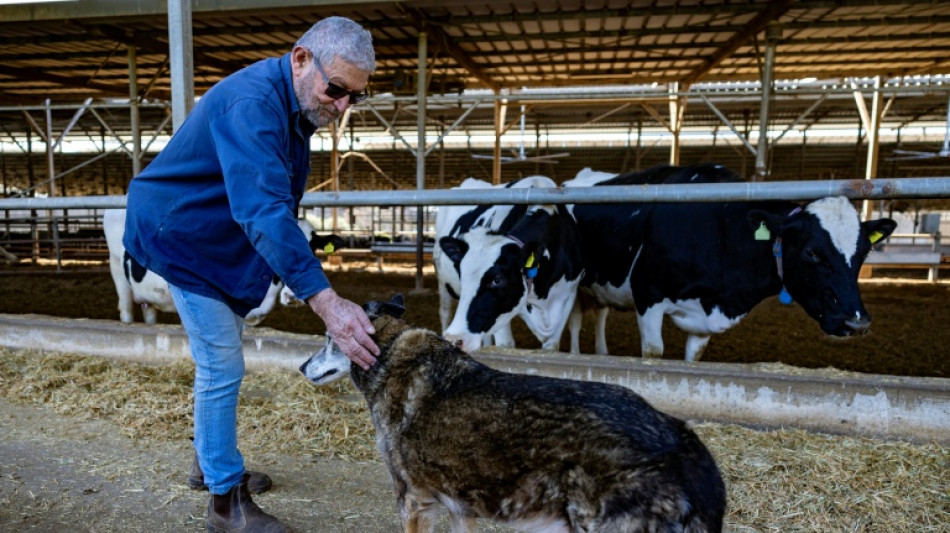
Under Hezbollah fire, people in north Israel hope for better days / Photo: © AFP

 Indonesia to capture last-known wild Bornean rhino for IVF
 USA, Australia eye World Cup knockout rounds, Brazil in action

 Iran to lodge complaint with FIFA over World Cup restrictions

 New Zealand minister defends fishers after two orcas killed in net

 Seoul record leads most Asian markets higher, crude extends losses

 Burnham wins key UK poll, paving way for bid to challenge PM Starmer

 'Pico' Lopes -- Cape Verde defender's journey from Ireland to World Cup
 'Pretty special': captains eye Super Rugby glory in clash of top seeds

 Ivory Coast's Diomande living World Cup dream, dealing with tragedy

 Australia seek 'respect' from US amid World Cup 'layup' row

 Japan doctor-turned-author moots amputations to ease care crunch

 Fossils challenge assumptions on how animals adapted to land
 Canada romp to first World Cup win, Switzerland thump Bosnia

 Venezuela govt, opposition hold US-backed talks on democratic transition

 Horror injury overshadows Canada's first World Cup win

 Swiss wunderkind Manzambi scores 'childhood dream' brace

 Good US Open shots not good enough for 2-over Scheffler
 Subs send Swiss to World Cup rout of Bosnia-Herzegovina

 McIlroy pleased with reduced green speeds in US Open winds

 US stocks resume upward climb as dollar advances again after Fed outlook

 Stevens seizes US Open lead with McIlroy, Aberg one back

 'Big-game' Bellingham shows his worth for England at World Cup

 Vance warns Israel against criticizing US-Iran deal

 Australian qualifier Hijikata shocks Lehecka at Queen's Club

 O'Brien's royal century reward for sacrificing all for racing

Israeli dairy and fruit farmer Tommy Kurlender refused to abandon his herd during the last war with Hezbollah, and vowed he would again stay put this time around.
The Israel-Lebanon border area has once again come under fire since Hezbollah launched attacks in support of its backers in Tehran, after Israel killed supreme leader Ayatollah Ali Khamenei.
The massive attack on Iran, which Israel has conducted alongside its ally the United States, has sparked a war engulfing the entire region, with both Iran and Hezbollah targeting Israel with missiles and drones.
In the citrus groves around Kurlender's farm in Beit Hillel, about four kilometres (2.5 miles) from Israel's northern border, the crack of artillery fire and the roar of planes reverberated overhead.
The Israeli military said on Monday it had begun what it described as "limited" ground operations against Hezbollah.
But 78-year-old Kurlender, who owns some 300 cows and employs more than a dozen workers, said he was determined to stay despite the threat of rocket fire.
"I'm not young. I've been through several wars here in the country," he told AFP.
"A farm is not abandoned. We continue taking care of everything."
- 'A lot of worries' -
During the last war with Hezbollah, which erupted after Hamas's October 7, 2023 attack on Israel, Beit Hillel was evacuated along with other northern border communities.
The military said that this time there would be no such measures.
At Kurlender's farm, work has continued largely as normal, with dozens of cows lining up to be milked at midday.
Kurlender said his two sons, who normally help him on the farm, have been called up to fight.
"It's not pleasant, it's a lot of worries, but there's nothing we can do," he told AFP.
"If we want to survive, if we want to exist in this country, the condition is a strong army, a strong army that carries out orders," he said.
Kurlender said it pained him to see hundreds of thousands of south Lebanese displaced from their villages just minutes away, but thought that Israel's military offensive was necessary.
"It's very sad, but since we know what's happening in Lebanon, the government there can't enforce what it wants on Hezbollah, so we really understand what the army is doing, and we're definitely encouraged by that."
- 'Very tense' –
Since the start of the war, at least one million Lebanese have fled their homes and Israel's defence minister has warned that they would not return home until northern Israel was secure.
In the hills above Beit Hillel, military vehicles rumbled along the winding roads heading towards the border.
A flatbed truck carrying a tank rolled through the highlands, making its way through fields of blossoming pink almond trees and yellow wildflowers.
In a churned-up field, soldiers milled among dozens of tanks, armoured personnel carriers and bulldozers being readied for deployment.
Back down in the valley, in the Israeli city of Kiryat Shmona, the mood was subdued, with few pedestrians wandering the streets.
"The atmosphere here is very tense," said Haim Ohana, 49, who manages public shelters for the municipality.
"People are currently thinking about leaving the city, going out, refreshing themselves, but right now they can't afford it," he told AFP.
"Last time there was government assistance for hotels and that, but right now today there is nothing."
Due to their proximity to Lebanon, residents in these parts of northern Israel only have a matter of seconds to seek shelter once sirens start wailing, warning of incoming rockets.
- 'Life will look different' -
In a public bomb shelter two storeys underground, one woman lay sleeping on a bunk bed in the mid-afternoon, while another worked at their laptop.
"Some don't leave the shelters, don't leave their homes, because of the situation, because sometimes we have interceptions even before there is a siren and it's scary," Ohana explained.
Outside on the street, a young child waved to the sky with his mother, unfazed by the booms as artillery shots rang out overhead.
For Kiryat Shmona resident Zehava Barak, the constant state of conflict seemed untenable.
"It can't be that every few months there is an operation like this, going in and out (of Lebanon) and leaving all this mess," the 54-year-old caregiver told AFP.
After a November 2024 ceasefire, Israel had maintained five military positions in Lebanon, and frequently struck what it said were Hezbollah positions across the border.
Like Kurlender and Ohana, Barak said she supported the current operation in the hope that this would be the last and that it would win northern Israel some security.
"It's good that they will end it now, end with it and life will look different."
O.Schlaepfer--VB