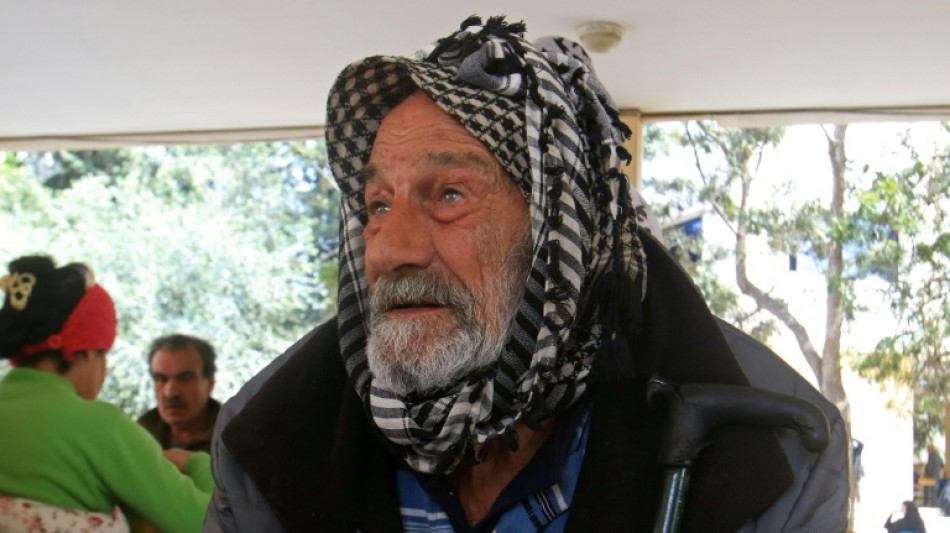
South Lebanon residents flee death and destruction / Photo: © AFP

 Indonesia to capture last-known wild Bornean rhino for IVF
 USA, Australia eye World Cup knockout rounds, Brazil in action

 Iran to lodge complaint with FIFA over World Cup restrictions

 New Zealand minister defends fishers after two orcas killed in net

 Seoul record leads most Asian markets higher, crude extends losses

 Burnham wins key UK poll, paving way for bid to challenge PM Starmer

 'Pico' Lopes -- Cape Verde defender's journey from Ireland to World Cup
 'Pretty special': captains eye Super Rugby glory in clash of top seeds

 Ivory Coast's Diomande living World Cup dream, dealing with tragedy

 Australia seek 'respect' from US amid World Cup 'layup' row

 Japan doctor-turned-author moots amputations to ease care crunch

 Fossils challenge assumptions on how animals adapted to land
 Canada romp to first World Cup win, Switzerland thump Bosnia

 Venezuela govt, opposition hold US-backed talks on democratic transition

 Horror injury overshadows Canada's first World Cup win

 Swiss wunderkind Manzambi scores 'childhood dream' brace

 Good US Open shots not good enough for 2-over Scheffler
 Subs send Swiss to World Cup rout of Bosnia-Herzegovina

 McIlroy pleased with reduced green speeds in US Open winds

 US stocks resume upward climb as dollar advances again after Fed outlook

 Stevens seizes US Open lead with McIlroy, Aberg one back
 'Big-game' Bellingham shows his worth for England at World Cup

 Vance warns Israel against criticizing US-Iran deal

 Australian qualifier Hijikata shocks Lehecka at Queen's Club

 O'Brien's royal century reward for sacrificing all for racing

The line of cars stretched as far as the eye could see along the coast of southern Lebanon, as residents of areas bombarded in the Israel-Hezbollah war poured into the ancient city of Sidon in search of safety.
At war with Iran-backed Hezbollah, Israel has called on everyone living south of the Zahrani River to evacuate immediately.
It is an area comprising 14 percent of Lebanon's territory, and is highlighted in red in the maps posted by the Israeli military.
Nidal Ahmad Chokr initially intended to stay put but finally decided on Tuesday to leave his village of Jibchit, as the air strikes intensified.
"Bakers died while making bread" in the village square and "municipal workers were martyred while using bulldozers", the 55-year-old said.
Joining a civil defence convoy, he reached Sidon at 5:00 am, a small bag in tow. All he packed was a towel, underwear and medication -- painkillers for his back and some sleeping pills.
The war has already forced more than a million Lebanese to flee their homes. With no room left at reception centres, entire families are left to crowd along the seafront or sleep in their cars.
"Sidon is overcrowded," said Jihan Kaisi, an NGO director helping the displaced at a school that is already sheltering three times more people than it can handle.
"Imagine the families arriving in the middle of the night, their eyes terrified, and they ask: 'Can we sleep on the floor just to be safe until the morning?'," she said, upset that she has to turn them away.
- 'My land, my country' -
Safaa al-Tabl arrived three days prior with her husband and their five children from the village of Kharayeb.
"We thought we could stick it out, but the village was under constant attack. Drones never left the sky... We weren't able to get any sleep or rest. It became unbearable," the 37-year-old said.
"They were targeting people, houses. It was all happening right in front of our eyes. I saw bodies."
By the end, "the village was practically deserted", she said, getting emotional as she described her tulip-filled home.
"That there is my land, my country, my memories, my childhood. It means everything to me."
She hopes she will be able to see Kharayeb again. But she fears the bombs will destroy her house, or that the Israeli army will expand its ground assault.
For now the military says it is only conducting "limited" ground operations against Hezbollah in southern Lebanon.
But many Lebanese who were driven from their homes have not forgotten the long years under Israeli occupation of the south, from 1978 to 2000.
Nor have they forgotten the Hezbollah-Israel conflicts from 2006 and 2024.
- 'No choice' -
"In the south, we're very resilient, we're used to bombardments... I'd never left my house until now," said Mustafa Khairallah, now sheltering in Sidon.
Elderly and propping himself up with canes, he said this conflict was of a different magnitude.
"Now they're targeting civilians more and more... I was forced to leave," he added, just as the sound of an explosion echoed outside Sidon.
Not everyone has left. Some residents of all faiths remain in the predominantly-Shia south, which is also home to Christians and Sunnis.
While some believe it is not their war and hope they will be spared, others "have no choice" but to stay, said Haidar Bitar, an entrepreneur from Nabatiyeh, which he continues to visit.
"People don't have the money to leave" after years of economic crisis, the 28-year-old said, adding that the war was also driving up prices.
"Before, rent was $100 or $200. Now, you have to pay $1,000 and three months upfront."
He is convinced Israel will not be able to defeat Hezbollah, which still enjoys backing from many in its support base.
Though weakened, the militant group has said it is ready for a long confrontation.
"They fight night and day. They know where to hide above and below ground," Bitar said.
"It won't be easy for Israel."
L.Stucki--VB