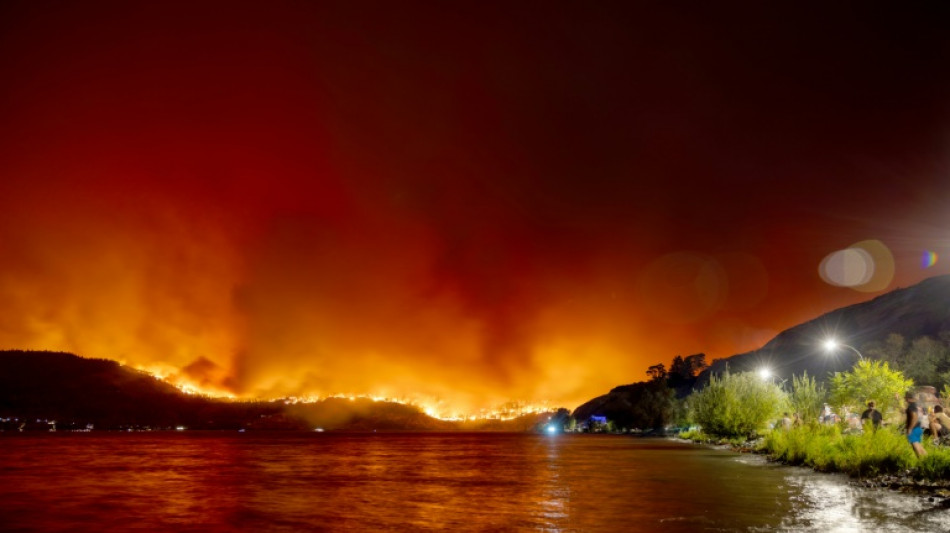
Wildfires caused major CO2 emissions last year: annual study / Photo: © AFP/File

 EU calls Russia 'reckless' after flares fired at Danish helicopter

 US Treasury chief says to meet Chinese counterpart at weekend

 Trump slams 'horrible' Supreme Court mail-in ballot ruling

 Brazil's crisis-hit Supreme Court probes judge's ties to jailed banker
 Sterling admits dangerous driving after Lamborghini crash

 Ambassador to Thailand plays down anti-Israeli protests

 BingX Evolves into a Multi-Asset Trading Platform, Connecting Users to Global Opportunities

 Flick supporting 'self-confident' Yamal Ballon d'Or bid

 As Ballon d'Or vote nears, stars campaign for the award

 Markets on edge as US Fed meets to tackle high inflation

 International Trading Institute Expands Professional Trader Development Beyond the Master’s in Trading

 Nairobi to host 2029 world athletics championships in African first

 Ukraine winemakers defy war to make a splash at home

 Prominent Greek neo-Nazi exits prison, vows return to politics: AFP

 Saudi Arabia vows to respond 'firmly' to Houthi attacks

 'We unleashed the beast': the world's fears and hopes about AI

 Carragher sees Manchester City’s winning start as challenge to Arsenal
 Oasis fans weigh ticket costs and reunion memories ahead of 2027 tour

 EastEnders previews Kat’s grief after Zoe’s death

 US military confirms Iran war has led to munitions shortfall

 SkySail Strategies Outperforms Wall Street's 30-Year Risk Standard With Proprietary AI Inference Model

 Canada ends refugee family sponsorship exemption over integrity concerns
 Berlin's run-down public spaces at heart of election campaign

 Ribeiro and Richie among celebrity birthdays for September 20–26

 Bob Mackie, costume designer for Cher and Madonna, dies aged 87

Wildfires made more frequent and intense by climate change released significant quantities of CO2 into the air in 2023-2024, said a first-of-its-kind annual study published Wednesday.
Fires in natural areas caused 8.6 billion tonnes of CO2 emissions worldwide between March 2023 and February 2024 -- 16 percent above average.
Only a relatively calm fires season in the African savannah prevented the 2023-2024 season from breaking a fresh record for CO2 emissions at the global level.
These were among the conclusions in a new study, "State of Wildfires", published in the journal Earth System Science Data.
It was carried out by the University of East Anglia and other institutions based in Britain and aims to be updated on an annual basis.
Emissions from fires in Canada's boreal forests were more than nine times greater than the average over the past two decades. They contributed to almost a quarter of global emissions.
In Canada alone, the fires forced the evacuations of 232,000 people and eight firefighters lost their lives.
Other areas that also suffered included the Amazon (Brazil, Bolivia, Peru, Venezuela), Hawaii and Greece.
"Last year, fires killed people, destroyed homes and infrastructure, caused mass evacuations, threatened livelihoods and damaged vital ecosystems," said Matthew Jones of the University of East Anglia and lead author of the study.
"These fires are becoming more frequent and intense with climate warming, and both society and the environment are suffering the consequences."
The authors of the report concluded that climate change has made weather conditions favouring the fires more likely.
They found that human influence has increased by at least a factor of 20 the probability of weather conditions conducive to fires in the western Amazon.
If humanity continues to produce large amounts of greenhouse gas, major fires -- like those that took place last year -- will become more likely.
But nothing is set in stone.
"The risk can be minimised. It is not too late," said Jones during a presentation of the report to media.
"A low-carbon future offers a lot of respite from the risks we face in the future."
Over the past two decades as human activity has warmed the planet, the frequency and intensity of extreme wildfires has more than doubled worldwide, according to a study published in June in Nature Ecology & Evolution.
S.Gantenbein--VB