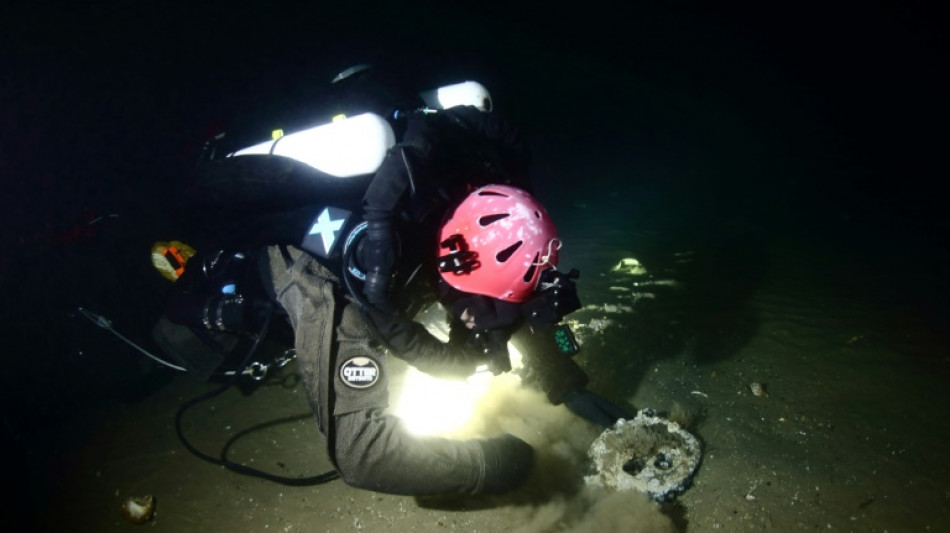
Wreck discovered of French steamship that sank in Atlantic in 1856 / Photo: © Atlantic Wreck Salvage/AFP

 Trump renames AI 'super intelligence' as leaders jostle over dangers

 Oil prices retreat as markets welcome US-Iran talks

 US refusing to give Sudan's de facto leader visa for UN: diplomatic sources, UN

 Macron urges world to choose UN over 'law of the jungle'

 All-rounder Jacks stars as England beat Sri Lanka in 1st ODI

 Man City peg back Bayern to start Women's Champions League

 Trump beats 'America first' drum at UN as allies tread carefully

 Snedeker backs Spaun for Ryder Cup after Presidents snub

 French prosecutors probe secret filming of women with smart glasses

 Trump renames AI "super intelligence," rejects international oversight

 Trump rejects international regulation of AI

 How is the EU approaching record fuel prices?

 Sri Lanka's Colombage strikes on debut as England dismissed for 265 in first ODI

 Hurricane Polo strengthens to top category 5 off Mexico

 11 hurt as teen opens fire outside school in western Turkey

 UN chief says 'Big Oil' treats atmosphere as open sewer

 Tunisia says 2026 summer hottest on record

 England's Rashid out of Sri Lanka ODIs with hand injury

 Houthis accuse Saudi Arabia of deadly strikes as thousands flee

 Stocks climb as oil slides, AI buzz returns

 India cricketers win in style as Afghan savours 'special' Games silver

 La Liga president hits out at Real Madrid refereeing 'conspiracy' claims

 MEXC Launches “Real Stocks, Real Friends” with Rewards for Bringing Friends to Wall Street

 Mbappe continues media push for Ballon d'Or recognition

 Stocks rise on AI buzz, oil prices cool

A US dive team has discovered the wreck of a French steamship, Le Lyonnais, that sank in the Atlantic Ocean in 1856 after a "hit-and-run" collision with an American sailing vessel, claiming 114 lives.
Le Lyonnais, which was built in 1855 and was considered state-of-the-art at the time, was returning to France after completing its maiden voyage from Le Havre to New York when the disaster occurred.
Jennifer Sellitti of Atlantic Wreck Salvage, a New Jersey-based company, said a team on the dive boat D/V Tenacious discovered the wreckage of Le Lyonnais last month after a two-decade search.
Sellitti said divers positively identified the ship in waters 200 miles (320 kilometers) off of New Bedford, Massachusetts, in an area known as the Georges Bank. They are not revealing the exact location for now.
"She certainly doesn't look as good as she used to," Sellitti told AFP. "She was really broken apart.
"The North Atlantic is a brutal place to be a shipwreck -- storms, tides," she said. "The Nantucket shoals are known for shifting sands that just completely bury wrecks."
Sellitti said measurements of an engine cylinder were key to identifying the vessel.
The iron-hulled Le Lyonnais, which had both sails and a steam engine, was built by a British shipmaker, Laird & Sons, for Compagnie Franco-Americaine to provide passenger and mail service across the Atlantic.
"The 1850s was the beginning of the transition from sail to steam," Sellitti said. "This was an early attempt by France to have its first successful passenger line."
Le Lyonnais had sailed to New York carrying cargo and mail, she said, and was returning to Le Havre with its first passengers, most of whom were French.
- Hit-and-run -
On the night of November 2, 1856, Le Lyonnais, carrying 132 passengers and crew, collided with the Adriatic, an American barque which was sailing from Maine to Georgia.
Jonathan Durham, the Adriatic's captain, in a statement published in the November 19, 1856 edition of The New York Times, said it was around 11:00 pm on a starlit but "hazy" night when Le Lyonnais "suddenly changed her course, which rendered a collision inevitable."
Durham said the Adriatic suffered significant damage but managed to make it to Gloucester, Massachusetts two days later while Le Lyonnais continued on its way.
The French ship had, in fact, suffered extensive damage -- a hole at the water line and another one lower, probably near its coal bunkers, Sellitti said.
It sank several days later. The handful of survivors were picked up by another ship.
Sellitti, whose book about the incident, "The Adriatic Affair: A Maritime Hit-and-Run Off the Coast of Nantucket," comes out in February 2025, said the sinking of Le Lyonnais was "a really big deal at the time."
The American captain was arrested and put on trial in France, she said, and the collision raised a number of novel maritime liability questions such as what happens when a sailing vessel meets a steamship at sea.
The disaster, which is mentioned in Jules Verne's novel "Twenty Thousand Leagues Under the Sea," was the focus of much international attention, she said, but when the US Civil War broke out in 1861 "everybody stopped talking about this and went on to the Civil War."
S.Gantenbein--VB