Bluetongue anguish for Dutch farmers / Photo: © AFP

 알렉스 보디와 슈테판 하우프트 교수, 루마니아의 전설적인 미술품 컬렉션을 위한 협력 합의

 BaazEX Enters the Asian Trading Market With a New Approach to Online Forex Trading.

 Asian markets fall on US-China jitters as leaders meet

 Thais hail teen rocker Nene for 'America's Got Talent' win

 Zverev, Agassi defend 'spectacular' Laver Cup

 Eel-powered Japan whizz-kid, 11, dominates in historic Games debut
 Madagascar's Gen Z 'betrayed' after ushering in new rule
 As Moscow steps up attacks, Kyiv residents brace for harsh winter
 Comic inspires unlikely kabaddi dreams for Japan's Asian Games amateurs

 Thailand slams chaotic Asian Games organisation as 'musical chairs'

 North Korea to keep nuclear weapons 'forever': foreign minister
 Markets mixed as China's Xi arrives for US talks

 Swiss voters expected to shun stricter neutrality

 Rapper-turned-PM faces first big test after Nepal disaster

 Tuchel seeks tonic to England World Cup 'scar' in Spain showdown

 'Helps me cope': Catholic baptisms rise among French youth

 Colombians in Santa Marta stay inside after violence wracks the city

 Iran airlines cancel flights as US sanctions hit

 Meta launches camera-free AI glasses amid privacy pushback

 Australian PM says OpenAI hacked government health website

 Xi arrives in US to personal Trump welcome

 Morocco elects new parliament amid social frustration, youth discontent

 Scheffler and Burns to face Im and Lee in Presidents Cup opener

 Crushing wins for Lyon and Barca in women's Champions League

 Rio breaks record for rainiest September amid powerful El Nino

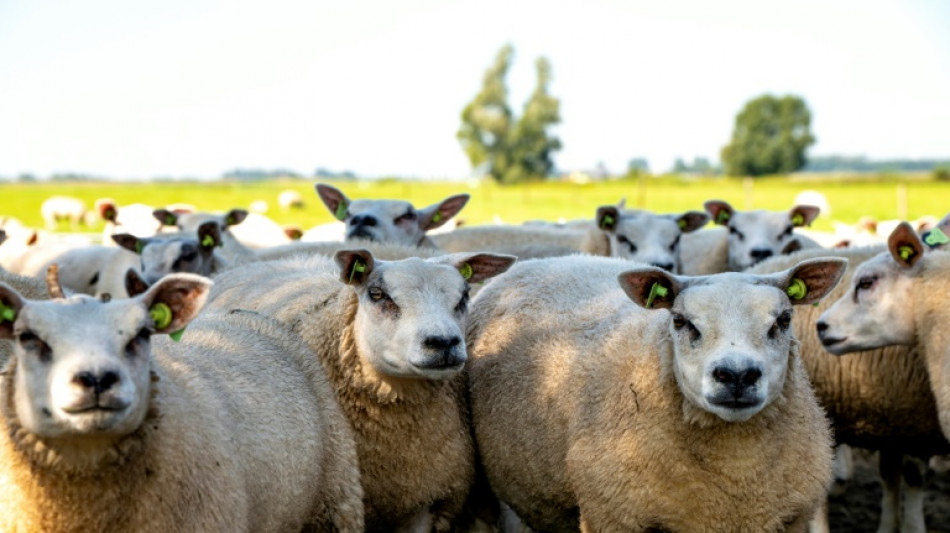
One sheep dribbles, another limps, a third can barely stand: the bluetongue virus is causing havoc for Dutch farmer Erik van Norel, who thought he had seen the back of it.
Still recovering from the impact of the virus last year, the 41-year-old thought the nightmare was finally over -- then bluetongue staged a comeback on his farm.
Bluetongue is a non-contagious, insect-borne viral disease that affects sheep and cows but not pigs or horses. It is difficult to control once it takes hold.
In September 2023, when the BTV-3 strain of the virus broke out in the Netherlands, Van Norel rounded up his ill animals and transported them on his quad bike to the stable.
Some died within 12 hours. He lost 80 animals in total, roughly three quarters of the sheep that fell sick.
"The situation was desperate. There was nothing I could do," he told AFP, surrounded by his flock in Oosterwolde, in the north of the Netherlands.
Symptoms include excessive salivation, the swelling of lips, tongue, and jaw, and the loss of offspring for pregnant animals, in proportions varying from farm to farm.
Unlike bird flu for example, an animal infected with the virus is not automatically slaughtered.
Bluetongue is rarely fatal for cows, but leads to a dramatic drop in milk production.
The virus poses no danger to human health.
Dutch authorities have registered outbreaks of the virus in 6,384 places, with the rate steadily rising.
However, farming union LTO says this is hugely underestimated, as farmers are no longer taking blood samples from all infected animals.
The virus has also been recorded in France, Belgium and Germany. Nearly 1,200 Belgian farms are affected, according to figures out Tuesday, a tripling in three weeks.
France is dealing with an "explosion" of cases that have quadrupled in eight days, according to authorities at the agriculture ministry.
And in Germany, officials have detected 3,212 cases by August 22, also a concerning rate of growth.
- 'She's dribbling a lot' -
Van Norel says he is now battling through "season two" of the bluetongue disaster but thanks to vaccination, his animals are less sick than last year.
Nevertheless, the impact on his farm is clearly visible.
He approaches one sheep that is staying away from the rest of the flock.
"The mouth is very sensitive, you can see she is hardly eating and she is getting very thin," he said.
"She's dribbling a lot, she's also had diarrhoea. All the symptoms show that she is sick," concluded Van Norel.
But he thinks this particular sheep will survive, but is not so sure for six others taken to the "sick bay" in a meadow behind the stable. They have recovered but are now suffering from complications.
Swollen legs prevent them from walking or even standing upright. Those who don't recover are put down "out of respect for the animals," Van Noren.
Vaccination does not stop the animals contracting the disease but eases the symptoms. Around 10 percent of his sheep are dying from bluetongue, compared to 75 percent last year.
- 'Bankrupt' -
Dutch farmers have three vaccines available. The government sped up approvals before the insects that carry the disease became more active over the summer.
But LTO points out that all the costs, from buying the vaccine to vet fees, are borne by the farmers.
"The government has done its job with the vaccines but, given the current social impact on sheep farmers and milk producers, we want the ministry to do more," said Heleen Prinsen, animal welfare official at LTO.
"In Germany, France and Denmark, farmers get a payment for the vaccines," Prinsen told AFP, urging the European Union to come up with a joint response to the virus.
It is too early to put a figure on the total damage to the industry, she said. But it is sure that it represents yet another "tough financial hit" for farmers.
A man as gentle as a lamb, Van Norel inherited the farm from his uncle and is passionate about his job.
But he says that bluetongue cost him "ten of thousands of euros" last year, which had a "huge impact" on his business.
He managed to absorb the cost but he is not sure he can take many more episodes of the virus. "That will mean going bankrupt," he said.
B.Baumann--VB