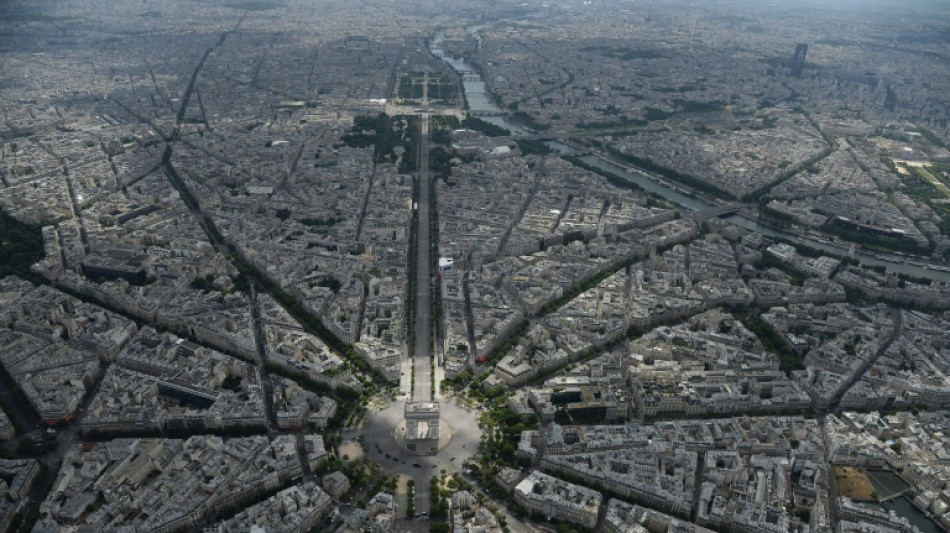
Two key Paris landmarks for Paralympics opening ceremony / Photo: © AFP/File

 Wellalage and Mendis star as Sri Lanka level England ODI series
 Guyana urges Venezuela at UN to respect ICJ's ruling on Essequibo region

 Argentina coach says Messi deserves to go out on own terms
 Xi sets red lines for Trump despite lavish White House welcome

 Cowboys, Ravens happy with footing for first Rio NFL clash

 Starbucks to close 250 more cafes in North America

 French actress Marina Vlady dies at 88

 CNN, MS NOW, Politico allowed back in White House after judge's order

 Morocco's ruling coalition dominates low-turnout parliament election

 Napoli hoping to build new stadium, says owner
 What's behind the Pakistani strikes on Afghanistan?
 Hundreds protest for return of Nobel peace laureate Machado to Venezuela

 Aubameyang to miss two months for Deportivo after knee surgery

 Newsom says Trump presidency 'as we know it' ends in November

 Stocks fall as oil prices rise and bonds back under pressure
 Russell leads Mercedes 1-2 in Azerbaijan GP practice

 Ukrainian kills priest, wounds four at Polish abbey
 Sri Lanka captain Mendis hits century in 321-6 against England

 Oscar-winner Cotillard fears being moved by AI actor

 Agassi demands proper break for exhausted tennis stars

 Seixas 'crushes' teammates in training to draw Pogacar comparisons
 Trump welcomes Xi to White House, touting agreement on AI
 Stocks fall, oil prices rise as global bonds back under pressure
 UK man died putting women, children first in Mozambique jihadist siege: coroner

 Russell leads Mercedes 1-2 at Azerbaijan GP practice

Paris has chosen the iconic Champs-Elysees avenue and the historic Place de la Concorde to host the opening ceremony for the Summer Paralympics on Wednesday.
The prestigious avenue sweeping through the 8th arrondissement to the west of central Paris is dotted with cafes, palaces and luxury shops and connects the Arc de Triomphe in the west with Place de la Concorde in the east in a single straight line.
- The Champs-Elysees -
Tens of thousands of people daily throng the two-kilometre-(one mile)-long tree-lined artery with its wide sidewalks.
It has long been for French a place of celebrations and popular gatherings.
It was there in 1960 that American actress Jean Seberg appeared in Jean-Luc Godard's legendary new wave film "Breathless" selling copies of the New York Herald Tribune.
On Wednesday it will be the scene of a popular parade, open to everyone and involving up to more than 180 delegations and 4,400 para-olympians from around the world.
France has celebrated two football World Cup victories there, the traditional military parade on July 14, the Bastille Day national holiday, and the Tour de France cycle race ends there.
Hundreds of thousands of Parisians and tourists gather there to celebrate New Year's Eve.
Once fields and fallow land, the avenue started to take shape when Louis XIV's city planner first linked the Louvre to the Tuileries Garden in the mid-17th century.
At one end of the avenue is the Arc de Triomphe, commissioned by French Emperor Napoleon which now honours France's war dead, and was inaugurated in 1836.
France's WWII leader General Charles de Gaulle, chose it, of course, for his triumphant return from exile on August 26, 1944, after the Liberation of Paris from the Nazis.
However the prestigious thoroughfare has known scenes of unrest. Police used tear gas, rubber bullets and water cannon when "yellow vest" anti-government protesters in 2018 attacked the Arc de Triomphe, and ransacked shops.
However, with stores and historic cinemas closing along the avenue due to rising rents and falling sales, locals have gradually abandoned the Champs-Elysees over concerns that it is too noisy, dirty and expensive.
With Paris' other famous symbol the Eiffel Tower looming just across the River Seine, the name is the French for Elysian Fields, the paradise for dead heroes in Greek mythology.
- Place de la Concorde -
At the other end, the Place de la Concorde, the largest square in Paris, will be the scene of the official parade for ticket holders, in addition to the protocol and artistic sequences.
The square has a bloody past: then known as "Place de la Revolution" it was a place of execution and heads rolled (literally) there during the French Revolution.
King Louis XVI and his wife Marie-Antoinette were famously guillotined there in 1793 during the Reign of Terror that followed the 1789 Revolution.
It was renamed Concorde after the July Revolution of 1830.
Today the elegant paved square by the Seine is defined by its huge obelisk, one of a pair originally erected by Ramses II outside the temple in Luxor in Egypt in the 13th century BC. It was gifted to Paris in 1830.
K.Hofmann--VB