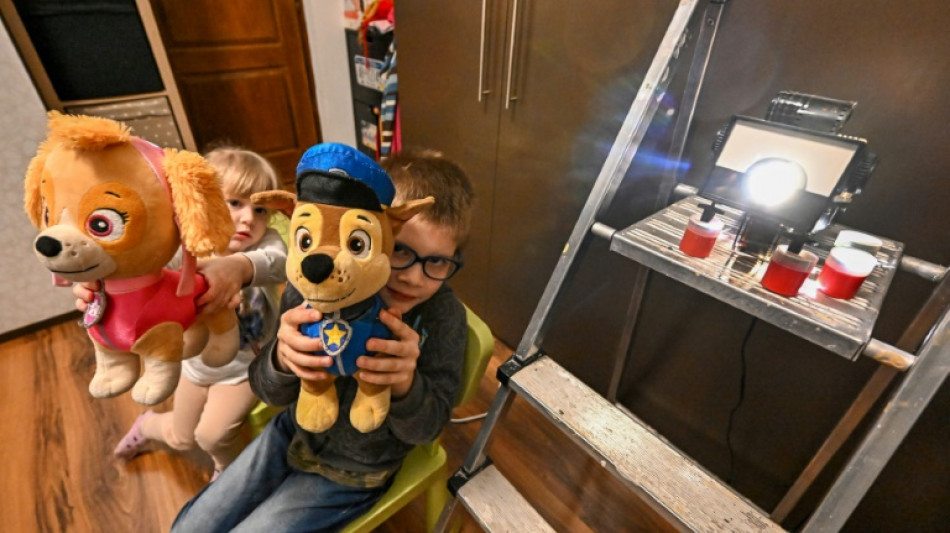
Filmstrip, Hungary's old-school projectors children love / Photo: © AFP

 Australia's new Ghost Shark submarines grow some 'teeth'

 'I call it a bribe': Pennsylvania residents spurn $10,000 data center checks

 In a former US steel city, ordinary people struggle to get by

 'Liar,' 'clown': Lula and Bolsonaro spar in Brazil poll debate

 Record El Nino? Depends who's counting

 On the front line of ocean conservation off Portugal's Madeira

 Wembanyama targets title breakthrough as NBA season tips off
 With LeBron on board it's title or bust for Philly fans

 One year after Louvre heist, where are the missing jewels?

 Knicks face tall task in NBA championship repeat bid

 Warriors' Curry 'fine' after limping out of practice - Kerr

 Zelensky speaks to US envoys as Trump lashes out

 'Surprise package' Lazio crush Juve to keep pace with Serie A leaders Inter

 China growth expected to miss official target in third quarter

 Lazio crush Juventus to move level with Serie A leaders Inter

 Leeds draw feels like 'fresh start' for Man Utd's Carrick

 Macron denounces 'unbridled' violence as France hit by new clashes

 Hurzeler lauds 'hard worker' Gomez after Brighton goal from halfway line

 Toulouse hold off Exeter, Northampton save English Champions Cup blushes

 Arsenal snatch late win to keep pressure on Man City as Man Utd held

 Arsenal strike late to keep pressure on Man City as Man Utd held

 Four soldiers dead, dozens injured in fire at Canada military base

 Ton-up Agha helps Pakistan down Sri Lanka in tri-series opener

 Man Utd draw at Leeds keeps pressure on Carrick

 Barca defenders Garcia, Kounde injured before key games

Tablets and mobile phones may have to be prised from the fingers of children elsewhere, but in Hungary storytime can be all about a 100-year-old piece of tech -- filmstrip.
Generations of kids there have been enthralled with stories told with the help of a projector.
Alexandra Csosz-Horvath turns off the lights and reads "Sleeping Beauty" from a series of still captioned images projected onto the bedroom wall -- her three- and seven-year-old clearly under her spell.
"We're together, it's cozier than the cinema yet it's better than a book," said the 44-year-old lawyer.
Filmstrip -- a century-old storytelling medium that was killed off in the West by the video cassette in the 1980s -- is not just hanging on in Hungary, it is thriving with a new wave of enthusiasts charmed by its slower-paced entertainment.
Printed on rolls of film, the still images were never meant to move.
- Long tradition -
"Between the 1940s and the 1980s filmstrips were used worldwide as a cost-effective visualisation tool in education and other fields," Levente Borsos, of Seoul's Hankuk University of Foreign Studies, told AFP.
But while it was surpassed by more advanced technologies in the West, it became a popular form of home entertainment in the Soviet bloc where TVs and videos were harder to come by.
When communism collapsed, filmstrip began to disappear -- except in Hungary, where the since privatised Diafilmgyarto company survives as the country's sole producer.
"Continuous filmstrip publishing and slide shows at home can be considered a Hungarian peculiarity, a special part of the country's cultural heritage," Borsos said.
- Revival -
Producer Diafilmgyarto has seen sales rebound from 60,000 in the 1990s to 230,000 rolls last year.
Each film -- produced solely for the domestic market -- costs around five euros ($5.50), less than a cinema ticket. Most are adaptations of classic fairy tales or children's books.
One bestseller, Hungarian classic "The Old Lady and the Fawn" about a woman taking care of a young deer, has been in the top 10 since its release in 1957, according to Diafilmgyarto's managing director Gabriella Lendvai.
The company also commissions artists, including some famous Hungarians, to create exclusive content for its filmstrips.
It's "an irreplaceable tradition in Hungarian culture", said Beata Hajdu-Toth, who attended a recent filmstrip screening in a Budapest cinema along with her son to celebrate Diafilmgyarto's 70th anniversary.
"I am very happy it's part of our life and hopefully I will be able to narrate to my grandchildren as well," the 37-year-old added.
At her home in the Budapest suburbs, Csosz-Horvath also hails the tradition, preferring it to fast-paced cartoons, which she said drive the children "wild".
"They just can't understand that what happens in three seconds on the screen happens in three hours in real life," she said.
With filmstrips "they don't believe that everything happens in the blink of an eye."
T.Zimmermann--VB