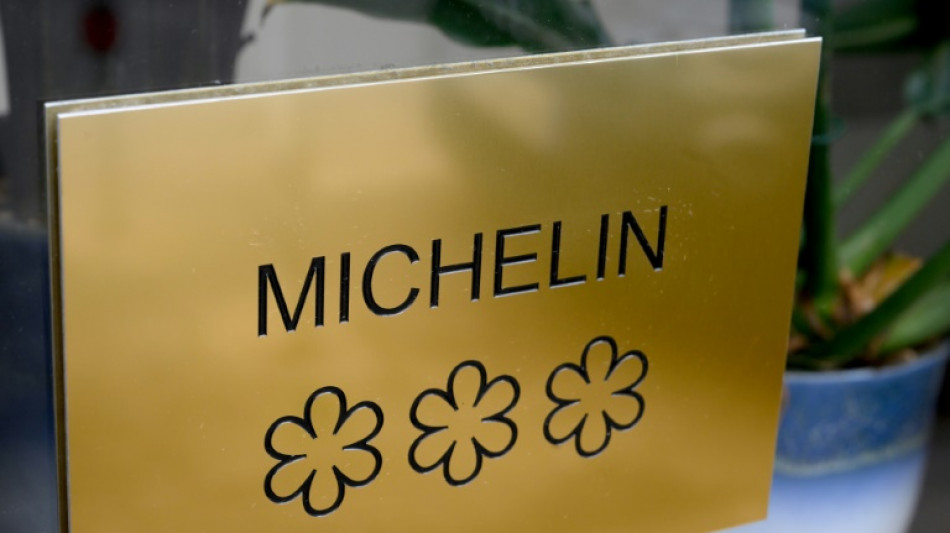
The secret agents of the Michelin Guide / Photo: © AFP

 Australian lawmaker hurt in car attack underwent surgery overnight: PM

 Japan launches rocket for potential world first Mars moon mission

 Ethiopia PM warns Eritrea of 'severe consequences' if supports enemies

 Boland grabs opportunity for Australia as South Africa struggle in second Test

 Ronaldo handed 30-day suspension: Portuguese federation

 France announces curfews as government grapples with unrest

 Boland sets pace as South Africa struggle

 Ukraine on back foot as Kremlin moots US, China meeting

 'Stay home!': Tourists find themselves in a France convulsed by protests

 Kenyan cult leader guilty on all charges over 191 starvation deaths

 Eagles star Hurts to miss rest of NFL season: reports

 Oil-rich Alberta votes on Canada breakup

 Israel announces arrests after West Bank settler attacks on Westerners
 Guehi insists players have 'trust and belief' in Man City after charges
 UN climate panel head wants swift end to deadlock over key scientific report

 PM calls for curfews in France as govt grapples with unrest

 Man City's Semenyo out for up to eight weeks

 Australian lawmaker critically hurt in 'violent' vehicle attack
 England women's coach Wiegman signs two-year contract extension

 Louvre blocked as France grapples with unrest

 Bollywood actor Tiger Shroff shot at in Mumbai, three suspects held: police
 UN biodiversity summit opens with nature goals off track

 'Physical hell': Hong Kong hosts gruelling underwater hockey tournament
 Police 'lost control' during French protests, says interior minister
 Australia's new Ghost Shark submarines grow some 'teeth'
They are paid to eat in the best restaurants in the world -- but the price is having to lie even to their friends about the job.
Hidden amongst hundreds of guests descending on the 16th century Chateau de Chambord in the Loire Valley for a luxurious dinner ahead of the Michelin Guide's annual ceremony on Monday was the group's covert inspectors.
One guest at the weekend event told AFP he worked in the automobile industry -- plausible given Michelin's main business of selling tyres.
But his knowledge of France's best restaurants was suspiciously encyclopedic.
Whether or not he was a Michelin inspector would remain a mystery, since they are sworn to secrecy.
Each year, the guide receives 8,000 spontaneous applications to become an inspector, its boss Gwendal Poullennec told AFP.
The key criteria are "professionalism" and "openness" -- to travel, different cultures and new experiences, he added.
Michelin does not say how many it employs -- part of the strict secrecy it maintains to ensure they are never recognised by a restaurant and given preferential treatment.
The guide does reveal that its inspectors currently include 25 different nationalities, and men and women of all ages, operating across the 45 destinations covered by Michelin.
- Undercover -
It is a full-time job, and all are drawn from the world of fine dining and hospitality: applicants must have at least 10 years of experience as chefs, sommeliers or hoteliers, according to the guide's website.
A new inspector is paired with a more experienced colleague for a training period of up to two years -- or around 800 meals -- to learn the Michelin method, the organisation told AFP.
The inspector then lives undercover. Only their inner circle of family are allowed to know -- and they have an interest in keeping quiet since they often tag along to meals to avert suspicion.
The most common cover story that inspectors give their friends and wider family is that they are "consulting" with restaurants on their business strategies -- a good excuse to travel and indulge.
They give false names and even change their phone numbers when making reservations -- vital since many restaurants now have applications to scan their bookings for journalists and potential inspectors.
The reviews require an excellent memory. The inspector must recall the tiniest details of the food, service and ambiance -- right down to the appearance of the toilets -- without taking notes, though phone pictures are now common.
They must also research the wider context -- the restaurant's suppliers, how it fits into the local community and its finances.
The final report sticks to five criteria: the quality of the ingredients, the culinary technique, the harmony of the flavours, the emotion which the chef is seeking to convey through their menu, and the restaurant's consistency over time. The latter requires multiple visits.
The awarding of a star -- with three stars as the absolute pinnacle -- must be a unanimous choice when inspectors meet to discuss their reviews.
If there is disagreement, further visits are organised until a consensus is reached.
A.Kunz--VB