Israeli researchers find opium residue in 3,500-year-old pottery / Photo: © AFP

 Houthis target Red Sea shipping as US hits Iran

 Record-equalling Red Sox streak halted at 15 wins

 Messi-less Miami beat Fire 3-2 to spoil Lewandowski's MLS debut

 Mercedes expect Hungary challenge from Hamilton and Ferrari

 In Ghana, one man's race to save critically endangered fish
 Wilson captain, Slipper absent in Kiss's first Wallabies squad

 New Mideast fighting puts eurozone rate-setters on alert

 Venezuelans search for animal companions lost in the quakes

 Argentine Football Association says US did not detain its president

 June heatwave cost UK economy more than £1bn: study

 Google-parent Alphabet beats expectations, cloud revenue nearly doubles

 US announces civilian nuclear deal with Saudi Arabia

 Tesla shares dip after profit misses expectations

 Red Sox tie club record with 15th straight MLB win

 US eyes offshore nuclear reactors

 The Sterling Announces Luxury Cocktail Lounge Concept and Investor Showcase in Orlando

 Inter Miami signs Brazil veteran Casemiro but MLS probes deal

 White House accuses China's Moonshot of stealing Anthropic AI

 Pogacar sweating on Yates's fitness ahead of Tour Queen stage

 Ukrainian soldiers and civilians welcome new army commander

 UK fintech Revolut valuation soars to $115 bn: source

 German FM, on Africa tour, eyes business ties amid US, China pressure

 Rubio says at ASEAN meeting he expects 'positive' US visit by China's Xi

 Philipsen wins Tour de France 17th stage

 DonnaPro Introduces AI-Trained Executive Assistants for European CEOs

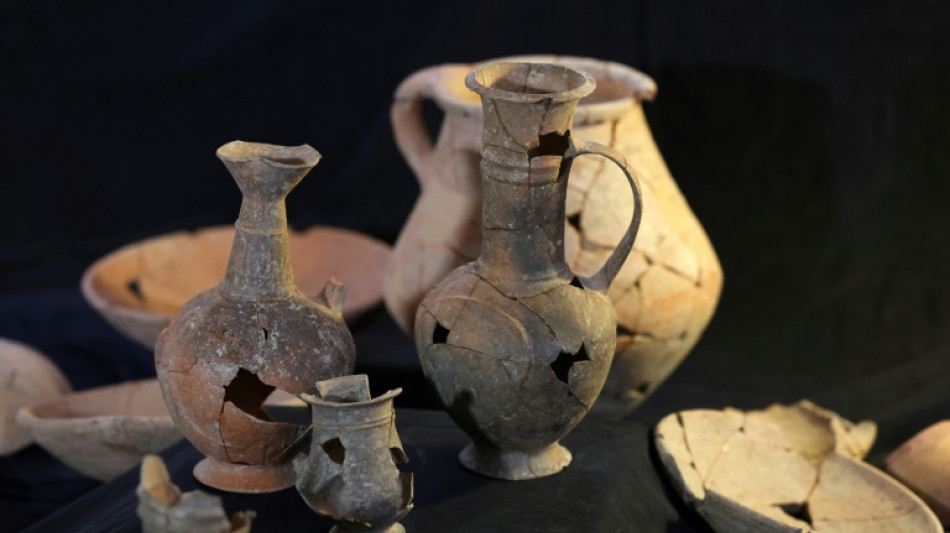
Israeli archaeologists said Tuesday they had discovered opium residue in 3,500-year-old pottery pieces, providing evidence to support the theory that the hallucinogenic drug was used in ancient burial rituals.
The joint investigation by the Israel Antiquities Authority and Weizmann Institute of Science began in 2012 when excavations in the central Israeli town of Yehud revealed a series of Late Bronze Age graves.
Researchers found pottery vessels at the site that resembled poppy flowers -- from which opium is derived -- dating back to the 14th century BC.
They then examined whether they had served as containers for the drug, which earlier writing had suggested was used in burial rituals in Canaan, and found "opium residue in eight vessels", the researchers said in a statement.
These were likely "placed in graves for ceremonial meals, rites and rituals performed by the living for their deceased family members", said Ron Be'eri, an archaeologist with the antiquities authority.
During these ceremonies, "family members or a priest on their behalf" would "attempt to summon the spirit of their dead relatives... and enter an ecstatic state by using opium", Be'eri said.
But he acknowledged that much remained unknown about its use in ancient times. "We can only speculate what was done with opium," he said.
J.Fankhauser--BTB