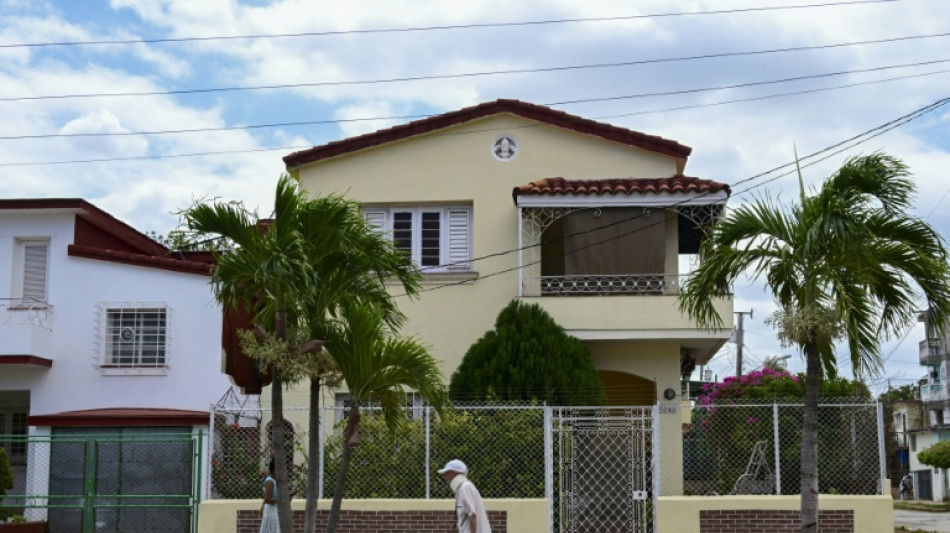
Havana property market stirs as investors bet on political change / Photo: © AFP

 Cycling industry bets on smart bikes to boost sales

 In Idaho, the next generation of US nuclear reactors nears reality

 Africa the winner of expanded World Cup amid mixed fortunes for minnows

 Asia's vendors grapple with rising costs of ever-present plastics

 Messi scores again as Argentina head into World Cup last 32 on a high
 Wissa proud to deliver World Cup joy to war-torn DR Congo

 South Korea's 'dismal' World Cup ends in group phase

 Colombia and Portugal through to World Cup last 32 after thrilling draw

 Wissa sends DR Congo into World Cup last 32 clash with England
 A painful wait by a pile of rubble in quake-hit Venezuela
 Tuchel delighted to have Bellingham in 'sweet spot' for England at World Cup

 Bellingham says 'job done' but England must improve at World Cup
 Trump threatens to annihilate Iran after new exchange of attacks
 Scotland boss Clarke resigns after World Cup exit confirmed: official

 Kane, Bellingham on target as England clinch top spot

 Bellingham, Kane score as England beat Panama to reach World Cup last 32

 Canada's Davies 'available' for historic knockout clash

 Hovland seizes one-shot PGA Travelers lead over Scheffler

 Mauvaka double inspires Toulouse to fourth-straight Top 14 in storm-impacted final

 Solidarity, sadness among Venezuelans made destitute by quake
 Iran says US violated peace deal as both sides attack

 'We need help': Venezuelans furious at slow official response to quakes

 Venus Williams relishes 'very special' Wimbledon reunion with sister Serena

 Ravindra leads New Zealand rally in England finale after Archer's double strike
 Wimbledon 'towel thief' Swiatek back on the trophy hunt

Havana's real estate market is showing glimmers of revival as investors bet that a political and economic revolution is coming to the Communist-governed island.
Prices are ticking up, and brokers are getting busier as something stirs Cuba's real estate market, long battered by sanctions, recession and mass emigration.
That something is acute US political pressure coupled with an oil blockade, and a belief among some Cuban-Americans that the Communist Party could reform or be toppled after six decades in power.
"The market is moving on expectations" not supply and demand, said Luis Mijail Lopez, owner of a private construction firm in Havana.
He said there is suddenly "a great deal of interest" from clients, including emigres and foreign residents, willing to invest.
In the words of one 48‑year‑old Cuban living in Miami who asked a family member to look for an apartment, "changes are coming."
- Recovery in flow -
Cuba's housing market emerged only in 2011, when the government legalized home sales.
For decades before that residents were limited to swapping properties.
In theory, foreigners are still barred from buying homes unless they hold permanent residency or use proxies.
No private real‑estate agencies operate, although self‑employed brokers exist.
Broker Yovanni Cantillo said the market has regained momentum in recent months, particularly Havana's most desirable neighborhoods.
Prices have increased in places like Miramar, Nuevo Vedado and Vedado -- neighborhoods with neoclassical mansions, embassies and art deco jewels.
It is "a recovery in its flow, in its dynamics" said Cantillo, while acknowledging that values remain 40 to 50 percent below levels seen during the diplomatic thaw between Havana and Washington under former US president Barack Obama.
Obama's rapprochement triggered a tourism‑linked property boom after Airbnb began operating in Cuba.
Tougher US sanctions followed under his successor Donald Trump, and the Covid-19 pandemic halted the surge.
A mass exodus of more than 1.5 million Cubans since 2020 then flooded the market with homes, driving prices sharply lower.
Cantillo said now buyers are multiplying and sellers have pulled listings or raised prices in anticipation of a broader rebound.
Expectations have been fueled by talks between Washington and Havana, and by a draft law that would allow Cubans to own two urban homes and take out mortgages.
The legislation, which could be approved in July, would make it possible to "do business with those properties," according to an architect who asked not to be identified.
Small and medium‑sized private companies were authorized in 2021 and are expanding, often operating from homes in a capital with virtually no office market.
Private construction firms that manage their own imports have also improved access to building materials, making renovations easier.
In this context, interest from Cuban-Americans is "essential," Cantillo said.
The prospect of change is also reviving hopes among some exiles of recovering properties nationalized after the 1959 revolution.
J.Sauter--VB