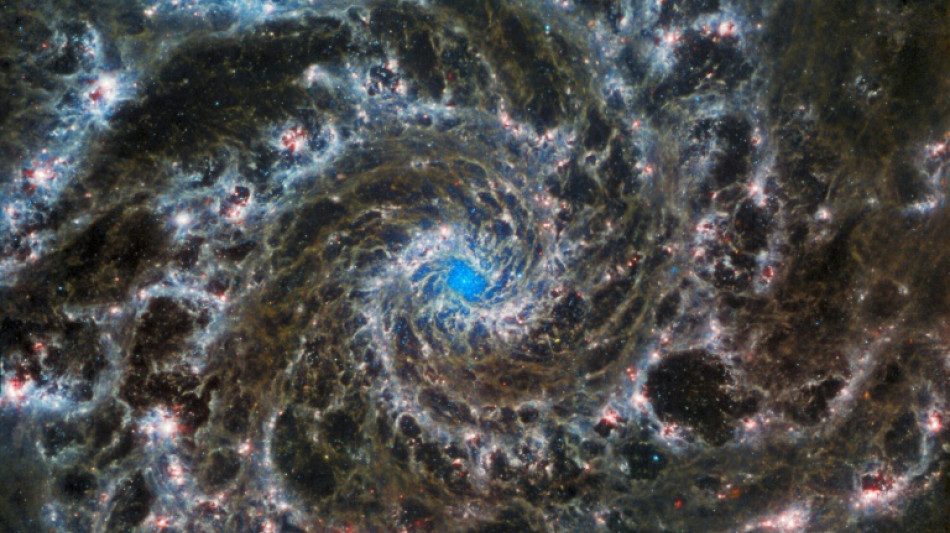
Webb telescope captures new detail of Phantom Galaxy / Photo: © NASA/ESA/AFP

 Houthis target Red Sea shipping as US hits Iran

 Record-equalling Red Sox streak halted at 15 wins

 Messi-less Miami beat Fire 3-2 to spoil Lewandowski's MLS debut

 Mercedes expect Hungary challenge from Hamilton and Ferrari

 In Ghana, one man's race to save critically endangered fish

 Wilson captain, Slipper absent in Kiss's first Wallabies squad

 New Mideast fighting puts eurozone rate-setters on alert

 Venezuelans search for animal companions lost in the quakes

 Argentine Football Association says US did not detain its president

 June heatwave cost UK economy more than £1bn: study

 Google-parent Alphabet beats expectations, cloud revenue nearly doubles

 US announces civilian nuclear deal with Saudi Arabia

 Tesla shares dip after profit misses expectations

 Red Sox tie club record with 15th straight MLB win

 US eyes offshore nuclear reactors

 The Sterling Announces Luxury Cocktail Lounge Concept and Investor Showcase in Orlando

 Inter Miami signs Brazil veteran Casemiro but MLS probes deal

 White House accuses China's Moonshot of stealing Anthropic AI

 Pogacar sweating on Yates's fitness ahead of Tour Queen stage

 Ukrainian soldiers and civilians welcome new army commander

 UK fintech Revolut valuation soars to $115 bn: source

 German FM, on Africa tour, eyes business ties amid US, China pressure

 Rubio says at ASEAN meeting he expects 'positive' US visit by China's Xi

 Philipsen wins Tour de France 17th stage

 DonnaPro Introduces AI-Trained Executive Assistants for European CEOs

The James Webb space telescope has revealed dazzling new detail of a previously known slice of the cosmos 32 million light-years away, in a new picture released by NASA and the European Space Agency (ESA).
The infrared technology of the telescope, launched in December 2021, has allowed for an even clearer view of the so-called Phantom Galaxy than astronomers had ever seen before.
"Webb's sharp vision has revealed delicate filaments of gas and dust in the grandiose spiral arms which wind outwards from the center of this image," NASA and the ESA said Monday.
"A lack of gas in the nuclear region also provides an unobscured view of the nuclear star cluster at the galaxy's center," the agencies said in a statement.
The whirling celestial form, officially called M74, is located in the Pisces constellation 32 million light-years away from Earth.
The Webb image shows the galaxy's brilliant white, red, pink and light blue appendages of dust and stars swirling around a bright blue center, all set against the dark backdrop of deep space.
M74 was previously photographed by the Hubble telescope, which captured the galaxy's spiraling blue and pink arms, but instead showed its glowing center as a soft yellow.
The Phantom Galaxy is a "favorite target for astronomers studying the origin and structure of galactic spirals," NASA and the ESA said. The picture taken by Webb will help them "learn more about the earliest phases of star formation in the local Universe," and record more information about 19 star-forming galaxies close to our own Milky Way.
Astronomers will also use the picture to "pinpoint star-forming regions in the galaxies, accurately measure the masses and ages of star clusters, and gain insights into the nature of the small grains of dust drifting in interstellar space," the statement said.
Webb's new pictures have thrilled the space community as the telescope orbits the Sun at a distance of a million miles (1.6 million kilometers) from Earth, in a region of space called the second Lagrange point.
The telescope, which has a primary mirror more than 21 feet (6.5 meters) wide, is an international collaboration between NASA, the ESA and the Canadian Space Agency. It is expected to operate for approximately 20 years.
P.Anderson--BTB