Maghreb farmers embrace drones to fight climate change / Photo: © AFP

 India protest leaders to meet govt after Modi vows action
 Fear, arrests keep Cambodians quiet decade after critic's murder
 Over 80% of Mexican exports exempt from new US tariffs

 Is 'superstar' Pogacar's Tour de France domination boring?

 Iran ramps up executions under shadow of war
 Rosalia's Argentine fans up in arms over alleged World Cup snub

 Six candidates to lead UN take stage for televised debate

 King Charles opens slimmed down Commonwealth Games in Glasgow
 US unveils new tariffs on 60 partners as Trump rebuilds trade agenda
 WNBA viral star Cunningham wades into trans athletes row
 Hearn dismisses Fury talk of Joshua no-show for super fight

 'Like a war zone': France evacuates 20,000 due to wildfires
 Ships avoid Ukrainian grain ports after Russian attacks
 Oil passes $100 a barrel again: why it's more serious this time

 Who are the six candidates vying to lead the UN?
 Hamilton proud of recovery after hitting rock bottom a year ago
 Carapaz eyes polkadot mountains jersey after stage win
 Fields medal awarded to four young mathematicians
 Carapaz claims Tour de France stage as Pogacar loses key team-mate
 Alonso welcomes Aston Martin upgrade, warns against unreal expectations
 Anderson declares Man City 'kings of Manchester' after £116 mn move

 Relieved Russell says Mercedes have solved his power problems mystery

 Oil soars above $100 as Middle East fears grow

 Venezuelans turn to scrap collecting in quake-hit beach 'paradise'

 Heptathlon champion Johnson-Thompson joins list of Commonwealth Games absentees

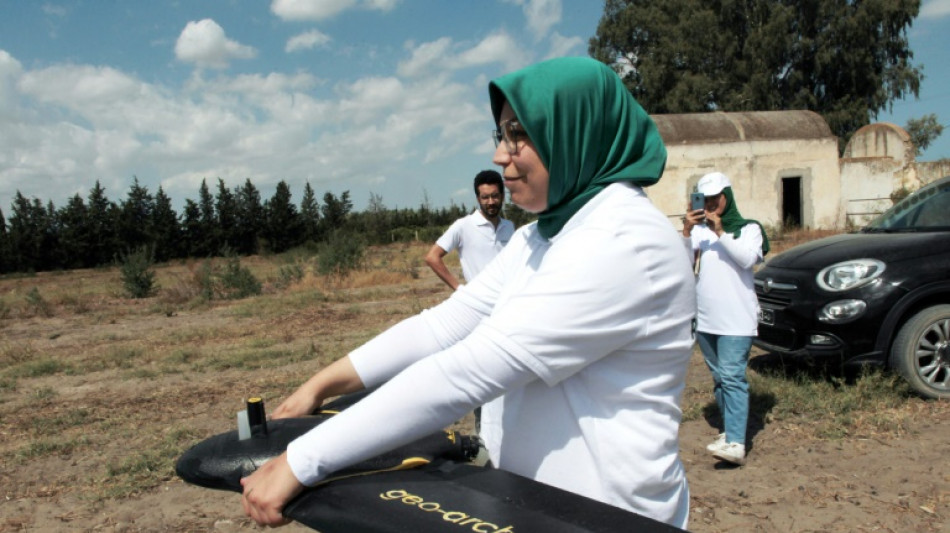
A drone buzzed back and forth above rows of verdant orange trees planted near Nabeul, eastern Tunisia.
The black unmanned aircraft, equipped with a multi-lens camera and sensors, has been enlisted by Tunisian farmers to help adapt to years of drought and erratic weather patterns caused by climate change.
"The seasons are not like they were before where we knew exactly what to do," said farmer Yassine Gargouri, noting temperatures now can begin to climb as early as May while in August there have been unusual summer rains.
He hired start-up RoboCare to scan the trees from the air and assess their hydration levels, soil quality and overall health -- to prevent irreversible damage.
The technology "provides us with information on how much water each plant needs, no more, no less", he said.
The use of modern technologies in agriculture is globally on the rise, including in North Africa where countries rank among the world's 33 most water-stressed, according to the World Resources Institute.
RoboCare, employing about 10 people, is the only company in Tunisia, according to its 35-year-old founder Imen Hbiri, to use drones to help farmers combat the impacts of climate change and reduce costs, crop losses and water consumption.
"Resorting to modern technologies in the sector of agriculture has become inevitable," Hbiri told AFP while monitoring the drone's path on her computer screen.
-'Challenge of tomorrow'-
The daughter of farmers, the entrepreneur knows well the limits of existing farming methods.
Now, in just a few clicks, she can access scans that detect signs of illness or malnourishment before they are visible to the naked eye.
On the screen, fields appear in RGB (red, green, blue) imagery -- the greener the plants, the healthier.
Farmers can then use medicine-filled sprinklers mounted to the drones to target the sickly plants with more precision and consequently less expense.
"By relying on this technology, we can save water consumption by up to 30 percent and reduce about 20 percent of the cost of fertilisers and medicine, while raising crop production by 30 percent", Hbiri explained.
Gargouri, who spends about 80 percent of his budget on fertilisers and other remedies, says this technology is the future.
"We must adapt to these upheavals," Gargouri added. "It's the challenge of tomorrow".
Tunisia is currently experiencing its eighth year of drought (four of which were consecutive) in recent years, according to its agriculture ministry.
The country's dams, which are the primary source for drinking water and irrigating crops, are currently only filled to about 22 percent capacity.
And about 20 dams -- mostly located in the south -- have gone completely out of service.
In neighbouring countries, water scarcity is also a major issue.
- Licensing hurdles -
Morocco -- where agriculture accounts for 13 percent of the gross domestic product, 14 percent of exports and 33 percent of jobs -- also suffered its worst drought in four decades in 2022.
Only about three percent of nearly two million Moroccan farmers use new technologies in their fields, Loubna El Mansouri, director of the digital centre at Morocco's agriculture ministry, told AFP.
A study they conducted found that using drones to water crops could use "less than 20 litres of water to irrigate one hectare compared to nearly 300 litres" used with traditional methods, Mansouri added.
Similarly, Algeria's agriculture ministry said it was using drones and satellite imagery for mapping "to optimise the use of agricultural land by evaluating its characteristics and suitability for production", local media reported.
For the use of these technologies to become widespread, however, Hbiri says the law needs to be changed in Tunisia and awareness raised.
Algeria, Morocco, and Tunisia ban the use of unmanned drones without a permit, which in the case of commercial uses can take months to be issued.
Hbiri hopes authorities will help start-ups reach more farmers as she estimates "only 10 percent of farmers in Tunisia depend on this type of technology".
"We want to focus our work on the use of technology and not spend time and effort on administrative issues and moving between departments and banks, which is slowing our progress," she said.
H.Gerber--VB