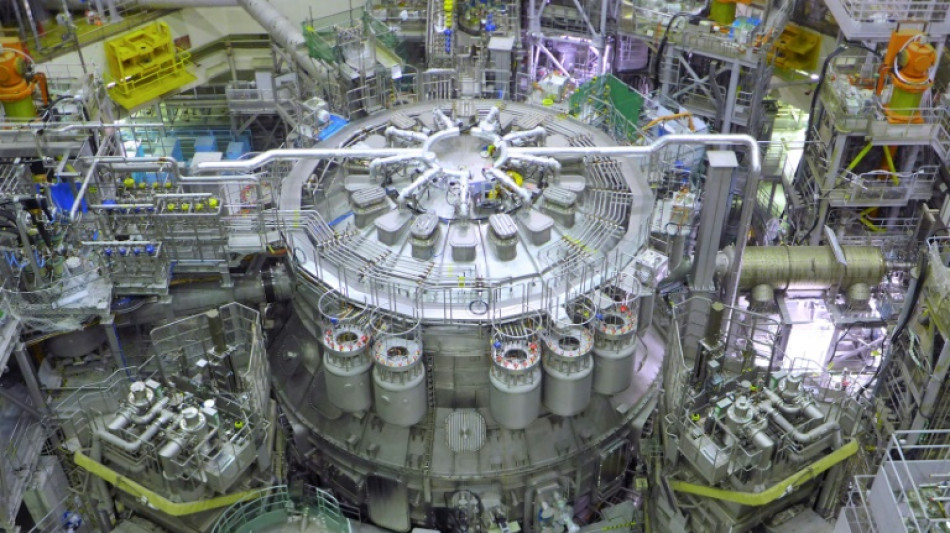
Japanese experimental nuclear fusion reactor inaugurated / Photo: © National Institutes for Quantum Science and Technology (QST)/AFP

 India protest leaders to meet govt after Modi vows action

 Fear, arrests keep Cambodians quiet decade after critic's murder

 Over 80% of Mexican exports exempt from new US tariffs

 Is 'superstar' Pogacar's Tour de France domination boring?

 Iran ramps up executions under shadow of war

 Rosalia's Argentine fans up in arms over alleged World Cup snub

 Six candidates to lead UN take stage for televised debate

 King Charles opens slimmed down Commonwealth Games in Glasgow

 US unveils new tariffs on 60 partners as Trump rebuilds trade agenda
 WNBA viral star Cunningham wades into trans athletes row

 Hearn dismisses Fury talk of Joshua no-show for super fight

 'Like a war zone': France evacuates 20,000 due to wildfires

 Ships avoid Ukrainian grain ports after Russian attacks
 Oil passes $100 a barrel again: why it's more serious this time

 Who are the six candidates vying to lead the UN?

 Hamilton proud of recovery after hitting rock bottom a year ago

 Carapaz eyes polkadot mountains jersey after stage win
 Fields medal awarded to four young mathematicians
 Carapaz claims Tour de France stage as Pogacar loses key team-mate
 Alonso welcomes Aston Martin upgrade, warns against unreal expectations

 Anderson declares Man City 'kings of Manchester' after £116 mn move
 Relieved Russell says Mercedes have solved his power problems mystery

 Oil soars above $100 as Middle East fears grow

 Venezuelans turn to scrap collecting in quake-hit beach 'paradise'

 Heptathlon champion Johnson-Thompson joins list of Commonwealth Games absentees

The world's biggest experimental nuclear fusion reactor in operation was inaugurated in Japan on Friday, a technology in its infancy but billed by some as the answer to humanity's future energy needs.
Fusion differs from fission, the technique currently used in nuclear power plants, by fusing two atomic nuclei instead of splitting one.
The goal of the JT-60SA reactor is to investigate the feasibility of fusion as a safe, large-scale and carbon-free source of net energy -- with more energy generated than is put into producing it.
The six-storey-high machine, in a hangar in Naka north of Tokyo, comprises a donut-shaped "tokamak" vessel set to contain swirling plasma heated up 200 million degrees Celsius (360 million degrees Fahrenheit).
It is a joint project between the European Union and Japan, and is the forerunner for its big brother in France, the under-construction International Thermonuclear Experimental Reactor (ITER).
The ultimate aim of both projects is to coax hydrogen nuclei inside to fuse into one heavier element, helium, releasing energy in the form of light and heat, and mimicking the process that takes place inside the Sun.
Researchers at ITER, which is over budget, behind schedule and facing major technical problems, hope to achieve nuclear fusion technology's holy grail, net energy.
Sam Davis, deputy project leader for the JT-60SA, said the device will "bring us closer to fusion energy".
"It's the result of a collaboration between more than 500 scientists and engineers and more than 70 companies throughout Europe and Japan," Davis said at Friday's inauguration.
EU energy commissioner Kadri Simson said the JT-60SA was "the most advanced tokamak in the world", calling the start of operations "a milestone for fusion history".
"Fusion has the potential to become a key component for energy mix in the second half of this century," Simson added.
The feat of "net energy gain" was managed last December at the National Ignition Facility at Lawrence Livermore National Laboratory in the United States, home to the world's largest laser.
The US facility uses a different method to ITER and the JT-60SA known as inertial confinement fusion, in which high-energy lasers are directed simultaneously into a thimble-sized cylinder containing hydrogen.
The US government called the result a "landmark achievement" in the quest for a source of unlimited, clean power and an end to reliance on carbon-emitting fossil fuels that cause climate change as well as geopolitical upheaval.
Unlike fission, fusion carries no risk of catastrophic nuclear accidents -- like that seen in Fukushima in Japan in 2011 -- and produces far less radioactive waste than current power plants, its exponents say.
C.Bruderer--VB