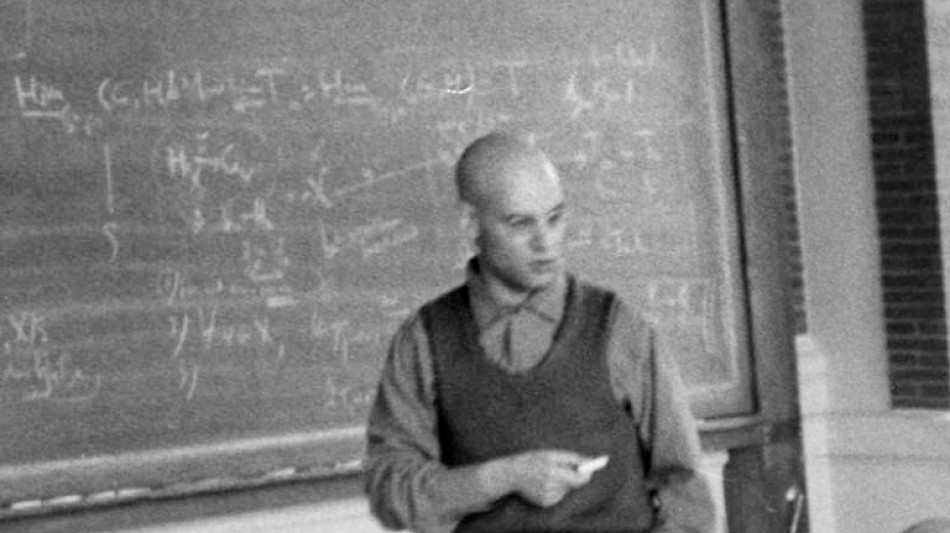
Hermit 'scribblings' of eccentric French maths genius unveiled / Photo: © IHES/AFP/File

 US imposes new tariffs on 60 partners as Trump rebuilds trade agenda

 Stocks suffer fresh blow as markets hit by perfect storm
 Trump under pressure from all sides over Chinese AI surge
 ICC member states decide fate of embattled prosecutor Karim Khan
 Dodgers return to Trump White House despite fan anger

 Lyles, Richardson ease into 100m semis at US athletics championships
 Salman Rushdie testifies at knife attacker's US terror trial

 World Bank confirms plan to phase out China lending by 2031

 US panel backs trendy peptides despite safety concerns

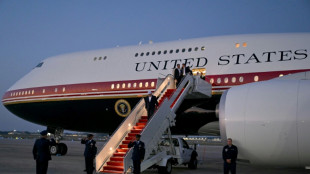 Justice Dept withdraws NY Times subpoenas over Trump plane report

 Barcelona's De Jong returns from World Cup with torn ligament
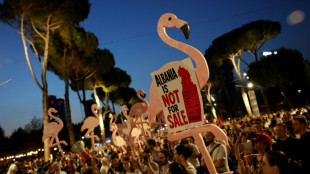 Albania police teargas protesters against Trump-linked resort
 US panel says to loosen restrictions on popular peptide despite safety concerns

 Verstappen swerves around future questions
 EU renews online child sex abuse detection powers

 Airbus, Boeing fly in different directions at Farnborough

 Bab al-Mandeb Strait: another key oil shipping route under threat
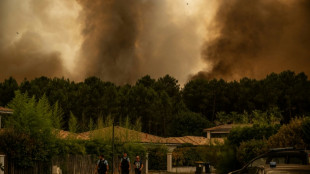
 Deadly wildfires in Europe force thousands to flee

 NATO to overhaul European fuel pipeline network
 US trade envoy to make tariff announcement as 10% duty soon expires

 Trump stuns Saudis by pinning nuclear deal to Israel ties

 Tough day for Ubisoft stock topped with weaker revenues

 Swelling jet fuel costs hit American Airlines outlook
 Carapaz climbs unopposed to Tour de France 18th stage win

 Sooryavanshi hits maiden 50 as India thump Zimbabwe in T20

Tens of thousands of handwritten pages by one of the 20th century's greatest mathematicians, Alexander Grothendieck, many of which the eccentric genius penned while living as a hermit, were unveiled in France on Friday.
The unpublished manuscripts, which veer from maths to metaphysics, autobiography and even long musings on Satan, offer a unique insight into the enigmatic mind of the French mathematician, according to experts at the Paris library where they were donated.
Grothendieck, who died aged 86 in 2014, is considered by some to have revolutionised the field of mathematics in the way that Einstein did for physics.
His work on algebraic geometry earned him the 1966 Fields Medal, known as the Nobel prize of the maths world.
At that time Grothendieck was already a radical environmentalist and pacifist. But he withdrew from the world almost entirely in the early 1990s, in part to focus on what he referred to as his "scribblings".
While living as a hermit in the southern French village of Lasserre he frantically wrote "Reflections on Life and the Cosmos," one of the two main works added to the collection of the National Library of France (BnF) on Friday.
The massive tome includes 30,000 pages across 41 different volumes covering science, philosophy and psychology -- all densely scribbled with a fountain pen.
The second work, "The Key to Dreams or Dialogue with the Good Lord," is a typed manuscript in which he explores the interpretation of dreams.
These pages, which have previously circulated online, were written between 1987-1988.
- 'Completely cut ties' -
At that time, Grothendieck remained a professor at the University of Montpellier but had largely withdrawn from the mathematical community.
He became a recluse when he moved to Lasserre.
"He completely cut ties with his family, we could no longer communicate with him," his daughter Johanna Grothendieck told AFP.
"When we sent him a letter, it was returned to sender," said Johanna, a 64-year-old ceramic artist who travelled from southwest France to attend the ceremony at the library.
"Writing was his main activity," she added.
Towards the end of Grothendieck's life, a neighbour told his family that his health was deteriorating.
Johanna and one of her brothers were finally able to visit their father. It was than that they discovered "Reflections on Life and the Cosmos," which was meticulously catalogued in his library.
In his 1997 will, Grothendieck left the early sections of the tome to the BnF. Now his children have donated the rest.
"It was an extremely important work in his eyes. He even wanted to create a foundation to look after it," Johanna Grothendieck said.
- 'Ghosts of his past' -
Jocelyn Monchamp, a curator an the BnF, said the manuscripts were unique because they covered so many subjects at the same time yet formed a whole with "undeniable literary qualities".
This is particularly the case for the autobiographical volume "Harvest and Sowing", which depicts the author "in a metaphysical retreat," she said.
Monchamp has spent a month poring over the writing, trying to decipher the dense fountain pen text.
"I became used to it," she said, adding that at least Grothendieck methodically wrote the numbers and dates on all the pages.
In one of the sections, "Structures of the Psyche," enigmatic diagrams translate psychology into the language of algebra.
In another, "The Problem of Evil," Grothendieck muses over 15,000 pages on metaphysics and Satan.
One gets the feeling of a man "overtaken by the ghosts of his past," Johanna Grothendieck said.
The mathematician's father fled Germany during World War II, only to be handed by the Vichy France government to the Nazis and die at the Auschwitz concentration camp.
Experts expect it will take some time to fully understand Grothendieck's writing.
On Friday, the collection joined the manuscript department of the BnF, where it will only be accessible to researchers.
During the donation ceremony, one of the volumes was placed in a glass case next to a manuscript by ancient Greek mathematician Euclid, considered the father of geometry.
A.Zbinden--VB