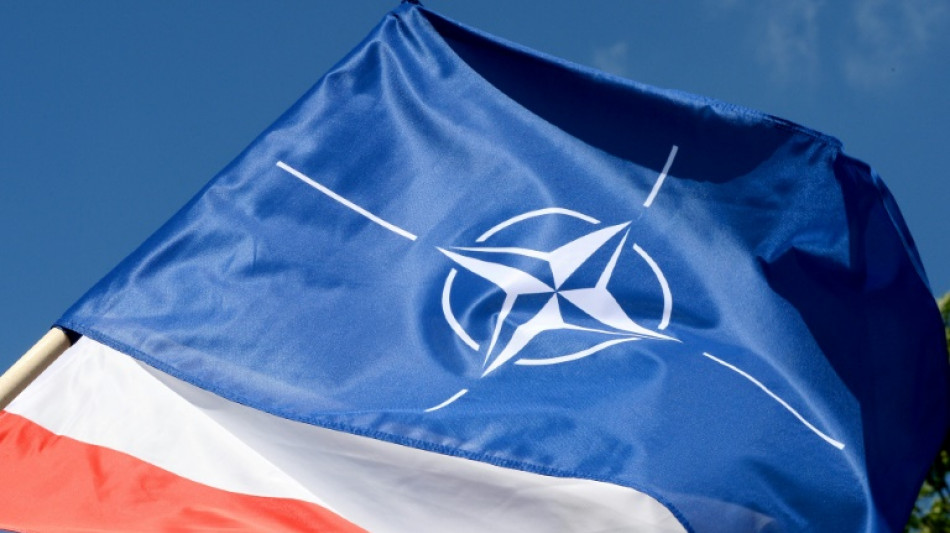
Russian drones in Poland put NATO to the test / Photo: © AFP

 S. Africa deploys police as anti-migrant protests loom

 Monaco parcel bomb blast wounds Ukrainian oligarch

 Sweden face France's attacking firepower at the World Cup

 Online same-sex romance series embrace AI 'freedom'

 New Oxford academic centre symbolises UK's big-donor era

 Trump says Iran meeting set in Qatar, despite uncertainty

 Morocco down Netherlands to reach World Cup last 16

 Asian stocks unable to track Wall St higher, yen holds at 40-year low

 'We came from nothing': DR Congo dreams of England World Cup upset

 Peruvian political heir Fujimori wins presidency

 What to expect as EU small parcel levy kicks in

 Nagelsmann says won't 'run away' after Germany World Cup exit

 Paraguay coach salutes 'extraordinary' World Cup win over Germany

 Japan fans stunned as Brazil end their World Cup dream

 'Powerhouse' Haaland leads by example at World Cup: Norway coach Solbakken

 Sadness and joy as breakaway Catholic group nears schism

 HUNTING/HER Headhunter Talk with EnBW Board Member & CHRO Colette Rückert-Hennen

 'I recognized her ring': identifying Venezuela's dead in a makeshift morgue

 Tuchel defensive headache as England ready for DR Congo clash

 US reopens Venezuela port as quake deaths top 1,700

 Coach says Japan getting closer to World Cup glory despite defeat

 NBA Grizzlies deal Morant to Portland: report
 Sweden ready for 'game of our lives' in France World Cup clash

 MLS Chicago Fire announce signing of Poland's Lewandowski

 Tech rebound lifts Dow to record, yen hits 40-year low against dollar

The intrusion of Russian drones into Poland -- whether deliberate, as Ukraine's European allies contend, or accidental -- is a test of NATO's readiness and resolve, experts say.
- Were the violations deliberate? -
The overflights came as Russia unleashed a barrage of strikes across Ukraine overnight, including in the western city of Lviv, around 50 miles (80 kilometres) from the Polish border.
Poland's airspace was violated 19 times, Prime Minister Donald Tusk said Wednesday, and at least three drones were shot down after Warsaw and its allies scrambled jets.
Russia's defence ministry denied that it had targeted Poland but such cases have fuelled speculation that President Vladimir Putin is testing how far he can push the West.
EU foreign policy chief Kaja Kallas said the breach of Polish airspace appeared to be "intentional, not accidental".
But Belarus, a Russian ally bordering Ukraine and Poland, said Wednesday it had also shot down drones that had "lost their trajectory" over its territory, raising questions over whether the intrusion was deliberate or drones had simply gone astray.
The low-cost drones used by Russia are vulnerable to Ukrainian jamming that can throw them off course.
There are precedents however for deliberate intrusions, said Romain Le Quiniou, head of the Euro Creative think tank.
"There have been multiple entrances by enemy drones since 2022 in Poland, Romania, Lithuania and even Croatia," Le Quiniou told AFP.
In July, Polish and Lithuanian SIM cards -- used to guide drones via local mobile networks -- were found in drones shot down over Ukraine, the Defence Express daily reported.
"It seems very unlikely to me that around 20 drones would accidentally find themselves in a territory where they are not supposed to be," said Ulrike Franke, a researcher at the European Council on Foreign Relations.
- What is Putin's goal? –
The intrusion came just days before Russian President Vladimir Putin is to launch his Zapad-2025 military exercise near NATO's borders, and days after European countries in a "coalition of the willing" pledged they would implement security guarantees for Kyiv in the event of a ceasefire.
The diplomatic and military context is key to understanding the true nature of the intrusions, said Mick Ryan of the Lowy Institute's international security programme.
Ryan described the violations as "probing" -- an attempt to gauge NATO's readiness to retaliate in the event of confrontations that could occur if the bloc establishes bases in eastern Poland to support a future presence in Ukraine.
The overflights tested NATO's air defences and, more importantly, Western resolve over its security guarantees, said Marko Mihkelson, head of the Estonian parliament's foreign affairs commission.
"By entering Polish airspace with attack drones, Russia is testing not only Poland but also the United States as NATO's main deterrent force," he wrote on X.
US Democratic senator Dick Durbin said the repeated violations of NATO airspace were a "warning".
"Vladimir Putin is testing our determination to protect Poland and the Baltic countries," he said.
Whether deliberate or not, these overflights are "not seen as the start of something bigger", a NATO diplomat, who spoke on condition of anonymity, told AFP.
"It looks like it was either aimed at testing NATO or... the aim was to approach targets in Ukraine from a different angle," the diplomat added.
– Is NATO ready? -
NATO's swift response showed its "capability and resolve to defend Allied territory", the bloc's top commander in Europe, US General Alexus Grynkewich, wrote on X.
Doubts remain however over NATO and Europe's ability to withstand any large-scale Russian air assault, beyond the handful of drones intercepted.
The alliance's strategy needs to catch up to drone warfare, said retired US general Ben Hodges.
"Using F35 and F22 versus drones shows we are not yet prepared," he said.
And on missile defence, Europe's strategy of sheltering under a shield "is a losing one", said German researcher Fabian Hoffman.
"Russia produces roughly one-and-a-half to two times as many ballistic and cruise missiles as Europe produces interceptors, and it is far outpacing Europe in long-range drone production," he said, calling the current approach "unsustainable" in the long run.
Put more simply, cost is a concern, said Admiral Pierre Vandier, the top NATO commander overseeing battlefield innovation.
"Western countries have a price-per-shot problem: if we fire $1 million missiles at $10,000 targets, one day, we will lose," he said.
T.Suter--VB