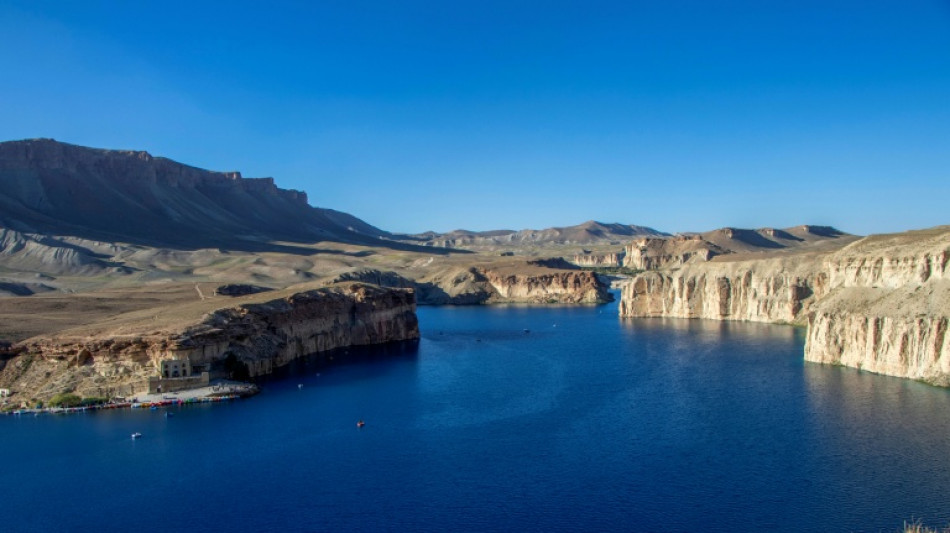
Drought, dams and diplomacy: Afghanistan's water crisis goes regional / Photo: © AFP

 Inflation slows in top eurozone economies as ECB ponders next move

 Starmer boosts budget to modernise UK military before exit

 Stocks mostly higher, yen stays near 40-year low against dollar

 Data centres emitting more CO2 than thought: study

 Over 1 million migrants apply for Spain's mass regularisation
 Germany questions footballing identity after fresh World Cup failure

 MEXC Lists Ondo's Tokenized Strategy Preferred Stock on Spot Market

 Stocks climb, yen stays near 40-year low against dollar

 Swim star Marchand limps out of French nationals as Europeans loom

 UN says transport infrastructure must adapt to climate

 Sommer, Acerbi, Darmian, De Vrij leave Inter Milan

 Germany's labour market dilemma: rising unemployment despite vacancies

 Skating allows Russian, Belarussians to return as neutrals

 Russian double Olympic figure skating champion Dmitriev dies aged 58

 S. Africa deploys police as anti-migrant protests loom

 Monaco parcel bomb blast wounds Ukrainian oligarch

 Sweden face France's attacking firepower at the World Cup

 Online same-sex romance series embrace AI 'freedom'

 New Oxford academic centre symbolises UK's big-donor era

 Trump says Iran meeting set in Qatar, despite uncertainty

 Morocco down Netherlands to reach World Cup last 16

 Asian stocks unable to track Wall St higher, yen holds at 40-year low

 'We came from nothing': DR Congo dreams of England World Cup upset

 Peruvian political heir Fujimori wins presidency
 What to expect as EU small parcel levy kicks in

Over four decades of war, Afghanistan wielded limited control over five major river basins that flow across its borders into downstream neighbouring nations.
But as Taliban authorities swept to power and tightened their grip on the country, they have pushed for Afghanistan's water sovereignty, launching infrastructure projects to harness precious resources in the arid territory.
Dams and canals have sparked tensions with neighbouring states, testing the Taliban authorities' efforts to build strong regional ties, as they remain largely isolated on the global stage since their 2021 takeover.
At the same time, the region is facing the shared impacts of climate change intensifying water scarcity, as temperatures rise and precipitation patterns shift, threatening glaciers and snowpack that feed the country's rivers.
Here are key points about Afghanistan's transboundary water challenges:
- Central Asian states to the north -
Afghanistan is emerging as a new player in often fraught negotiations on the use of the Amu Darya, one of two key rivers crucial for crops in water-stressed Central Asia, where water sharing relies on fragile accords since Soviet times.
Central Asian states have expressed concern over the Qosh Tepa mega canal project that could divert up to 21 percent of the Amu Darya's total flow to irrigate 560,000 hectares of land across Afghanistan's arid north, and further deplete the Aral Sea.
Uzbekistan and Turkmenistan are likely to face the biggest impact, both joined by Kazakhstan in voicing alarm, even as they deepen diplomatic ties with the Taliban authorities -- officially recognised so far by only Russia.
"No matter how friendly the tone is now," water governance expert Mohd Faizee warned, "at some point there will be consequences for Uzbekistan and Turkmenistan when the canal starts operating".
Taliban officials have denied that the project will have a major impact on the Amu Darya's water levels and pledged it will improve food security in a country heavily dependent on climate-vulnerable agriculture and facing one of the world's worst humanitarian crises.
"There is an abundance of water, especially when the Amu Darya floods and glacial meltwater flows into it" in the warmer months, said project manager Sayed Zabihullah Miri, during a visit to the canal works in Faryab province, where diggers carved into a drought-ridden plain dotted with camels and locusts.
- Iran to the west -
Iran is the only country with which Afghanistan has a formal water sharing treaty, agreed in 1973 over the Helmand river, which traverses Taliban heartland territory, but the accord was never fully implemented.
Longstanding tensions over the river's resources have spiked over dams in southern Afghanistan, particularly in periods of drought, which are likely to increase as climate shocks hit the region's water cycle.
Iran, facing pressure in its parched southeastern region, has repeatedly demanded that Afghanistan respect its rights, charging that upstream dams restrict the Helmand's flow into a border lake.
The Taliban authorities insist there is not enough water to release more to Iran, blaming the impact of climate pressures on the whole region.
They also argue long-term poor water management has meant Afghanistan has not gotten its full share, according to an Afghanistan Analysts Network report by water resources management expert Assem Mayar.
Iran and Afghanistan have no formal agreement over their other shared river basin, the Harirud, which also flows into Turkmenistan and is often combined into a single basin with the Morghab river.
While infrastructure exists on the Afghan portions of the basin, some has not been fully utilised, Faizee said.
But that could change, he added, as the end of conflict in Afghanistan means infrastructure works don't incur vast security costs on top of construction budgets, lifting a barrier to development of projects such as the Pashdan dam inaugurated in August on the Harirud.
- Pakistan to the east -
Water resources have not topped the agenda in consistently fraught relations between Afghanistan and Pakistan.
Afghanistan's Kabul river basin, which encompasses tributaries to the greater Indus basin and feeds the capital and largest city, is shared with Pakistan.
The countries, however, have no formal cooperation mechanism.
With the Afghan capital wracked by a severe water crisis, the Taliban authorities have sought to revitalise old projects and start new ones to tackle the problem, risking fresh tensions with Pakistan.
But the lack of funds and technical capacity means the Taliban authorities' large water infrastructure projects across the country could take many years to come to fruition -- time that could be good for diplomacy, but bad for ordinary Afghans.
E.Gasser--VB