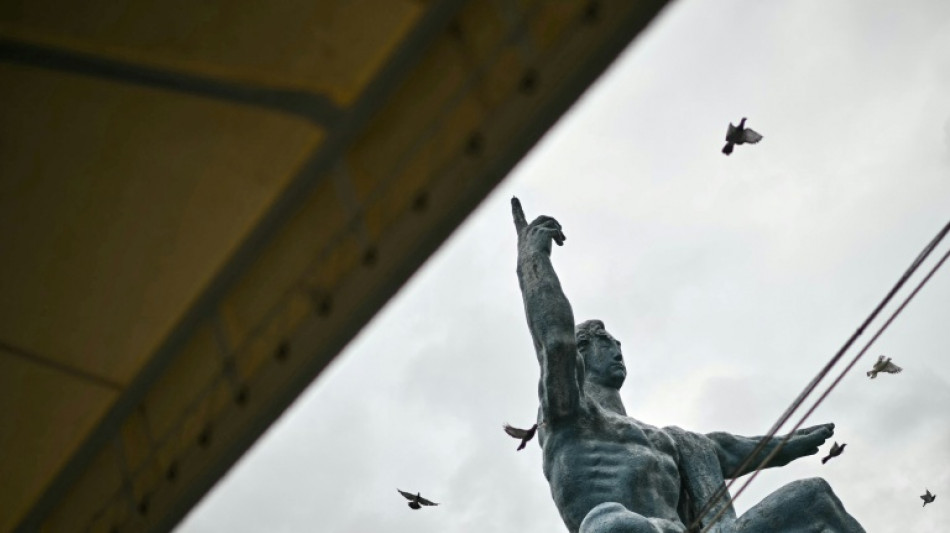
Restored Nagasaki bell rings in 80 years since A-bomb / Photo: © AFP

 South African voters report smoother local election but declining IEC trust

 Dolly Parton museum and Nashville hotel open after singer’s death

 George and Amal Clooney attend New York political-comedy reading

 British buyers pay substantial premiums for period-home appearance

 Thomas Markle released to house arrest after child-abuse-image charge

 Dawn of War 4 developers chose Adeptus Mechanicus for tactical variety

 Italy face unbeaten South Africa in Turin Nations Championship match

 ChatGPT interactive interface feature tested across six custom tools

 Freshways milk-price cut deepens pressure on UK dairy farms

 Labour and National remain virtually tied as New Zealand vote count advances

 The Good Daughter adapts Karin Slaughter thriller with Rose Byrne and Meghann Fahy

 Heavy-lift drone evacuates wounded Ukrainian soldier from frontline kill zone

 Morrison says West Brom recovered after pressure from successive derby losses

 Britain considers 2027 state visit for Ukraine’s Zelensky

 Arizona Democrats Secure Historic Trifecta with New Legislative Leadership

 Carney Welcomes U.S. Trade Reversal After Democratic Midterm Victory

 Armenian FM Discusses EU Accountability for Palestinian Rights in Madrid

 Trump and Vance Pursue Secret Diplomacy with Iran Amid Military Pressure

 Classic Car Values Surge: De Tomaso Vallelunga Leads 190% Gain

 Microsoft Ends Oracle AI Computing Rental Deal Amid Cloud Strategy Shift
Twin cathedral bells rang in unison Saturday in Japan's Nagasaki for the first time since the atomic bombing of the city 80 years ago, commemorating the moment the atrocity took place.
On August 9, 1945, at 11:02 am, three days after a nuclear attack on Hiroshima, the United States dropped an atomic bomb on Nagasaki.
After heavy downpours Saturday morning, the rain stopped shortly before a moment of silence and ceremony in which Nagasaki mayor Shiro Suzuki urged the world to "stop armed conflicts immediately".
"Eighty years have passed, and who could have imagined that the world would become like this?
"A crisis that could threaten the survival of humanity, such as a nuclear war, is looming over each and every one of us living on this planet."
About 74,000 people were killed in the southwestern port city, on top of the 140,000 killed in Hiroshima.
Days later, on August 15, 1945, Japan surrendered, marking the end of World War II.
Historians have debated whether the bombings ultimately saved lives by bringing an end to the conflict and averting a ground invasion.
But those calculations meant little to survivors, many of whom battled decades of physical and psychological trauma, as well as the stigma that often came with being a hibakusha.
Nagasaki resident Atsuko Higuchi told AFP it "made her happy" that everyone would remember the city's victims.
"Instead of thinking that these events belong to the past, we must remember that these are real events that took place," the 50-year-old said.
"In the end... when war breaks out, those who suffer the most are the little children or the mothers raising them."
On Saturday, the two bells of Nagasaki's Immaculate Conception Cathedral rang together for the first time since 1945.
The imposing red-brick cathedral, with its twin bell towers atop a hill, was rebuilt in 1959 after it was almost completely destroyed in the monstrous explosion just a few hundred meters away.
Only one of its two bells was recovered from the rubble, leaving the northern tower silent.
With funds from US churchgoers, a new bell was constructed and restored to the tower, and chimed Saturday at the exact moment the bomb was dropped.
- 'Working together for peace' -
The cathedral's chief priest, Kenichi Yamamura, said the bell's restoration "shows the greatness of humanity".
"It's not about forgetting the wounds of the past but recognising them and taking action to repair and rebuild, and in doing so, working together for peace," Yamamura told AFP.
He also sees the chimes as a message to the world, shaken by multiple conflicts and caught in a frantic new arms race.
"We should not respond to violence with violence, but rather demonstrate through our way of living, praying, how senseless it is to take another's life," he said.
Nearly 100 countries were set to participate in this year's commemorations, including Russia, which has not been invited since its 2022 invasion of Ukraine.
Israel, whose ambassador was not invited last year over the war in Gaza, was in attendance.
This year, "we wanted participants to come and witness directly the reality of the catastrophe that a nuclear weapon can cause", a Nagasaki official said last week.
- Martyrdom, torture -
An American university professor, whose grandfather participated in the Manhattan Project, which developed the first nuclear weapons, spearheaded the bell project.
During his research in Nagasaki, a Japanese Christian told him he would like to hear the two bells of the cathedral ring together in his lifetime.
Inspired by the idea, James Nolan, a sociology professor at Williams College in Massachusetts, embarked on a year-long series of lectures about the atomic bomb across the United States, primarily in churches.
He managed to raise $125,000 from American Catholics to fund the new bell.
When it was unveiled in Nagasaki in the spring, "the reactions were magnificent. There were people literally in tears", said Nolan.
Many American Catholics he met were also unaware of the painful history of Nagasaki's Christians, who, converted in the 16th century by the first European missionaries and then persecuted by Japanese shoguns, kept their faith alive clandestinely for over 250 years.
This story was told in the novel "Silence" by Shusaku Endo, and adapted into a film by Martin Scorsese in 2016.
He explains that American Catholics also showed "compassion and sadness" upon hearing about the perseverance of Nagasaki's Christians after the atomic bomb, which killed 8,500 of the parish's 12,000 faithful.
They were inspired by the "willingness to forgive and rebuild".
B.Baumann--VB
