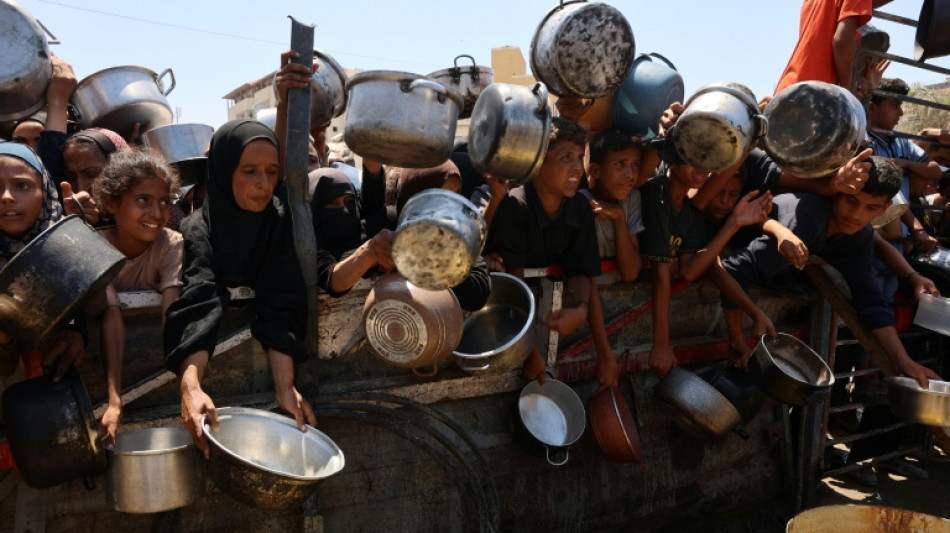
Chaos, gangs, gunfire: Gaza aid fails to reach most needy / Photo: © AFP

 Haaland hailed as 'greatest' after more World Cup heroics

 Koeman steps down as Netherlands coach after World Cup exit

 Nasdaq ends best quarter in 6 years as yen extends drop against dollar

 Zverev says Wimbledon hopes 'about me' despite open draw

 Lionel Scaloni: Argentina's mastermind marks 100 games in charge

 Mourinho's Real Madrid host Real Sociedad in La Liga opener

 Football brings joy to Venezuelan kids displaced by quakes

 Haaland fires Norway into last 16 as France, Mexico look to advance
 Merkel unveils official portrait for German chancellery

 Canada crews battle northern wildfire after crash kills 3

 Portugal's Silva bides his time after being benched at World Cup

 US stars relish soccer's primetime moment against Bosnia

 Lampard extends Coventry stay after promotion to Premier League

 Djokovic, Sinner aim to step up Wimbledon title chase

 Brook ready for "great honour" of succeeding Stokes as Test skipper

 Taps run dry in Hungarian village as heatwave bites

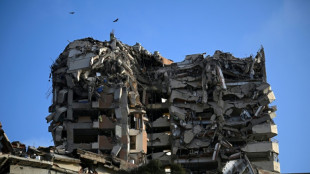 Venezuela quake survivors seek food, shelter amid risk of disease outbreaks

 LeBron James to leave Lakers, continue NBA career - media reports

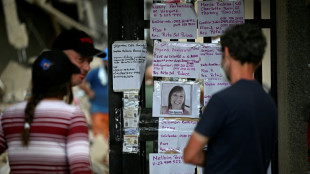 'Where is she?' The desperate search for Venezuela's missing

 No business as usual after shock World Cup exit, say German FA

 Pope appeals to Catholic traditionalists to avoid schism

 US Supreme Court upholds transgender sports bans

 US Supreme Court rejects Trump bid to restrict birthright citizenship

 Serena set for remarkable Wimbledon return, Swiatek survives scare

 Africa EV firm Spiro accused of torturing Uganda employees

The trickle of food aid Israel allows to enter Gaza after nearly 22 months of war is seized by Palestinians risking their lives under fire, looted by gangs or diverted in chaotic circumstances rather than reaching those most in need, UN agencies, aid groups and analysts say.
After images of malnourished children stoked an international outcry, aid has started to be delivered to the territory once more but on a scale deemed woefully insufficient by international organisations.
Every day, AFP correspondents on the ground see desperate crowds rushing towards food convoys or the sites of aid drops by Arab and European air forces.
On Thursday, in Al-Zawayda in central Gaza, emaciated Palestinians rushed to pallets parachuted from a plane, jostling and tearing packages from each other in a cloud of dust.
"Hunger has driven people to turn on each other. People are fighting each other with knives," Amir Zaqot, who came seeking aid, told AFP.
To avoid disturbances, World Food Programme (WFP) drivers have been instructed to stop before their intended destination and let people help themselves. But to no avail.
"A truck wheel almost crushed my head, and I was injured retrieving the bag," sighed a man, carrying a bag of flour on his head, in the Zikim area, in the northern Gaza Strip.
- 'Truly tragic' -
Mohammad Abu Taha went at dawn to a distribution site near Rafah in the south to join the queue and reserve his spot. He said there were already "thousands waiting, all hungry, for a bag of flour or a little rice and lentils."
"Suddenly, we heard gunshots….. There was no way to escape. People started running, pushing and shoving each other, children, women, the elderly," said the 42-year-old. "The scene was truly tragic: blood everywhere, wounded, dead."
Nearly 1,400 Palestinians have been killed in the Gaza Strip while waiting for aid since May 27, the majority by the Israeli army, the United Nations said on Friday.
The Israeli army denies any targeting, insisting it only fires "warning shots" when people approach too close to its positions.
International organisations have for months condemned the restrictions imposed by the Israeli authorities on aid distribution in Gaza, including refusing to issue border crossing permits, slow customs clearance, limited access points, and imposing dangerous routes.
On Tuesday, in Zikim, the Israeli army "changed loading plans for WFP, mixing cargo unexpectedly. The convoy was forced to leave early, without proper security," said a senior UN official who spoke on condition of anonymity.
In the south of Gaza, at the Kerem Shalom border crossing, "there are two possible routes to reach our warehouses (in central Gaza)," said an NGO official, who also preferred to remain anonymous. "One is fairly safe, the other is regularly the scene of fighting and looting, and that's the one we're forced to take."
- 'Darwinian experiment' -
Some of the aid is looted by gangs -- who often directly attack warehouses -- and diverted to traders who resell it at exorbitant prices, according to several humanitarian sources and experts.
"It becomes this sort of Darwinian social experiment of the survival of the fittest," said Muhammad Shehada, visiting fellow at the European Council on Foreign Relations (ECFR).
"People who are the most starved in the world and do not have the energy must run and chase after a truck and wait for hours and hours in the sun and try to muscle people and compete for a bag of flour," he said.
Jean Guy Vataux, emergency coordinator for Doctors Without Borders (MSF) in Gaza, added: "We're in an ultra-capitalist system, where traders and corrupt gangs send kids to risk life and limb at distribution points or during looting. It's become a new profession."
This food is then resold to "those who can still afford it" in the markets of Gaza City, where the price of a 25-kilogramme bag of flour can exceed $400, he added.
– 'Never found proof' -
Israel has repeatedly accused Hamas of looting aid supplied by the UN, which has been delivering the bulk of aid since the start of the war triggered by the militant group's October 2023 attack.
The Israeli authorities have used this accusation to justify the total blockade they imposed on Gaza between March and May, and the subsequent establishment of the Gaza Humanitarian Foundation (GHF), a private organisation supported by Israel and the United States which has become the main aid distributor, sidelining UN agencies.
However, for more than two million inhabitants of Gaza the GHF has just four distribution points, which the UN describes as a "death trap".
"Hamas... has been stealing aid from the Gaza population many times by shooting Palestinians," said the office of Prime Minister Benjamin Netanyahu on Monday.
But according to senior Israeli military officials quoted by the New York Times on July 26, Israel "never found proof" that the group had "systematically stolen aid" from the UN.
Weakened by the war with Israel which has seen most of its senior leadership killed, Hamas today is made up of "basically decentralised autonomous cells" said Shehada.
He said while Hamas militants still hunker down in each Gaza neighbourhood in tunnels or destroyed buildings, they are not visible on the ground "because Israel has been systematically going after them".
Aid workers told AFP that during the ceasefire that preceded the March blockade, the Gaza police -- which includes many Hamas members -- helped secure humanitarian convoys, but that the current power vacuum was fostering insecurity and looting.
"UN agencies and humanitarian organisations have repeatedly called on Israeli authorities to facilitate and protect aid convoys and storage sites in our warehouses across the Gaza Strip," said Bushra Khalidi, policy lead at Oxfam.
"These calls have largely been ignored," she added.
- 'All kinds of criminal activities' -
The Israeli army is also accused of having equipped Palestinian criminal networks in its fight against Hamas and of allowing them to plunder aid.
"The real theft of aid since the beginning of the war has been carried out by criminal gangs, under the watch of Israeli forces, and they were allowed to operate in proximity to the Kerem Shalom crossing point into Gaza," Jonathan Whittall, Palestinian territories chief of the UN humanitarian office (OCHA), told reporters in May.
According to Israeli and Palestinian media reports, an armed group called the Popular Forces, made up of members of a Bedouin tribe led by Yasser Abu Shabab, is operating in the southern region under Israeli control.
The ECFR describes Abu Shabab as leading a "criminal gang operating in the Rafah area that is widely accused of looting aid trucks".
The Israeli authorities themselves acknowledged in June that they had armed Palestinian gangs opposed to Hamas, without directly naming the one led by Abu Shabab.
Michael Milshtein, head of the Palestinian Studies Forum at the Moshe Dayan Center of Tel Aviv University, said many of the gang's members were implicated in "all kinds of criminal activities, drug smuggling, and things like that".
"None of this can happen in Gaza without the approval, at least tacit, of the Israeli army," said a humanitarian worker in Gaza, asking not to be named.
S.Leonhard--VB