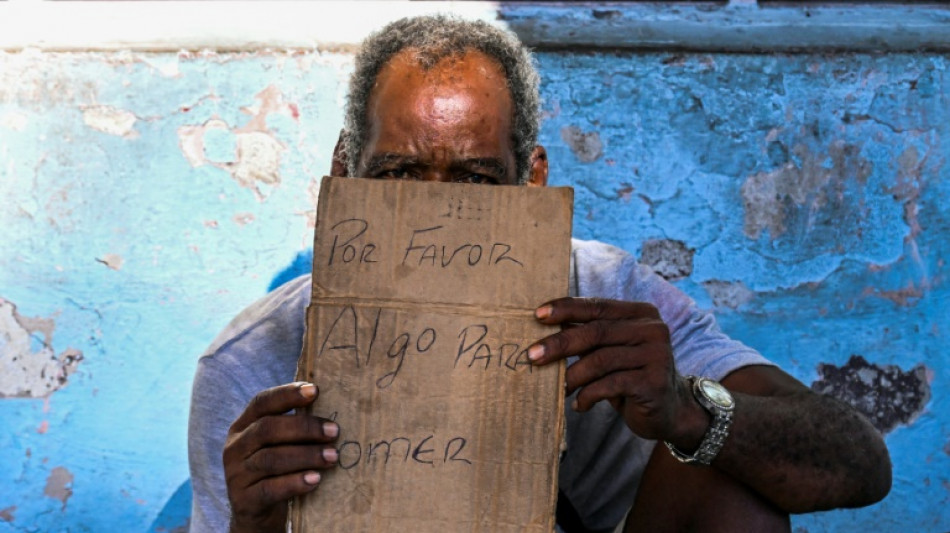
'Please, something to eat': Cubans forced to beg in economic crisis / Photo: © AFP

 The secret lives of Ukraine's deep-strike drone team
 NATO project tests perennial grass to clean Ukraine's war-hit soil
 Duffy returns for New Zealand against West Indies

 Mbappe dazzles as France march on at World Cup; Norway, Mexico advance

 US govt lifts restrictions on powerful AI models, Anthropic says
 Trump earned over $1 bn from crypto ventures in 2025

 The Afghan women farmers keeping their village alive
 Asian stocks fluctuate as traders eye crucial US jobs data
 Madison Square Garden: from Nazis to Knicks, and now... Taylor's wedding?
 'Love it': Wimbledon's military stewards tradition turns 80

 Venezuela quake survivors cherish kindness of strangers
 US deports first migrant to Pacific nation Palau

 Potter admits Sweden couldn't live with France in World Cup defeat

 US coach dismisses European jinx ahead of Bosnia clash

 World Bank to phase out lending to China by 2031

 Mbappe scores twice as France breeze past Sweden into World Cup last 16

 No corn dogs? Trump's 'Great American State Fair' threatens to be a flop

 Haaland hailed as 'greatest' after more World Cup heroics

 Koeman steps down as Netherlands coach after World Cup exit

 Nasdaq ends best quarter in 6 years as yen extends drop against dollar

 Zverev says Wimbledon hopes 'about me' despite open draw

 Lionel Scaloni: Argentina's mastermind marks 100 games in charge
 Mourinho's Real Madrid host Real Sociedad in La Liga opener
 Football brings joy to Venezuelan kids displaced by quakes

 Haaland fires Norway into last 16 as France, Mexico look to advance
William Abel peers inside a plastic bag he dug out of a trash can in Havana while scrounging for his next meal. It contains rice, vegetables, a meatless chicken bone and flies competing for the spoils.
The 62-year-old has been sleeping on the streets since his house outside the capital collapsed two years ago -- a frequent occurrence due to the dilapidation of many buildings, echoing an economy in ruins.
"Food is the hardest part. I've been rummaging through trash cans for two years to eat," he tells AFP, his speech hindered by many missing teeth.
Under a grimy T-shirt, Abel's body is skeletal. He says he suffers from arthritis, hypertension, and a liver problem for which he has no medicine.
He admits he used to drink "quite a lot... You know, we're going through a tough time."
Abel is one of a visibly growing number of beggars and homeless people in a country confronting its worst economic crisis in three decades.
Earlier this month, Labor and Social Security Minister Marta Elena Feito resigned after causing an outcry with her statement that "there are no beggars" in the communist state crippled by decades of US sanctions.
Analysts also point to structural weaknesses in Cuba's centralized economy and the Covid-19 pandemic's blow to the tourism industry.
Long a champion of egalitarian socialism but critically short on foreign currency, the Cuban state has not had enough money these last four years to keep up with spending on social programs such as free healthcare and subsidized food.
At the same time, food prices have skyrocketed nearly 500 percent, throwing Cubans into precarity.
There are no official numbers on poverty in Cuba, where the word "poor" is not used in official communications, but rather terms such as "vulnerable people."
Government data shows that 189,000 families and 350,000 individuals benefit from social aid programs on the island of 9.7 million inhabitants.
- 'A real problem' -
Juan De La Cruz, 63, told AFP he had been a beggar for two weeks.
He sat on the street in a busy neighborhood of central Havana with a piece of cardboard on which he had scribbled: "Please, something to eat."
"What Social Security gives me is not enough," said De La Cruz, who lost a leg to diabetes four years ago and receives an amount equivalent to less than $3 a month at the informal exchange rate.
It is not enough to buy a kilo of chicken, he said, and the soup kitchen is little comfort. "The food is bad, rice without butter, without oil."
At least he has a place to sleep, said the retired stretcher bearer, "a very small room," but "empty, empty, empty."
President Miguel Diaz-Canel was forced to enter the fray over his minister's remarks, lambasting her "lack of sensitivity" and telling parliament that beggars are "concrete expressions of social inequalities" in Cuba.
Prime Minister Manuel Marrero also acknowledged the country was facing "a real problem."
In the absence of official data, experts have to rely on estimates.
Sociologist Mayra Espina Prieto recently calculated that "between 40 and 45 percent" of Cubans live "in poverty."
And UNICEF, the UN's children's agency, said last year that nearly one in ten Cuban children lived in "severe child food poverty," which means they survive one or two food groups a day, sometimes less.
- 'A small room' -
Arnaldo Victores sleeps in a motorcycle garage, on plastic bags, in a peripheral neighborhood of Havana.
As he has no fixed address, the 65-year-old former physiotherapist cannot access social benefits in spite of his visual impairment.
Every day, he travels to the city center and begs on a busy street.
His dream? Just "a small room with a bathroom," Victores told AFP.
Across the street from where he is forced to beseech strangers for alms there stands a brand-new state-owned hotel with 42 floors -- the tallest in the capital and a symbol of unforgivable waste for many Cubans struggling to make ends meet.
C.Bruderer--VB