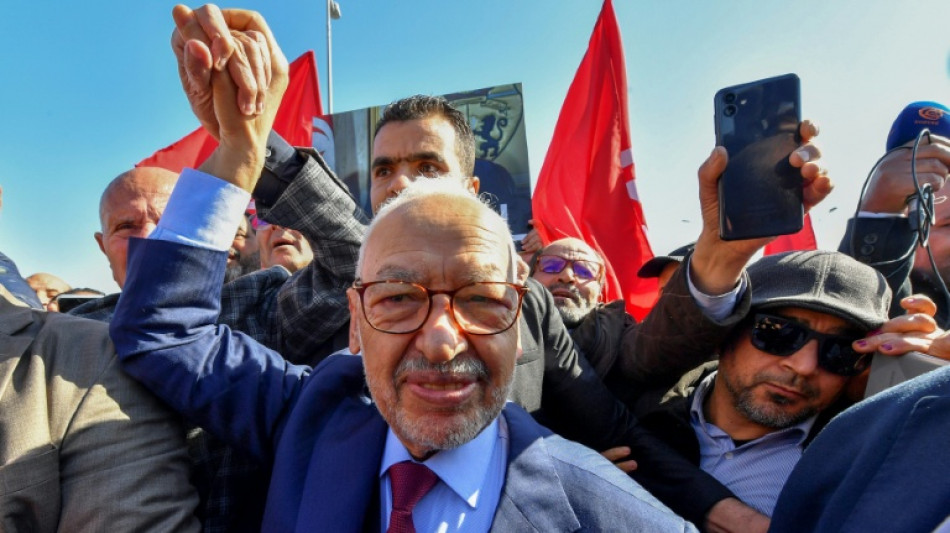
Once a leading force, battered Tunisian party awaits elusive comeback / Photo: © AFP/File

 South African voters report smoother local election but declining IEC trust

 Dolly Parton museum and Nashville hotel open after singer’s death

 George and Amal Clooney attend New York political-comedy reading

 British buyers pay substantial premiums for period-home appearance

 Thomas Markle released to house arrest after child-abuse-image charge

 Dawn of War 4 developers chose Adeptus Mechanicus for tactical variety

 Italy face unbeaten South Africa in Turin Nations Championship match

 ChatGPT interactive interface feature tested across six custom tools

 Freshways milk-price cut deepens pressure on UK dairy farms

 Labour and National remain virtually tied as New Zealand vote count advances

 The Good Daughter adapts Karin Slaughter thriller with Rose Byrne and Meghann Fahy

 Heavy-lift drone evacuates wounded Ukrainian soldier from frontline kill zone

 Morrison says West Brom recovered after pressure from successive derby losses

 Britain considers 2027 state visit for Ukraine’s Zelensky

 Arizona Democrats Secure Historic Trifecta with New Legislative Leadership

 Carney Welcomes U.S. Trade Reversal After Democratic Midterm Victory

 Armenian FM Discusses EU Accountability for Palestinian Rights in Madrid

 Trump and Vance Pursue Secret Diplomacy with Iran Amid Military Pressure

 Classic Car Values Surge: De Tomaso Vallelunga Leads 190% Gain
 Microsoft Ends Oracle AI Computing Rental Deal Amid Cloud Strategy Shift
The party that once dominated Tunisian politics has faded away since President Kais Saied staged a dramatic power grab, with its offices shuttered and leaders behind bars or in exile.
But observers say that Ennahdha, the Islamist-inspired movement still considered by some Tunisians as the country's main opposition party, could still bounce back after a devastating government crackdown.
On July 25, 2021, Saied stunned the country when he suspended parliament and dissolved the government, a move critics denounced as a "coup" a decade after the Arab Spring revolt ushered in a democratic transition in the North African country.
Many of Saied's critics have been prosecuted and jailed, including Ennahdha leader Rached Ghannouchi, 84, a former parliament speaker who was sentenced earlier this month to 14 years in prison for plotting against the state.
Ghannouchi, who was arrested in 2023, has racked up several prison terms, including a 22-year sentence handed in February on the same charge.
The crackdown over the past four years has seen around 150 Ennahdha figures imprisoned, prosecuted or living in exile, according to a party official.
"Some believe the movement is dead, but that is not the case," said political scientist Slaheddine Jourchi.
Ennahdha has been "weakened to the point of clinical death" but remained the most prominent party in Tunisia's "fragmented and fragile" opposition, Jourchi added.
- 'Once we're free again' -
Riadh Chaibi, a party official and adviser to Ghannouchi, said that even after "shrinking" its political platform, Ennahdah was still a relevant opposition outlet.
"Despite repression, prosecutions and imprisonment" since 2021, "Ennahdha remains the country's largest political movement," Chaibi said.
He said the current government has been "weaponising state institutions to eliminate political opponents", but "once we're free again, like we were in 2011, Ennahdha will regain its strength".
Since 2011, when Ghannouchi returned from exile to lead the party, Ennahdha for years had a key role in Tunisian politics, holding the premiership and other senior roles.
But by 2019, the year Saied was elected president, the party's popularity had already begun waning, winning only a third of the 1.5 million votes it had in 2011.
Experts ascribed this trend to the party's failure to improve living standards and address pressing socio-economic issues.
Ennahdha has also been accused of jihadist links, which it has repeatedly denied.
Saied, who religiously avoids mentioning either Ennahdha or Ghannouchi by name, has often referred to the party's years in power as "the black decade" and accused it of committing "crimes against the country".
Crowds of Tunisians, increasingly disillusioned as a political deadlock trumped Ennahdha's promise of change, poured into the streets in celebration when Saied forced the party out of the halls of power in 2021.
Analyst Jourchi said Ennahdha's rise to power was a "poorly prepared adventure", and the party had "made many mistakes along the way".
Left-wing politician Mongi Rahoui said it was "only natural that Ennahdha leaders and their governing partners be prosecuted for crimes they used their political position to commit".
Today, the party's activities have been reduced mostly to issuing statements online, often reacting to prison sentences handed down to critics of Saied.
- 'Silence everything' -
But Ennahdha has weathered repression before, harshly suppressed under Tunisia's autocratic presidents Habib Bourguiba and Zine El Abidine Ben Ali.
Party leaders were jailed or forced into exile, and Ghannouchi was sentenced to life in prison under Bourguiba but then freed -- and later exiled -- under Ben Ali.
Tunisian historian Abdellatif Hannachi said that the party "seems to be bending with the wind, waiting for changes that would allow it to return".
It has been in "clear decline", he added, but "that does not mean it's disappearing."
Ennahdha's downfall was not an isolated case. Other opposition forces have also been crushed, and dozens of political, media and business figures are currently behind bars.
"This regime no longer distinguishes between Islamist and secular, progressive and conservative," rights advocate Kamel Jendoubi, a former minister, recently said in a Facebook post.
Saied's government "wants to silence everything that thinks, that criticises, or resists", Jendoubi argued.
The opposition, however, remains fractured, failing for example to come together in rallies planned for the anniversary this month of Saied's power grab.
K.Sutter--VB

