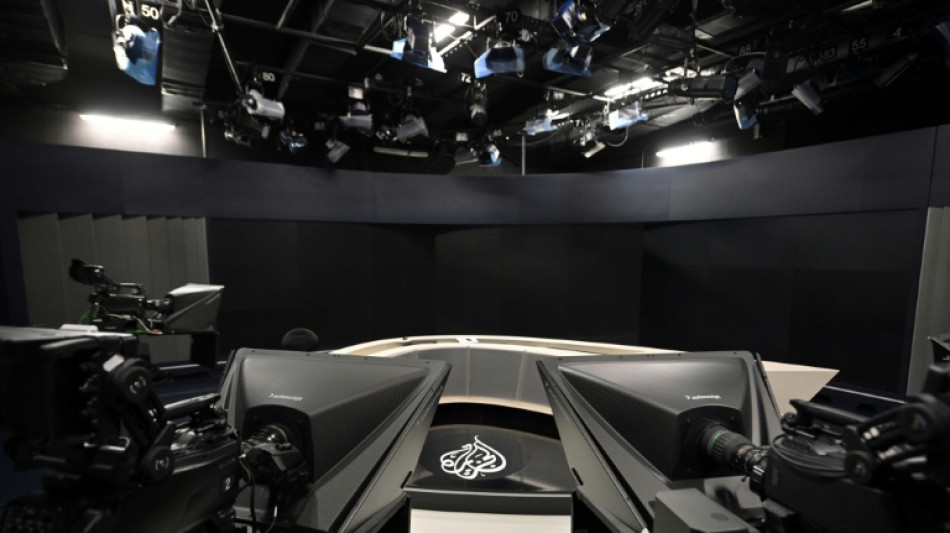
Shock media closure deals new blow to press freedom in Balkans / Photo: © AFP

 South African voters report smoother local election but declining IEC trust

 Dolly Parton museum and Nashville hotel open after singer’s death

 George and Amal Clooney attend New York political-comedy reading

 British buyers pay substantial premiums for period-home appearance

 Thomas Markle released to house arrest after child-abuse-image charge

 Dawn of War 4 developers chose Adeptus Mechanicus for tactical variety

 Italy face unbeaten South Africa in Turin Nations Championship match

 ChatGPT interactive interface feature tested across six custom tools

 Freshways milk-price cut deepens pressure on UK dairy farms

 Labour and National remain virtually tied as New Zealand vote count advances

 The Good Daughter adapts Karin Slaughter thriller with Rose Byrne and Meghann Fahy

 Heavy-lift drone evacuates wounded Ukrainian soldier from frontline kill zone

 Morrison says West Brom recovered after pressure from successive derby losses

 Britain considers 2027 state visit for Ukraine’s Zelensky

 Arizona Democrats Secure Historic Trifecta with New Legislative Leadership

 Carney Welcomes U.S. Trade Reversal After Democratic Midterm Victory

 Armenian FM Discusses EU Accountability for Palestinian Rights in Madrid

 Trump and Vance Pursue Secret Diplomacy with Iran Amid Military Pressure

 Classic Car Values Surge: De Tomaso Vallelunga Leads 190% Gain

 Microsoft Ends Oracle AI Computing Rental Deal Amid Cloud Strategy Shift
Nearly 14 years after presenting the first newscast of Al Jazeera Balkans, Sasa Delic, like his 250 colleagues, learned of the channel's closure in a shock announcement.
The Bosnian journalist inaugurated the new network on November 11, 2011, telling viewers: "You are watching the first news channel in the region," and promising them "accurate, verified and impartial" information.
But on July 10, management suddenly announced the Qatari-based channel's regional branch was closing, the latest in a wave of closures and downsizing to hit the Balkans' strained media industry.
"I had no idea," Delic, 47, told AFP.
"It was sudden, but you have to adapt. It's the owner's decision."
Two days later, his colleague Dalija Hasanbegovic gave the channel's farewell sign-off: "That was the final Al Jazeera Balkans newscast.
"We always tried to be the voice of those who didn't have one, an island of truth."
- 'Silencing the last voices' -
Claiming more than 22 million viewers, "AJB" broadcast across most of the Balkans, with studios in Belgrade, Sarajevo and Zagreb.
"We never adhered to anyone's political agenda," said Delic, who added he fears the closure will hurt strained media freedoms in the region.
"A beacon of free journalism in the Balkans goes dark," said philosopher and journalist Dragan Bursac in his final column published on the Al Jazeera Balkans website.
Al Jazeera Balkans' executive director and one of its founders, Edhem Foco, told AFP the closure was a consequence of a "strategy shift" at the parent channel, which is investing in developing its online platform Al Jazeera 360.
The loss will be felt mostly at the broadcaster's Sarajevo hub, where nearly 200 employees worked, according to Foco.
"It is a warning: independent journalism in the region is increasingly under threat," said the SafeJournalists Network (SJN), a coalition of journalist associations and unions in the Balkans.
For Maja Sever, director of the European Federation of Journalists, "we are witnessing the silencing of the last voices that embodied professional and quality journalism".
The network's shuttering comes after the United States cut funding to a slew of foreign-based media outlets, part of President Donald Trump's budget cuts -- including to news outlets he deems hostile to his agenda.
Voice of America's Serbian office closed in March after 82 years, and the future of the regional newsrooms of Radio Free Europe remains unclear.
Many other independent outlets that relied on US government funding have also closed or are struggling around the world.
"The damage is very significant, profound," Sever said.
- Independent media disappearing -
Balkan countries rate poorly in the 2025 World Press Freedom Index, created by watchdog group Reporters Without Borders.
Out of 180 countries, Bosnia ranks 86th and Serbia 96th.
The report also noted that Serbian media "bear the brunt of attempts by the authorities to quell" large-scale anti-government protests that have rocked the country for months.
At least 28 media professionals had been assaulted by police or supporters of President Aleksandar Vucic since February, it said.
Independent media in the Balkans are increasingly rare, and some, like the N1 channel, are not distributed by public or government-affiliated cable operators.
As these outlets shrink, many journalists will leave the profession, Sever warned.
"Those who ask questions are leaving, those who think independently are leaving. Who, then, will ask a question to a prime minister or a president at a press conference? Algorithms? Artificial intelligence?" she said.
C.Koch--VB

