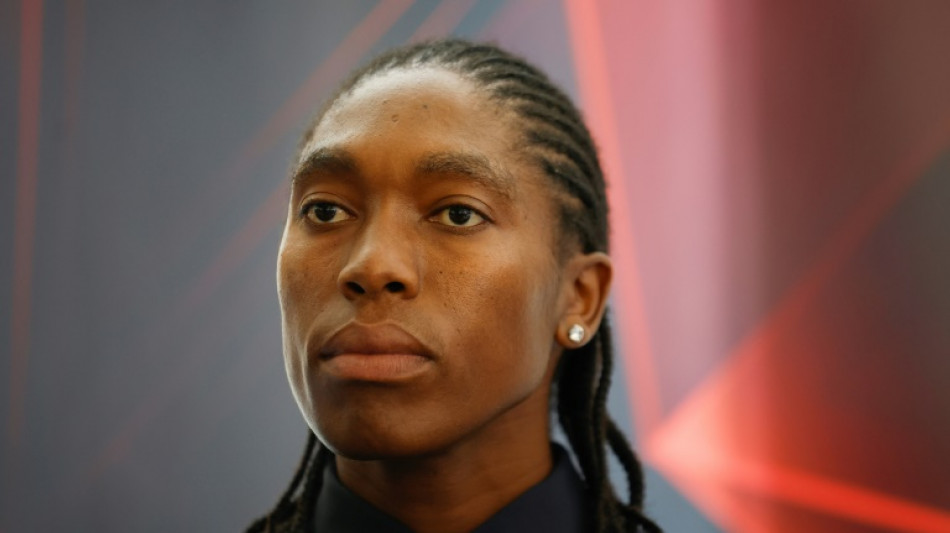
Europe court says S.African Semenya's gender eligibility trial wasn't fair / Photo: © AFP/File

 South African election results renew debate over identity-based voting

 South African voters report smoother local election but declining IEC trust

 Dolly Parton museum and Nashville hotel open after singer’s death

 George and Amal Clooney attend New York political-comedy reading

 British buyers pay substantial premiums for period-home appearance

 Thomas Markle released to house arrest after child-abuse-image charge

 Dawn of War 4 developers chose Adeptus Mechanicus for tactical variety

 Italy face unbeaten South Africa in Turin Nations Championship match

 ChatGPT interactive interface feature tested across six custom tools

 Freshways milk-price cut deepens pressure on UK dairy farms

 Labour and National remain virtually tied as New Zealand vote count advances

 The Good Daughter adapts Karin Slaughter thriller with Rose Byrne and Meghann Fahy

 Heavy-lift drone evacuates wounded Ukrainian soldier from frontline kill zone

 Morrison says West Brom recovered after pressure from successive derby losses

 Britain considers 2027 state visit for Ukraine’s Zelensky

 Arizona Democrats Secure Historic Trifecta with New Legislative Leadership

 Carney Welcomes U.S. Trade Reversal After Democratic Midterm Victory

 Armenian FM Discusses EU Accountability for Palestinian Rights in Madrid

 Trump and Vance Pursue Secret Diplomacy with Iran Amid Military Pressure

A top European court ruled Thursday that the Swiss judiciary did not give double Olympic champion Caster Semenya a fair trial when she contested a rule forcing her to lower her testosterone levels to be able to compete as a woman.
However, the European Court of Human Rights (ECHR) said it could not determine whether or not the South African runner had suffered discrimination.
The verdict came after a row over the gender of an Algerian boxing champion engulfed the 2024 Paris Olympics, and as the International Olympic Committee mulls reintroducing contested gender testing.
Semenya, 34, is classed as having "differences in sexual development", but has always been legally identified as female.
She has been unable to compete in her favoured 800m since 2018, after she refused to take drugs to reduce testosterone levels under rules from World Athletics, the track and field governing body.
Semenya told journalists the ECHR decision was a "positive outcome".
"We need to respect athletes, we need to put their rights first," said the athlete, who was Olympic 800m champion in 2012 and 2016 and world champion in 2009, 2011 and 2017.
It was a reminder to leaders that "priorities lie in the protection of athletes," she added.
Semenya has pursued a legal marathon to contest the World Athletics rule.
The Lausanne-based Court of Arbitration for Sport ruled against her in 2019 and the decision was validated by the Swiss Federal Court in Lausanne in 2020.
It judged that a testosterone level comparable to that of men gave female athletes "an insurmountable advantage".
The ECHR said the Swiss court did not give the case a "rigorous judicial review that was commensurate with the seriousness of the personal rights at issue", and had therefore breached Semenya's right to a fair trial under the European Convention on Human Rights.
It ordered Switzerland to pay her 80,000 euros ($93,000) for expenses.
South Africa's sport minister Gayton McKenzie said "Semenya has become the face of defiance against injustice in global sport, and this victory in court is a victory for every African child."
He vowed to continue supporting Semenya in the "fight for your bodily rights".
- 'Not far enough' -
An ECHR lower chamber in 2023 ruled that Semenya was the victim of discrimination by the Court of Arbitration for Sport -- though it did not tackle the World Athletics rule, nor allow Semenya to return to competition without taking medication.
Swiss authorities, supported by World Athletics, appealed to the European court's 17-member Grand Chamber, leading to Thursday's final ruling.
The Grand Chamber, however, said it could not rule on any discrimination as the alleged offence did not fall under Switzerland's jurisdiction.
Seema Patel, a sports law expert, said "the Grand Chamber didn't go far enough to recognise all violations in this case".
"But there is at least an alert to sport that convention rights must be respected," she said.
Antoine Duval, another legal scholar, said the ECHR had implied the World Athletics rule was disproportionate.
Its judgement "encourages intersex athletes affected by these rules to go before the Court of Arbitration for Sport and relaunch the debate," he said.
There are many types of "differences in sexual development", a group of rare conditions involving genes, hormones and reproductive organs.
Formerly known as intersexuality, they occur in approximately one in 1,000 to 4,500 births.
Semenya was born with the "46 XY" chromosome, rather than the XX chromosome most women have.
Before the 2009 world championships, where Semenya won the 800m aged 18, she was forced to undergo gender testing. She was then put on medication to reduce testosterone levels.
Semenya said she felt like a "human guinea pig" and vowed to reject future treatment.
Testosterone is produced by men and women but men produce 20 times more of the sex hormone.
But how much the hormone boosts performance remains a matter of debate.
- 'Degrading' -
The International Olympic Committee is weighing reintroducing gender testing.
World Athletics and World Boxing have already adopted chromosomal testing -- generally a cheek swab to check for the Y chromosome. World Aquatics in 2023 adopted a policy that foresees such testing.
Supporters say screening simplifies access to women's competition, and UN rapporteur Reem Alsalem has said such tests are "reliable and non-invasive".
But Madeleine Pape, a sociologist of gender in sport, says there is a lack of research proving DSD athletes gain a "disproportionate advantage" over XX competitors.
Human Rights Watch has called the World Athletics rule "degrading and invasive".
The gender debate reignited in June around Paris Olympic boxing champion Imane Khelif.
US President Donald Trump and Harry Potter author J.K. Rowling were among figures who stoked a row over the Algerian's gender.
burs-pau-ah/tw
A.Zbinden--VB