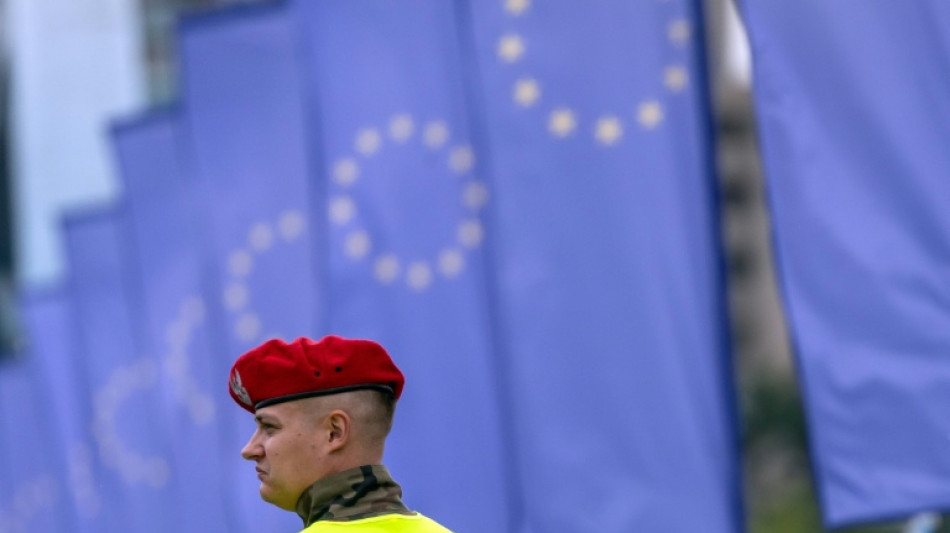
Poland starts border checks with Germany in anti-migrant clampdown / Photo: © AFP

 South African election results renew debate over identity-based voting

 South African voters report smoother local election but declining IEC trust

 Dolly Parton museum and Nashville hotel open after singer’s death

 George and Amal Clooney attend New York political-comedy reading

 British buyers pay substantial premiums for period-home appearance

 Thomas Markle released to house arrest after child-abuse-image charge

 Dawn of War 4 developers chose Adeptus Mechanicus for tactical variety

 Italy face unbeaten South Africa in Turin Nations Championship match

 ChatGPT interactive interface feature tested across six custom tools

 Freshways milk-price cut deepens pressure on UK dairy farms

 Labour and National remain virtually tied as New Zealand vote count advances

 The Good Daughter adapts Karin Slaughter thriller with Rose Byrne and Meghann Fahy

 Heavy-lift drone evacuates wounded Ukrainian soldier from frontline kill zone

 Morrison says West Brom recovered after pressure from successive derby losses

 Britain considers 2027 state visit for Ukraine’s Zelensky

 Arizona Democrats Secure Historic Trifecta with New Legislative Leadership

 Carney Welcomes U.S. Trade Reversal After Democratic Midterm Victory

 Armenian FM Discusses EU Accountability for Palestinian Rights in Madrid
Poland reimposed checks on its borders with EU neighbours Germany and Lithuania on Monday in a bid to crack down on irregular migration amid surging anti-immigrant sentiment creating political pressure in Berlin and Warsaw.
Border guards and military police could be seen looking into passing cars and occasionally stopping vehicles for document checks on the bridge connecting the Polish town of Slubice with Frankfurt an der Oder in Germany.
The new checks are a response to growing anti-migrant sentiment on both sides of the border.
Poland says hundreds of migrants, mostly from the Middle East, cross into the Baltic states from Belarus every month, then travel through Poland into Germany.
The issue has become a particularly sensitive one in Polish domestic politics and has led to tensions with Germany.
Warsaw has accused Berlin of sending the irregular migrants it manages to intercept back into Poland.
"The checks being implemented aim to combat illegal migration," Interior Minister Tomasz Siemoniak was quoted as saying by his ministry on X.
Shortly after the new checks came into force on Monday, Polish border guards detained a man for assisting irregular migration.
The Estonian national is accused of transporting four irregular migrants, believed to be from Afghanistan.
Siemoniak said the detention was "proof that these checks are necessary".
- 'Ping-pong game' -
Germany, which introduced checks on the border with Poland in 2023, has welcomed the Polish initiative and called for collaboration against a common problem.
Speaking to the daily Rheinische Post, the head of German police union GdP, Andreas Rosskopf, said the two countries needed a "workable procedure".
He warned against Polish and German border guards engaging in a "ping-pong game" with asylum seekers by sending them back and forth.
Representatives of German business associations have also voiced concern.
"We are receiving worrying feedback from the business community," Helena Melnikov, chief executive of the German Chamber of Industry and Commerce (DIHK), told the Handelsblatt newspaper.
"If commuters can no longer get to work reliably and on time at the German-Polish border, there is an increased risk that they will look for work elsewhere on a permanent basis –- with consequences for the shortage of skilled workers in border regions," she said.
Marek Klodnicki, an administrative employee who lives in Slubice but works in Germany, said the re-introduction of border controls was "very sad".
"We have waited so long for open borders," he said, adding that the checks would result in "a disruption in social and economic life".
Business owners, particularly hairdressers and tobacco shops, which get a lot of custom from Germans crossing the border, also voiced concern the checks could disrupt business.
"Ninety percent of our customers are Germans. We may have less traffic, less revenue," Kinga Dziuba, a 29-year-old cigarette vendor, told AFP.
But Dziuba said the checks were "very much needed" to control migration, adding: "Security is more important to me than trade".
The issue of migration was central to June's presidential election in Poland, where nationalist Karol Nawrocki -- who ran on a slogan of "Poland first, Poles first" -- narrowly defeated the candidate backed by pro-European Union Prime Minister Donald Tusk.
The Tusk government is now seeking to outflank its rivals by taking a tougher approach to immigration.
- Checks 'unnecessary' -
In total, 52 checkpoints have been set up on the border with Germany and 13 with Lithuania, Siemoniak said.
The controls will last from July 7 to August 5 but could be extended.
They will mostly consist of spot inspections, particularly of vehicles carrying several people, officials said.
In June, members of a far-right movement gathered at several points along the border to set up "citizens' patrols", which the government insists are illegal.
In Slubice, Edyta Taryma, a 54-year-old hair salon owner, said her revenues had already dropped by 20 percent after Germany re-imposed border controls.
"A great many people did not come, or came less often, because they were afraid of traffic jams," she said.
She called the checks "unnecessary".
H.Weber--VB