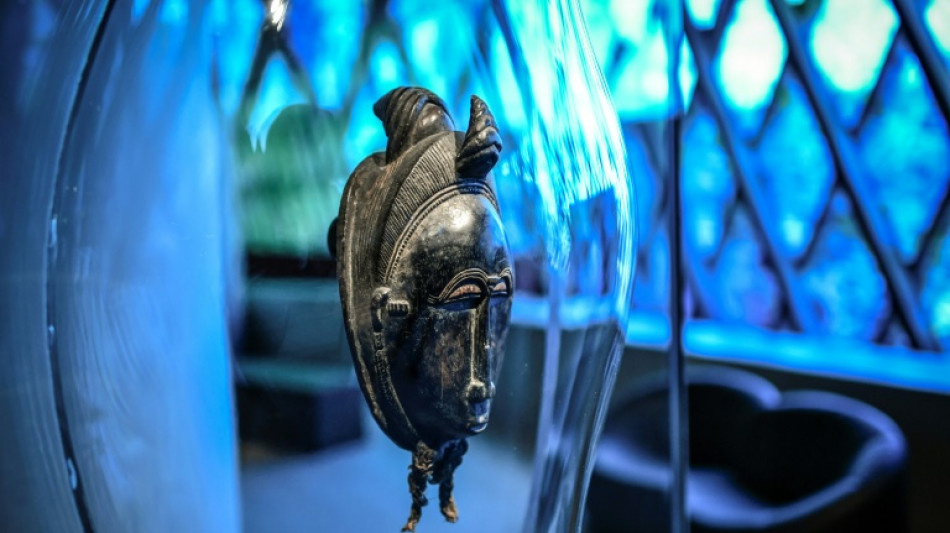
France backs returning colonial-era 'talking drum' to I.Coast / Photo: © AFP

 South African election results renew debate over identity-based voting

 South African voters report smoother local election but declining IEC trust

 Dolly Parton museum and Nashville hotel open after singer’s death

 George and Amal Clooney attend New York political-comedy reading

 British buyers pay substantial premiums for period-home appearance

 Thomas Markle released to house arrest after child-abuse-image charge

 Dawn of War 4 developers chose Adeptus Mechanicus for tactical variety

 Italy face unbeaten South Africa in Turin Nations Championship match

 ChatGPT interactive interface feature tested across six custom tools

 Freshways milk-price cut deepens pressure on UK dairy farms

 Labour and National remain virtually tied as New Zealand vote count advances

 The Good Daughter adapts Karin Slaughter thriller with Rose Byrne and Meghann Fahy

 Heavy-lift drone evacuates wounded Ukrainian soldier from frontline kill zone

 Morrison says West Brom recovered after pressure from successive derby losses

 Britain considers 2027 state visit for Ukraine’s Zelensky

 Arizona Democrats Secure Historic Trifecta with New Legislative Leadership

 Carney Welcomes U.S. Trade Reversal After Democratic Midterm Victory

 Armenian FM Discusses EU Accountability for Palestinian Rights in Madrid
France's parliament on Monday approved returning to Ivory Coast a "talking drum" that colonial troops took from the Ebrie tribe in 1916, in the latest boost to the repatriation of colonial spoils.
The Djidji Ayokwe drum is a communication tool more than three metres (10 feet) long and weighing 430 kilogrammes (almost 950 pounds) that was once used to transmit messages between different areas, for example to warn others of a forced recruitment drive.
France's lower house of parliament approved removing the artefact from the national museum collections to enable its return, after the upper-house Senate backed the move in April.
The talking drum had been in the care of the Quai Branly-Jacques Chirac Museum in Paris.
In late 2018, Ivory Coast asked Paris to return the Djidji Ayokwe among 148 works of art taken during the colonial period.
President Emmanuel Macron promised in 2021 to send the drum and other artefacts back home to the west African country.
"Local communities have been requesting it since independence" in 1960, said Serge Alain Nhiang'O, the founder of the Ivoire Black History Month association in Abidjan.
The drum's return "could become very symbolic", he said.
Clavaire Aguego Mobio, leader of the Ebrie, in 2021 called Macron's pledge "a highly historic move" as his people had long given up on the return of the drum, "which was our loudspeaker, our Facebook".
- Slow repatriations -
Since his election in 2017, Macron has gone further than his predecessors in admitting to past French abuses in Africa.
The restitution of looted artworks to Africa is one of the highlights of the "new relationship" he wanted to establish with the continent.
France still has in its possession tens of thousands of artworks and other prized artefacts that it looted from its colonial empire from the 16th to the first half of the 20th century.
According to a 2018 report, some 90,000 objects from sub-Saharan Africa are in French public museums.
But restitutions of such cultural objects have been slow without overarching legislation to help.
In late 2020, parliament adopted an exceptional law to permanently return 26 artefacts from the royal treasures of Abomey to Benin, as well as a sabre to Senegal.
In 2023, France adopted two so-called framework laws to return objects in two categories: one for goods looted from Jewish families during World War II, and another for the repatriation of human remains from public collections.
- New bill? -
The State Council, which acts as legal adviser to the government, last year rejected a similar blanket bill to permit the return of all colonial spoils.
According to Le Monde newspaper, which obtained a copy of its opinion, it did not deem "cultural cooperation" with former colonies to be sufficient justification.
It said that it was not enough of a "higher general interest" to justify breaking out the objects from inalienable national museum collections, Le Monde reported.
Culture Minister Rachida Dati said last week that a new version of the bill was to be presented at a government meeting by the end of the month.
She said that she hoped for a debate in parliament by the end of the year.
Macron has set up several commissions of historians to explore past relations between France and former colonies such as Cameroon, Algeria, Senegal and Haiti.
A.Ruegg--VB