Looted art: the battle for looted treasures / Photo: © AFP

 Repsol says profit more than triples on higher oil prices

 TotalEnergies says profit doubled on Mideast war

 Giant swing on Swiss peak aims to boost summer tourism as Alps warm

 ASEAN to call for open straits as US-Iran war casts shadow

 AI catches up with humans to score 100% at top maths contest

 South Korea election office raided in fake turnout figures probe: investigators

 Killer whales: orcas blow fish to bits 'for fun', study finds

 Deadly wildfires force thousands from homes in parts of Europe

 Tech bounce lifts Asia stocks, oil extends gains on US-Iran fears

 Surrounded by militias, Sudanese fear endless cycle of war

 Commonwealth Games 'where champions are made' despite slimmed down model, argues president
 Trump family project in Albania has already caused 'irreparable' damage: NGOs
 Bollywood blast master keeps it real with fire and fury

 Tearful fights, edible offerings: A glimpse into the Maradona trial

 What's the deal with peptides? The hyped market under US review
 Tesla shares fall as Musk touts ambitious -- and costly -- plans
 Houthis claim Red Sea tanker strikes as US hits Iran again

 Wildfires ravage parts of southern France, Italy and Spain

 Alphabet beats expectations in second quarter, cloud revenue nearly doubles

 Trump threatens Iran infrastructure, Tehran vows 'eye for eye'

 US teen withdraws lawsuit against Meta over social media addiction

 Lebanon PM says Beirut working for 'complete Israeli withdrawal'

 EU conditionally clears Paramount bid for Warner Bros.

 Philipsen snaps 'horrible' drought with Tour de France stage 17 victory

 US trial of Venezuela's Maduro set for June 2027

After the French parliament voted on Monday to return to Ivory Coast a "talking drum" that colonial troops took from the Ebrie tribe in 1916, here is a recap of other disputes over artefacts looted from Europe's former colonies.
- France: tens of thousands of pieces -
The Djidji Ayokwe, the beloved "talking drum" is one of tens of thousands of artworks and other prized artefacts that France looted from its colonial empire from the 16th century to the first half of the 20th century.
Three metres long and weighing 430 kilogrammes, it was seized by French troops in 1916 and sent to France in 1929.
President Emmanuel Macron in 2021 promised to return the drum, used as a communication tool to transmit messages between different areas, and other artefacts to the west African country.
Ivory Coast, Senegal and Benin have all asked for the repatriation of their treasures.
In late 2020, the French parliament adopted a law providing for the permanent return to Benin of 26 artefacts from the royal treasures of Dahomey.
- Britain: refuses to budge -
The Parthenon Marbles, the object of a long-running dispute between the United Kingdom and Greece, are the most high profile of contested treasures.
Athens has for decades demanded the return of the sculptures from the British Museum, saying they were looted in 1802 by Lord Elgin, the then-British ambassador to the Ottoman Empire.
The current government of Prime Minister Kyriakos Mitsotakis has escalated its efforts to secure the repatriation of the Marbles, holding official and unofficial meetings with the government of Keith Starmer last autumn.
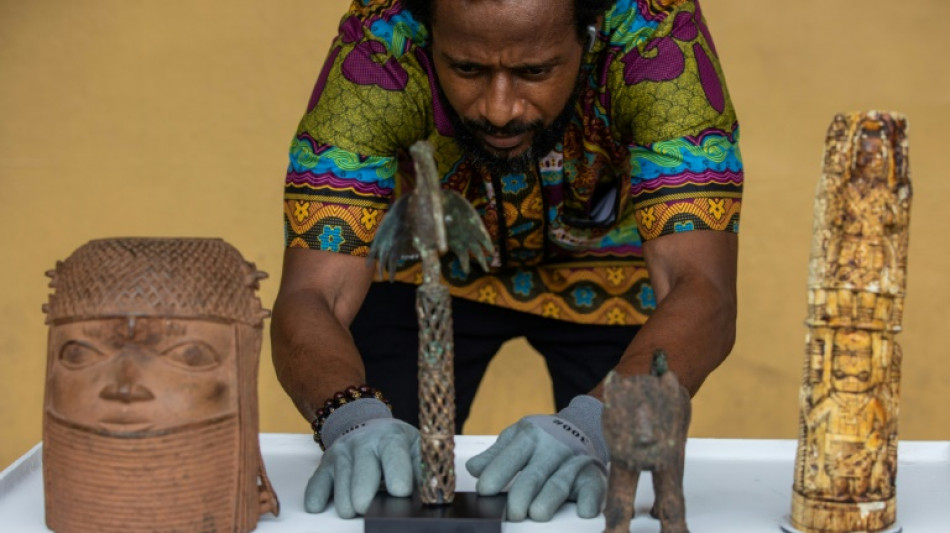
The British Museum has also refused to return any of the sacred sculptures and carvings known as the "Benin Bronzes" taken during a British military expedition in the former kingdom of Benin in southern Nigeria in 1897.
It has the biggest collection of the Benin Bronzes which are held in museums across the United States and Europe.
The British Museum is also standing firm on the 11 Ethiopian tabots, or sacred tablets, that it holds.
- Germany: agrees to return Bronzes -
The German government agreed in 2022 to hand 1,100 Benin Bronzes back to Nigeria. The first 22 were sent back in December 2022.
- Netherlands too -
The Netherlands in June 2025 officially handed back to Nigeria 119 Benin Bronzes sculptures with a ceremony held at the National Museum in Lagos, showcasing four of them in the museum's courtyard.
- Egyptian antiquities -
Many artworks and artefacts have over the centuries been looted from Egypt, the cradle of an ancient civilisation that has long fascinated Europeans.
Among the most high profile cases are the Nefertiti bust, the Rosetta Stone and the Dendera Zodiac, which are on show in top museums in Germany, the United Kingdom and France.
The bust of Nefertiti, the wife of the Pharaoh Akhenaten, was sculpted around 1340 BC but was taken to Germany by a Prussian archaeologist and was later given to the Neues Museum in Berlin.
The Rosetta Stone, a basalt slab dating from 196 BC, has been housed in the British Museum since 1802, inscribed with the legend "Captured in Egypt by the British Army in 1801".
It bore extracts of a decree written in Ancient Greek, an ancient Egyptian vernacular script called Demotic and hieroglyphics.
The Dendera Zodiac, a celestial map, was blasted out of the Hathor Temple in Qena in southern Egypt in 1820 by a French official.
Thought to date from around 50 BC, it has been suspended on a ceiling in the Louvre museum in Paris since 1922.
N.Schaad--VB