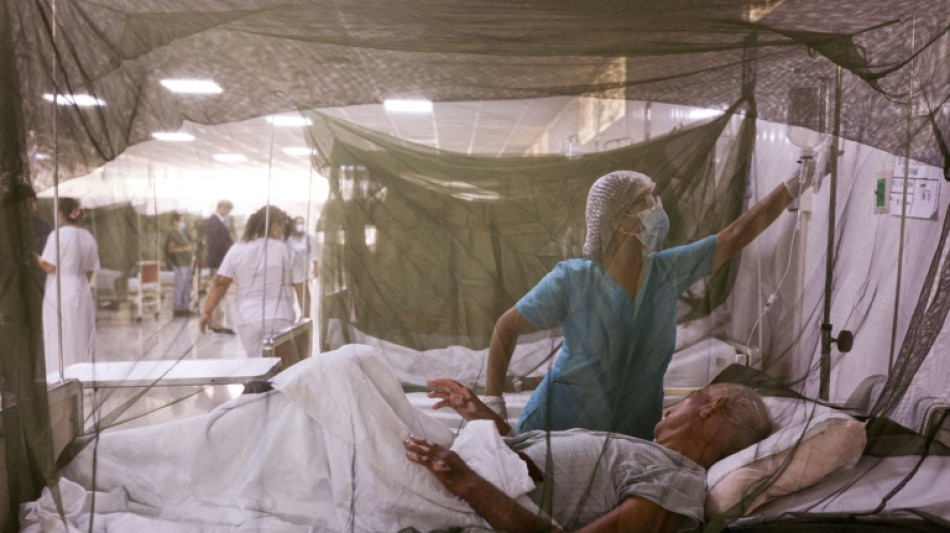
Pandemic agreement talks reaching end with deal elusive / Photo: © AFP

 Kiss tells Wallabies to 'return fire' after first loss as coach

 Russian strikes kill 11 including 3 children: Ukrainian authorities
 Russian teenager Andreeva breezes into China Open final

 Major earthquake hits Panama, injures at least 27
 India detains 'cockroach' leaders ahead of election protest

 'No divisions, no borders', French astronaut says of seeing Earth
 India's 'cockroach' movement chief detained ahead of major protest
 Year later, Gaza ceasefire promises mostly unfulfilled
 Taiwan's leader says increasing defence spending to 'deter war'
 Major quake hits Panama, no deaths reported

 Hurricane Isaias makes landfall in Florida
 Brazil prosecutors sue Shell for $108 mn over deadly 2024 floods
 Major earthquake destroys buildings, roads in Panama
 Anthropic AI model sent fake murder tip to Philadelphia police
 7.7-magnitude quake rocks Panama, triggers tsunami warning

 Prince Harry booed at English rugby match
 Kiplimo and Feysa seek repeat Chicago Marathon wins
 Fuellkrug halts Dortmund after late goal flurry
 Injured Ravens quarterback Jackson ruled out of Falcons clash
 Brewers aim to take down two-time defending champion Dodgers in NLCS rematch

 Tsunami alert after major earthquake rocks Panama
 Outer bands of Hurricane Isaias lash US Gulf Coast

 Hope, Rutherford fire West Indies to record T20 chase of 250

 Farhan leads Pakistan to T20 win over Sri Lanka
 Turkey sack coach Montella after Nations League woe
Countries trying to strike a landmark global agreement on handling future pandemics began discussing how to keep the process alive as they ran out of time to seal a deal Friday.
With the chances fading of concluding an agreement by the end of the day, negotiations turned to what the next steps might be.
Shaken by the failures exposed by Covid-19 -- which killed millions, shredded economies and crippled health systems -- countries have spent two years drafting an international accord on pandemic prevention, preparedness and response.
Despite a common desire for binding commitments aimed at preventing another such disaster, big differences quickly emerged between country blocs on how to go about it.
And though progress has been made on bridging the differences, the clock was always against them.
The World Health Organization's 194 member states were meant to finish the process in March so the agreement could be formally adopted at their annual assembly, which starts on May 27.
This additional fortnight of talks was crammed in amid hopes of achieving a breakthrough. Countries did finally begin thrashing out text wording but could not get everything completed in time.
- Delegates head for the door -
The talks are being held behind closed doors at the WHO headquarters in Geneva.
WHO chief Tedros Adhanom Ghebreyesus was attending the talks in person, along with the UN health agency's emergencies director Michael Ryan.
WHO spokeswoman Margaret Harris told a media briefing Friday that the overtime round of talks "will end later today".
Fuelled by trolleys full of coffee, bananas, biscuits and sandwiches, negotiators have been pulling 12-hour days since April 29 to try and find a way through.
Several diplomats were already leaving the building with their suitcases on Friday as the talks neared the end.
"During the past two weeks, negotiators have held extensive discussions on multiple aspects of the proposed agreement, meeting often into the early hours of the morning," Harris said.
"Next steps on the way forward will... be discussed today and they will be announced later."
- More time needed -
Non-governmental organisations that were deemed to be relevant stakeholders can follow the process outside the room and are briefed daily by the talks' co-chairs.
"Member states are discussing what the next steps will be," Medicines Law and Policy director Ellen 't Hoen told reporters.
"It's fair to say there's progress made. If you look at the outline of the agreement, all the important themes are there.
"But there remain a significant number of thorny issues that simply need more time. No country as far as we can tell has tried to pull the plug."
James Love, the director of Knowledge Ecology International, added: "There is some room for negotiating right now. I don't think we're really there yet.
"I don't think it's the worst outcome if they take more time. I also don't think they're going to quit."
The main disputes revolve around access and equity: access to pathogens detected within countries and to pandemic-fighting products such as vaccines produced from that knowledge; and equitable distribution of not only counter-pandemic tests, treatments and jabs, but also the means to produce them.
Each of the draft agreement's 37 articles has been individually thrashed out, with country negotiators breaking off into working groups to try to figure out a consensus.
While general agreement has been found on some articles -- without formally signing them off -- the core aspects have proved the hardest to negotiate.
F.Fehr--VB