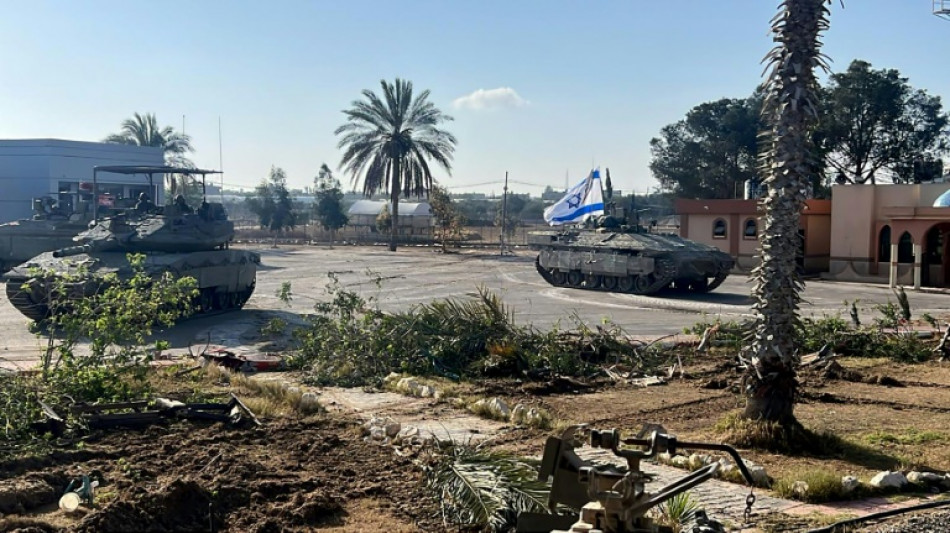
Israeli tanks roll into Rafah as army seizes key Gaza crossing / Photo: © Israeli Army/AFP

 Injury ends season for NHL Rangers star goalie Shesterkin

 Ten-man Spurs rescue draw at Man Utd, Arsenal survive Leeds scare

 Inter Milan dominate Parma to go top in Serie A
 Abbas postpones Palestinian legislative elections to September 2027
 'I don't feel fear': Fulham boss Arbeloa hits back as pressure mounts

 Hurricane Simon strengthens to category 4 as it nears western Mexico

 Alonso hails Henderson 'beauties' as Chelsea star rolls back the years

 Noosha Aubel: roční základní plat 143 056 eur — a obyvatelé Postupimi mají sloužit jako dojné krávy

 Romero claims Atletico late win at Alaves

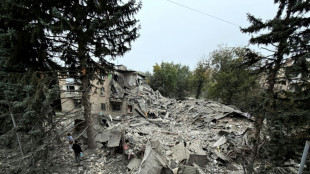 Zelensky blasts diesel deal as Russian strikes kill 16

 Arsenal back on track after Leeds scare, five-star Chelsea run riot

 Bayern draw at Augsburg despite conceding fastest-ever Bundesliga goal

 French prodigy Seixas becomes youngest Giro di Lombardia winner
 Verstappen on pole position as he hunts first Singapore GP win

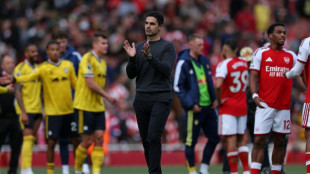 Arsenal learned lessons from Brighton collapse, says Arteta
 Noosha Aubel: €143,056 in annual basic pay — while Potsdam’s residents are expected to serve as cash cows
 Cristiano Ronaldo provisionally suspended by Portugal after walkout
 Brilliant Renshaw ton puts Australia in strong position

 Zelensky blasts diesel deal after Russian strikes kill 15

 Cristiano Ronaldo provisionally suspended after Portugal walkout

 Alcaraz through in straight sets on Shanghai Masters opener

 Palmer signs contract to stay at Chelsea until 2034
 India detains 'cockroach' movement leaders in bid to thwart election protest
 Proposed next EU budget cut back in search for deal
 All Blacks learn from 'failed' Springboks series to punish Wallabies
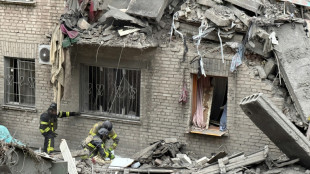
Israel sent tanks into Rafah in southern Gaza, seizing control of the border crossing with Egypt Tuesday, an operation the UN said denied it access to the key humanitarian passage.
The military's thrust into the eastern sector of the city packed with displaced civilians came with negotiators and mediators due in Cairo in the latest effort towards a hostage release and ceasefire in the seven-month-old war.
A senior Hamas official, requesting anonymity to discuss the negotiations, warned that it would be Israel's "last chance" to free the estimated 128 captives still held in the Palestinian territory, including 35 the military says are dead.
A Hamas delegation was headed "shortly" to Cairo, the official said. Israel has said it would also send negotiators, and mediator Qatar announced it was dispatching a team as well.
The long-threatened Rafah operation began hours after Hamas announced late Monday it had accepted a truce proposal, prompting cheering crowds to take to the streets despite Israel saying it was "far" from plans it had previously agreed to.
Rafah resident Abu Aoun al-Najjar said the "indescribable joy" following the Hamas statement and hopes for an end to the war were short-lived.
"It turned out to be a bloody night," he told AFP, as more Israeli strikes and bombardment "stole our joy".
Army footage showed tanks flying the Israeli flag taking "operational control" of the Palestinian side of the Rafah crossing, the military said, in a deployment that had a "very limited scope against very specific targets".
UN humanitarian office spokesman Jens Laerke said Israel had denied it access to both Rafah and Kerem Shalom -- the other main Gaza aid crossing, on the border with Israel -- with only "one day of fuel available" inside the besieged territory.
Unless fuel was allowed in, "it would be a very effective way of putting the humanitarian operation in its grave", he warned.
At the United Nations, Secretary-General Antonio Guterres urged Israel to "stop any escalation" and to "immediately" reopen the crossings.
"The closure of both... crossings is especially damaging to an already dire humanitarian situation", Guterres said, warning that "a full-scale assault on Rafah will be a human catastrophe".
- 'Permanent ceasefire' -
Overnight, heavy bombardments rocked Rafah, an AFP correspondent reported. The Kuwaiti hospital said it had received the bodies of 23 people and the Najjar hospital recorded another four killed.
Later, Hamas's armed wing said it fired rockets at Israeli troops at Kerem Shalom, two days after four Israeli soldiers were killed there in an attack it also claimed.
The Israeli army alleged the latest attack came from Rafah.
The war was sparked by Hamas's unprecedented October 7 attack on Israel, which resulted in the deaths of more than 1,170 people, mostly civilians, according to an AFP tally of Israeli official figures.
Vowing to destroy Hamas, Israel launched a retaliatory offensive that has killed at least 34,789 people in Gaza, mostly women and children, according to the Hamas-run territory's health ministry.
Egypt, which has a peace treaty with Israel, and Qatar, a US ally that also hosts Hamas leaders, have taken the lead in the ceasefire negotiations.
Hamas on Monday said it had told Egyptian and Qatari officials of its "approval of their proposal regarding a ceasefire".
Israeli Prime Minister Benjamin Netanyahu's office said the proposal was "far from Israel's essential demands", but the government would still send negotiators for talks.
In the meantime, it added, "Israel is continuing the operation in Rafah to exert military pressure on Hamas in order to advance the release of our hostages".
Close Israeli ally the United States said it was "reviewing" the Hamas response.
Hamas member Khalil al-Hayya told the Qatar-based Al Jazeera news channel that the proposal agreed to by Hamas involved a three-phase truce.
It included a complete Israeli withdrawal from Gaza, the return of Palestinians displaced by the war and a hostage-prisoner exchange, with the goal of a "permanent ceasefire", he said.
- International alarm -
International alarm has been building about the consequences of an Israeli ground invasion of Rafah, where the United Nations says 1.4 million people are sheltering.
EU foreign policy chief Josep Borrell expressed concern that an attack on Rafah began despite warnings from the European Union and the United States.
"I am afraid that this is going to cause again a lot of casualties, civilian casualties," he said.
Egypt urged Israel to "exercise the utmost restraint", while the Organization for Islamic Cooperation condemned Israel's "criminal aggression".
In a conversation with Netanyahu on Monday, US President Joe Biden restated "his clear position" opposing an invasion of Rafah, the White House said.
Netanyahu has repeatedly vowed to send ground troops into Rafah regardless of any truce, saying Israel needs to root out remaining Hamas forces.
The Hostages and Missing Families Forum said it had appealed to several countries to "exert your influence on the Israeli government".
In a message to ambassadors of governments with citizens among the hostages, it asked them to push for an agreement "while a tangible opportunity for the release of the hostages is on the table".
Israel's military on Monday told those in eastern Rafah to head for the coastal "expanded humanitarian area" at Al-Mawasi.
But aid groups said Al-Mawasi was not ready for such an influx.
German Foreign Minister Annalena Baerbock urged "protection" for civilians in Rafah.
"A million people cannot simply vanish into thin air," she said in a post on X, calling for "more humanitarian aid urgently".
Medical charity Doctors Without Borders (MSF) said it had begun discharging patients from a field hospital in Rafah and was preparing "for a possible evacuation".
"This offensive is... going to further aggravate the damage to the health system, which is barely functioning," an MSF statement said.
burs-ami/srm
C.Bruderer--VB