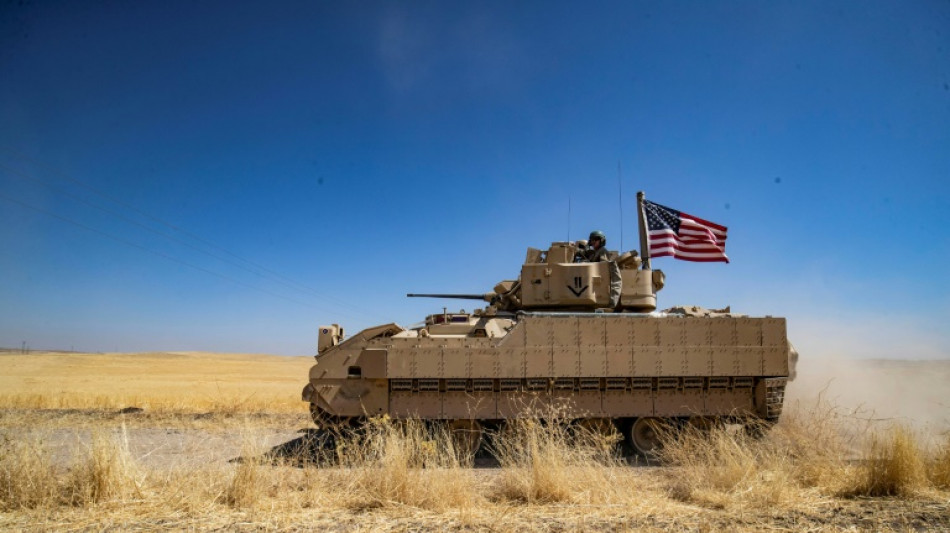
US forces in Iraq, Syria face spike in attacks / Photo: © AFP

 New Zealand and Tonga meet for place in Rugby League World Cup final

 Reports of unsafe AI-toy responses renew calls for child-safety rules

 Juneau food network combines difficult supply routes with deep sharing traditions

 India climbs green-transition ranking after first emissions decline in 25 years

 Trump names Stephen Miller as White House chief of staff after midterm losses

 Restored Albanian tower houses anchor new rural tourism trail

 Sonia Gandhi reflects on family tragedy and reluctant political career

 Pope Leo begins three-country South American tour in Uruguay

 Khawaja says entire Australia camp knew of 2018 ball-tampering plan

 Anna Miltina Confronted with Racism Allegations on ProSieben Show

 Microsoft Xbox App Update for PC Promises 60% Faster Startup

 California Humanities Honors Valdez and Burroughs for Courageous Leadership

 Friedmann and Kühner Analyze Bundesliga's Best Shot and Frankfurt's Goalkeeper Crisis

 Honoka‘a Dragons Face Hawaii Prep in BIIF Division II Championship

 Pakistan Demands Grant-Based Climate Finance at COP31 to Avoid Debt Trap
American and allied forces deployed in Iraq and Syria as part of an international anti-jihadist coalition have been repeatedly targeted by drone and missile attacks this month.
Although the attacks have not been claimed by a known group with documented links to Iran, Washington says Tehran is involved and has threatened to respond "decisively" to strikes by its proxies.
- Why have attacks increased? -
The recent spike in attacks is linked to the latest war between Israel and Hamas, which began when the militant group carried out a shock cross-border attack from Gaza on October 7 that Israeli officials say killed more than 1,400 people.
Israel's retaliatory bombardment has killed more than 6,500 people, according to the Gaza health ministry.
Armed factions close to Iran have threatened to attack US interests over Washington's support for Israel, with one of them -- Ketaeb Hezbollah -- demanding that American forces leave Iraq or "taste the fires of hell."
The Pentagon said there were 10 attacks on American and allied forces in Iraq and three in Syria between October 17 and 24, involving a "mix of one-way attack drones and rockets."
- Who is carrying them out? -
Many -- though not all -- of the recent attacks have been claimed by the "Islamic Resistance in Iraq."
It is not one of the established militant groups operating in the region and has not publicly claimed affiliation with or backing from a specific government.
But its claims of attacks on US forces have appeared in Telegram channels used by pro-Iranian armed factions, and the Pentagon has said the organizations "conducting these attacks are supported by the IRGC and the Iranian regime" -- a reference to Tehran's Islamic Revolutionary Guard Corps.
The White House has meanwhile said Iran is "actively facilitating" attacks on US forces in the Middle East.
Michael Knights, a senior fellow at the Washington Institute, said the "Islamic Resistance in Iraq is a media claiming name, it's not a group."
It is the result of various existing Iran-backed groups in Iraq deciding "during the duration of this Gaza conflict to jointly claim all of their attacks," he said.
- How dangerous are the attacks? -
The impact of the attacks has been limited so far, but the possibility of escalation is high.
The US Central Command said last week that members of the international coalition against the Islamic State (IS) jihadist group suffered "minor injuries" from an incident in which American forces shot down one drone and damaged another in western Iraq.
And a US civilian contractor suffered a "cardiac episode" and died while sheltering at a base in Iraq after early warning systems indicated a threat was approaching. In that case, an attack ultimately did not occur.
There is significant potential for the situation to worsen, especially in the event that a drone or rocket directly kills American personnel.
"What we are seeing is the prospect for more significant escalation against US forces and personnel across the region in the very near term coming from Iranian proxy forces, and ultimately from Iran," the Pentagon said.
- Why are US forces present? -
There are roughly 2,500 American troops in Iraq and some 900 in Syria as part of efforts to prevent a resurgence of IS, which once held significant territory in both countries but was pushed back by local ground forces backed by international air strikes in a bloody multi-year conflict.
US forces and other coalition personnel are deployed at bases in Iraq and Syria that have been the target of the attacks, but the facilities are ultimately controlled by local forces rather than international troops.
American troops in Iraq are playing a training and advisory role following the official end of the coalition's combat mission in December 2021, while those in Syria conduct frequent raids against IS.
C.Stoecklin--VB