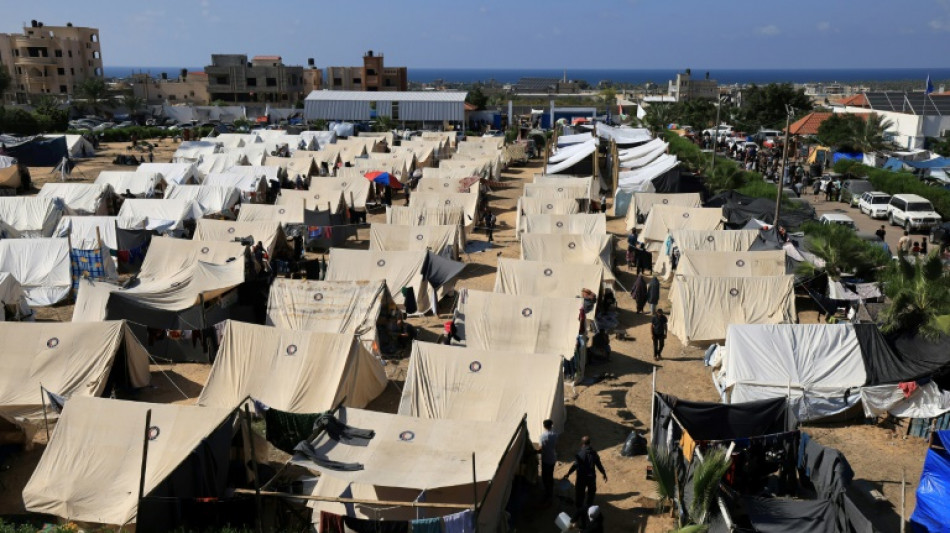
Gaza war sparks Arab fears of new Palestinian displacement / Photo: © AFP/File

 New Zealand and Tonga meet for place in Rugby League World Cup final

 Reports of unsafe AI-toy responses renew calls for child-safety rules

 Juneau food network combines difficult supply routes with deep sharing traditions

 India climbs green-transition ranking after first emissions decline in 25 years

 Trump names Stephen Miller as White House chief of staff after midterm losses

 Restored Albanian tower houses anchor new rural tourism trail

 Sonia Gandhi reflects on family tragedy and reluctant political career

 Pope Leo begins three-country South American tour in Uruguay

 Khawaja says entire Australia camp knew of 2018 ball-tampering plan

 Anna Miltina Confronted with Racism Allegations on ProSieben Show

 Microsoft Xbox App Update for PC Promises 60% Faster Startup

 California Humanities Honors Valdez and Burroughs for Courageous Leadership

 Friedmann and Kühner Analyze Bundesliga's Best Shot and Frankfurt's Goalkeeper Crisis

 Honoka‘a Dragons Face Hawaii Prep in BIIF Division II Championship

 Pakistan Demands Grant-Based Climate Finance at COP31 to Avoid Debt Trap
The sight of tent cities for Palestinians displaced within war-torn Gaza evokes dark historical memories for Israel's Arab neighbours, especially Egypt and Jordan.
"That's how the Nakba started," says the Gaza-based rights group Al Mezan, reflecting regional suspicions that Israel is planning to empty the coastal territory.
The Nakba, or "catastrophe", is how the Arab world refers to the exodus or forced displacement of 760,000 Palestinians in the war that led to the creation of Israel 75 years ago.
The fear of history repeating itself has been stoked as Israel has waged war on Hamas since the Islamist group killed 1,400 people in the October 7 attack on southern Israel.
The Gaza Strip is mostly populated by Palestinian refugees and their descendants, who have now endured over two weeks of withering bombardment that the Hamas-run health ministry says has killed over 5,000 people.
So Israeli warnings to evacuate the north of the territory ahead of a looming ground invasion have raised deeper historical fears, with one million Gazans already forced out of their homes.
The only possible way out of Gaza that is not controlled by Israel is the Rafah border crossing with Egypt.
Egypt has allowed aid convoys into Gaza through Rafah after Israel stopped bombing the Palestinian side under a US-brokered deal -- but there has been no mass flight of refugees heading the other way.
Egypt fears that throwing open the gates could facilitate Israeli plans for a forced mass eviction of Palestinians, many of whom are now homeless, sleeping in the open or sheltered in UN tents.
The Gaza-based Al Mezan Center for Human Rights said: "When we see the tents at the border today, it should give the chills to anyone who know Palestinian history -- the tents, that's how the Nakba started.
"Most of the people would rather die in Gaza than being made a refugee again."
- Security implications -
Israel has stressed its eviction order for northern Gaza aims to get Palestinian civilians out of harm's way as it goes after Hamas and hopes to rescue more than 220 hostages.
But the suspicion Israel is planning a mass eviction has been reinforced by former Israeli officials who have suggested in TV interviews that Egypt could build vast tent cities in its Sinai desert, with international funding.
Egyptian President Abdel Fattah al-Sisi has stressed that Israel as an occupying force has responsibility for Palestinian civilians under international law.
"If the idea is forced displacement, there is the Negev," he said, referring to the desert lands of southern Israel.
Jordan's King Abdullah II and Palestinian president Mahmud Abbas have warned that if Israel managed to drive Palestinians out of Gaza, it may want to do the same in the occupied West Bank in future.
Egypt -- which has long suppressed the Muslim Brotherhood, Hamas's Islamist ally -- also has reason to fear the security implications of hosting displaced Gazans on its territory.
The presence of Palestinians refugees and militant groups has previously pulled their host countries into conflict -- Jordan in the 1970s and Lebanon in the 1980s.
In Jordan, home to many Palestinians, the late King Hussein in the 1970s accused Palestinian fedayeen fighters of building a "state within a state" and seeking to take over the country.
- Sinai a 'red line' -
To prevent this, Jordan's Black September offensive drove Yasser Arafat's Palestine Liberation Organization to leave Jordan for Lebanon.
Lebanon's Christian parties had the same suspicion and fought the PLO during the civil war. Arafat and his fighters were forced to leave in the wake of Israel's full-scale invasion of Lebanon in 1982.
The PLO leadership dispersed to Tunisia and Yemen, while the occupied Palestinian territories were gripped by the first intifada or uprising from 1987.
The 1993 Oslo Accords were meant to usher in a Palestinian state, but that dream fizzled and serious talks have stalled for the past decade.
The idea of a substitute Palestinian homeland resurfaced under former US president Donald Trump, whose peace plan, rejected as biased by Palestinians, proposed an industrial zone in the Sinai to create jobs for Gazans.
Cairo too would dismiss it out of hand, analysts say.
"The Sinai is a red line for the Egyptians," said political scientist Sarah Daoud, who stressed that "this was already the case under Hosni Mubarak", the former president deposed in 2011.
"For Egypt, its territorial integrity is non-negotiable," she said.
The Sinai Peninsula, which Israel occupied from 1967, was the site of battles in which many Egyptian soldiers died, before Cairo regained it under its 1979 peace deal with Israel.
Sisi has warned that, if at some future stage Palestinian armed groups based on its lands were to attack Israel, that historic peace "will melt in our hands".
burs-sbh/fz/kir
W.Huber--VB