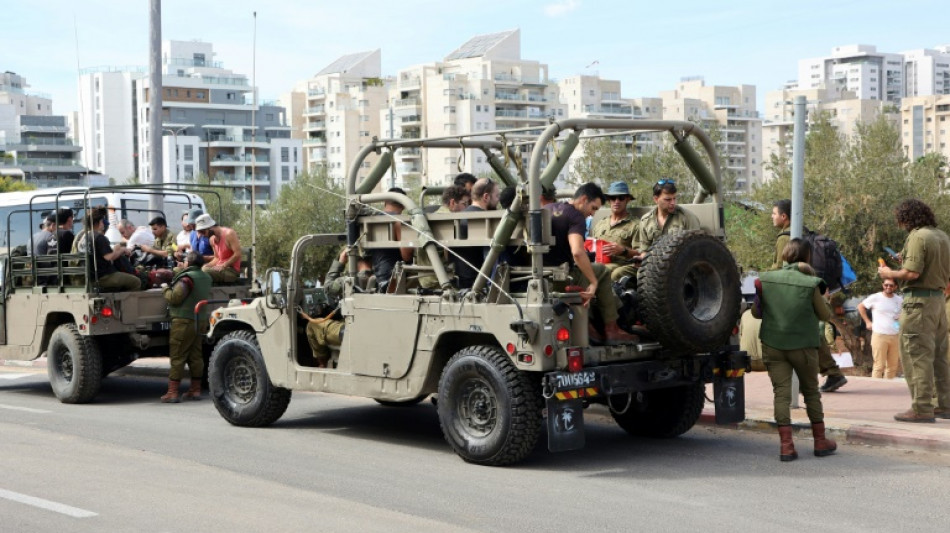
With dreadlocks, hipster beards, Israel reservists called to war / Photo: © AFP/File

 South African voters report smoother local election but declining IEC trust

 Dolly Parton museum and Nashville hotel open after singer’s death

 George and Amal Clooney attend New York political-comedy reading

 British buyers pay substantial premiums for period-home appearance

 Thomas Markle released to house arrest after child-abuse-image charge

 Dawn of War 4 developers chose Adeptus Mechanicus for tactical variety

 Italy face unbeaten South Africa in Turin Nations Championship match

 ChatGPT interactive interface feature tested across six custom tools

 Freshways milk-price cut deepens pressure on UK dairy farms

 Labour and National remain virtually tied as New Zealand vote count advances

 The Good Daughter adapts Karin Slaughter thriller with Rose Byrne and Meghann Fahy

 Heavy-lift drone evacuates wounded Ukrainian soldier from frontline kill zone

 Morrison says West Brom recovered after pressure from successive derby losses

 Britain considers 2027 state visit for Ukraine’s Zelensky

 Arizona Democrats Secure Historic Trifecta with New Legislative Leadership

 Carney Welcomes U.S. Trade Reversal After Democratic Midterm Victory

 Armenian FM Discusses EU Accountability for Palestinian Rights in Madrid

 Trump and Vance Pursue Secret Diplomacy with Iran Amid Military Pressure

 Classic Car Values Surge: De Tomaso Vallelunga Leads 190% Gain
 Microsoft Ends Oracle AI Computing Rental Deal Amid Cloud Strategy Shift
An earring pokes out from under the helmet of Israeli army reservist Amir, a self-professed leftist who is pro-peace but finds himself looking through his rifle scope at buildings inside Gaza.
"It's surreal to be here", said Amir, one of more than 360,000 Israeli reservists called up for the war against Gaza-based Hamas militants.
Civilians one day, men and women like Amir become soldiers the next.
Under camouflage only 1.5 kilometres (one mile) from the Palestinian enclave, Amir who did not give his last name according to army orders -- finished his military service in 2014, just after an earlier Israeli war with militants in Gaza.
He said meekly that he still has "grief and trauma" from that conflict, and despite undergoing annual training exercises, he didn't "realise" that -- nine years later -- he'd be called to fight again.
"No one should have to find themselves in this situation", he said, holding his rifle.
"I still know how to use it, but I hope I don't have to", he sighed.
Behind him, his platoon, a group of reservists who didn't know each other, practise the basics of tactical movement while camouflaged on the ground, communicating silently through hand signs.
Most Israelis who have already done their mandatory military service remain in the reserves until age 40.
In Amir's unit, like many across Israel, older volunteers have also decided to come back into service since the beginning of the war on October 7, when Palestinian Hamas militants broke through the militarised border barrier around Gaza and attacked southern Israel.
They gunned down, stabbed and burned more than 1,400 people, mostly civilians.
Since then, at least 258 Israeli soldiers have been killed in fighting, the army said.
It is preparing for a ground invasion of Gaza but has for days been dropping thousands of munitions on targets in the coastal strip, levelling entire neighbourhoods, where at least 2,750 people, most of them ordinary Palestinians, have been killed.
Israel's reserves supplement the 169,500 military personnel under contract -- both mandatory service and career soldiers.
- Dreadlocks -
Elia, 24, is a female reservist, a medic who hasn't worn a uniform in four years.
The French-Israeli, who works in a startup, found out that she had been called up for service while she was in a swimsuit on a beach in Thailand.
"Even for us, it's terrifying. Of course I'm asking myself what I'm doing here, but this is just how it is. It's our duty", she told AFP, with a medical bag on her back.
At a rest stop in Beit Kama, one of the last stops before Gaza, the scene is colourful as the transformation from civilian to soldier takes place. Dreadlocks hang from under helmets. There are hipster beards, quirky glasses, oversize pants hanging down below the waist, and hiking shoes that are anything but regulation.
While the army dress code is extremely rigid, and a source of punishment for soldiers who deviate from the right sock colour to the texture of a hair scrunchie, the reservists "come as they are", a military police officer near Gaza explained to AFP.
In Israel, flipping from civilian to military life happens via text message or phone call.
Since October 7, entire planes have been chartered to bring home reservists and other Israelis.
The extent of the mobilisation can be seen in the two kilometre line of cars parked along the highway passing one of the largest bases in the country, near Jerusalem.
To support their loved ones, the home front is increasing donations: food, equipment, camping material, and even free hair cuts. But the army reminded over-eager donors that tactical or combat equipment is its responsibility.
S.Spengler--VB
