Debt, inflation and the peso: Argentina's election worries / Photo: © AFP

 South Africa's migrant exodus leaves employers short-handed
 US holds fire against Iran as reports emerge of stockpile concerns

 Marvel announces 'Black Panther III' at Comic-Con
 Will heatwaves push European holidaymakers to 'coolcations'?
 Messi-less Miami win on Casemiro debut, Berterame suffers head blow

 German police hunt suspect after deadly car ramming near Berlin Gay Pride

 US Federal Reserve expected to hold rates steady as inflation swirls

 Merz vows justice after deadly car ramming near Berlin Gay Pride event

 Joshua survives knockdowns, stops Prenga

 Ohtani delays throwing session over knee 'regression'

 One killed, 15 wounded as car hits crowd near Berlin Gay Pride
 Hodge, Hope give West Indies edge in rain-impacted Pakistan Test

 Scheffler surges at 3M Open with blistering back nine

 Brazil's right-wing party nominates Bolsonaro son to battle Lula
 Norris back on pole at Hungarian GP as rivals handed penalties

 Close to Madrid, those who escaped flames worry what is next
 Messi can skip All-Star Game after grueling World Cup, says MLS
 Hamilton stung by three-place grid penalty
 Howe uncertain if Guimaraes will stay with Newcastle amid Arsenal interest
 Varane concussions motivate Como to ban heading in academy teams

 'Amazing' Pogacar-Del Toro friendship lights up Tour de France

 Crisis-hit Flavio Bolsonaro launches presidential candidacy in Brazil

 As wildfires grip France and Spain, what are the risks from the smoke?
 Pogacar set to win Tour de France, Carapaz claims Queen stage
 India's education minister resigns, end called to Delhi protests
Argentina is Latin America's third-largest economy, bursting with natural resources, but has been unable to claw its way out of decades of economic instability that has brought its population to its knees.
As Argentines head to the polls on Sunday for a first-round election, presidential candidates have campaigned hard on proposed elixirs for the country's economic ills.
Here are the main challenges facing the country as it heads to the polls:
- Record inflation -
Weary Argentines have become accustomed to seeing prices soar from one day to the next, with inflation fueled by rampant money printing used to finance government overspending.
In September, annual inflation hit 138 percent.
"Doing the shopping gives me chills. I went from using a shopping cart to a bag and now I hold what I can buy in one hand," said Lidia Pernilli, 73, who bought two bananas instead of a kilo, after the price more than doubled in a month.
"Argentina has this reputation of a voting public that is just willing to sustain levels of inflation and economic struggle because they are just resilient" and have "learned to live with it", said Benjamin Gedan, director of the Argentina Project at the Washington-based Wilson Center.
"To some degree, that has been true, but no one could live with the conditions they have now."
- The dollar peso tango -
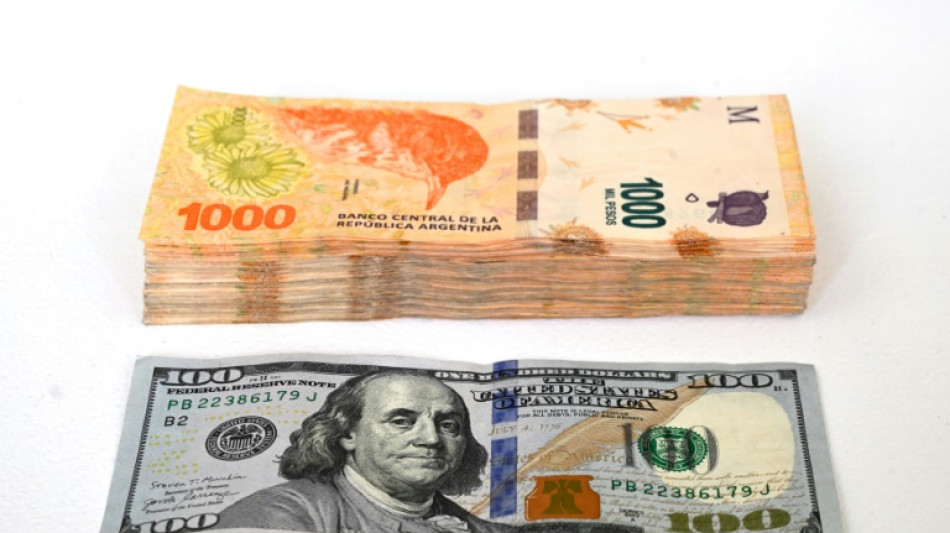
Argentina's peso and a myriad of dollar exchanges have resulted in a currency quagmire that has turned citizens into savvy economists.
The government keeps strict control over the value of the peso, clamping down on the purchase of foreign exchange to protect its dwindling reserves.
This has led to a thriving informal market for the dollar -- with daily rates for the so-called "blue dollar" advertised on television and news sites.
This parallel dollar is now three times the value of the official rate -- meaning the threat of a painful currency devaluation is always looming.
The disparity has led to a plethora of official exchanges: the "Coldplay Dollar" for concert tickets, the "Qatar Dollar" for Argentines traveling abroad, or the "Soy Dollar" for the agriculture sector.
Deeply distrustful of their volatile peso and banks, Argentines convert their cash to dollars on the black market whenever possible, and the Central Bank estimates some $244 billion is stashed away in homes.
- Debt, drought, and dwindling reserves -
Argentina has been bailed out by the International Monetary Fund 22 times, despite several major defaults.
The most recent loan of $44 billion dollars was granted in 2018. The government has been in near constant renegotiations of a refinancing plan agreed in 2022.
A historic drought -- the country's worst in a century -- saw agricultural exports plummet in the past two years, leading to a shortfall in $20 billion in revenue.
The IMF predicts Argentina's economy will contract by 2.5 percent in 2023.
The country has loaned money from Qatar, and has used yuan from a currency swap with China to make payments to the IMF, to avoid touching its dwindling reserves.
The Central Bank says the country has $25 billion in its reserves, but analysts believe the real amount is far lower.
After the election "there will be significant expectation that Argentina gets its house in order as a basis for continued support," said Mark Sobel, US chairman of the Official Monetary and Financial Institutions Forum (OMFIF).
- The painful remedy -
Any candidate seeking to set Argentina on the path to fiscal discipline and economic stability faces an uphill battle in a country heavily dependent on the state, which subsidizes public transport, electricity and water.
"Forty percent of the country is now living in poverty and an unimaginable amount of Argentines depend on the state, either for social welfare programs or direct employment," said Gedan.
"The pain will be acute and spread widely.... That's why the politics of stabilization are so difficult."
- A glimmer of hope -
After the drought, Argentina's agricultural industry is expecting booming harvests of soy and maize between 2023 and 2024.
The next government will also benefit from a savings in energy imports as a new gas pipeline ramps up production from southern Vaca Muerta -- a massive oil and gas reserve.
The country's massive lithium reserves are also predicted to bring in precious dollars.
B.Baumann--VB