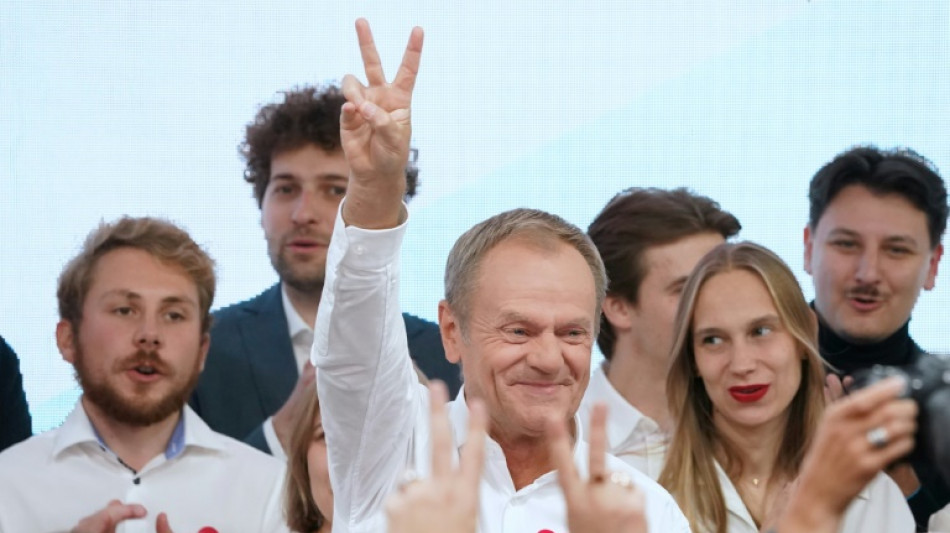
'Poland is back': Brussels greets election result / Photo: © AFP

 South African voters report smoother local election but declining IEC trust

 Dolly Parton museum and Nashville hotel open after singer’s death

 George and Amal Clooney attend New York political-comedy reading

 British buyers pay substantial premiums for period-home appearance

 Thomas Markle released to house arrest after child-abuse-image charge

 Dawn of War 4 developers chose Adeptus Mechanicus for tactical variety

 Italy face unbeaten South Africa in Turin Nations Championship match

 ChatGPT interactive interface feature tested across six custom tools

 Freshways milk-price cut deepens pressure on UK dairy farms

 Labour and National remain virtually tied as New Zealand vote count advances

 The Good Daughter adapts Karin Slaughter thriller with Rose Byrne and Meghann Fahy

 Heavy-lift drone evacuates wounded Ukrainian soldier from frontline kill zone

 Morrison says West Brom recovered after pressure from successive derby losses

 Britain considers 2027 state visit for Ukraine’s Zelensky

 Arizona Democrats Secure Historic Trifecta with New Legislative Leadership

 Carney Welcomes U.S. Trade Reversal After Democratic Midterm Victory

 Armenian FM Discusses EU Accountability for Palestinian Rights in Madrid

 Trump and Vance Pursue Secret Diplomacy with Iran Amid Military Pressure

 Classic Car Values Surge: De Tomaso Vallelunga Leads 190% Gain

 Microsoft Ends Oracle AI Computing Rental Deal Amid Cloud Strategy Shift
After years of tensions over Warsaw's perceived democratic backsliding, Brussels on Monday trumpeted the apparent victory of Poland's pro-EU opposition in a weekend election.
"Poland is back," declared Manfred Weber, the head of the European People's Party, the biggest grouping in the European Parliament, in Strasbourg.
The applause that met echoed relief in other EU institutions as they contemplated a changed political direction for the bloc's sixth-biggest economy, away from the nationalist/populist lines espoused by the outgoing government, which had openly defied Brussels on several issues.
As vote-counting was continuing in Poland, the European Commission struck a more prudent tone in keeping with its role as executive for the bloc.
With more than 80 percent of votes tallied, the nationalist Law and Justice Party (PiS) was the party in the lead after the election, but without a majority, taking 37 percent.
The opposition parties, with Donald Tusk -- a former European Council president -- as the leading figure, was seen as the likely winner garnering collectively 52 percent.
The shift that portends is drastically changed relations between Warsaw and Brussels, which had butted heads with the Polish government since PiS rose to power in 2015.
Poland for eight years was one of the major spoilers of EU efforts to reshape the bloc's migration and asylum policy by attempting to share around responsibilities for hosting asylum-seekers, or contributing to hosting them, to take pressure off so-called frontline EU countries.
It also fiercely challenged Brussels' efforts to ensure European standards of rule of law were observed in the running of its democracy, particularly when it came to the independence of judges.
Two years ago, Poland's outgoing Prime Minister Mateusz Morawiecki laid down the gauntlet by declaring EU law -- which is meant to overrule any national legislation -- "incompatible" with the Polish constitution.
- 'More open to compromise' -
Some EU peers, including France, saw that as an assault against the European Union and what it stood for. The result was Poland being dragged before the European Court of Justice, where a legal battle continues.
A political analyst, Romona Coman, said that, while it often occurred that individual countries complained their interests were being trampled on at EU level, "the Polish and Hungarian governments went much further by challenging the legality and legitimacy of the European Union itself".
"PiS's exit will change matters," she said.
Lukas Macek, a researcher at the the Jacques Delors Institute think tank in Paris, agreed.
The expected victory with Tusk as its figurehead "is good news for those who defend the European project," he said.
The EU is about to gain "a partner that is more conciliatory, more positive and more open to compromise," he predicted.
But he cautioned against a "black-and-white vision" of future relations, saying: "Not everything will radically change. There will be a transition, with a reduced margin for manoeuvre."
Macek explained that, after ruling for eight years, the PiS had built up supporters and political machinery "that will take time to pry free," giving the country's media and judiciary as examples.
That should instil caution in Tusk, should he become prime minister, who, several analysts said, would likely not change everything overnight.
During his campaign, at the head of his Civic Coalition, Tusk had promised to improve the right to abortion in the largely Catholic country.
He also vowed to unblock EU funds frozen because of the various struggles between Warsaw and Brussels, which included the challenge to rule of law, and the defence of minorities.
P.Vogel--VB
