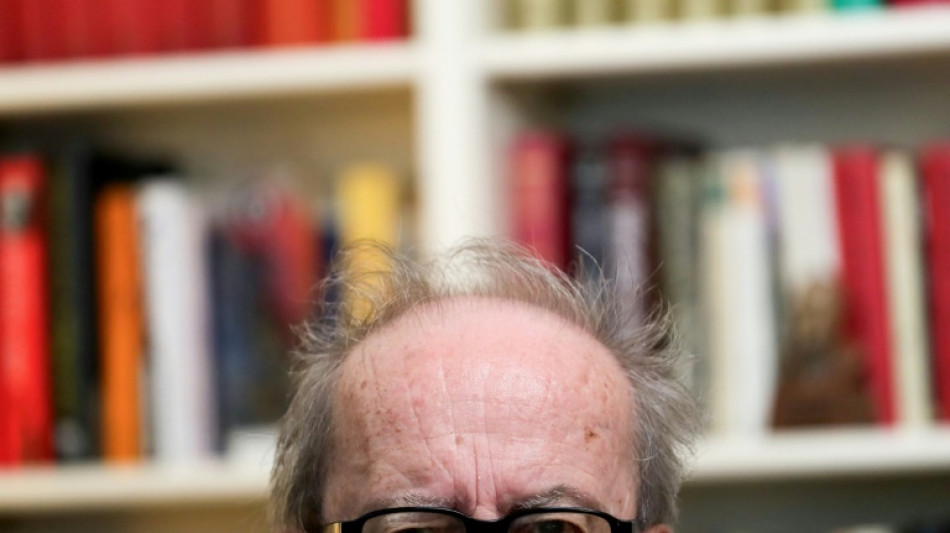
Writing triumphed over 'hell of communism', says Albania's Kadare / Photo: © AFP

 South African voters report smoother local election but declining IEC trust

 Dolly Parton museum and Nashville hotel open after singer’s death

 George and Amal Clooney attend New York political-comedy reading

 British buyers pay substantial premiums for period-home appearance

 Thomas Markle released to house arrest after child-abuse-image charge

 Dawn of War 4 developers chose Adeptus Mechanicus for tactical variety

 Italy face unbeaten South Africa in Turin Nations Championship match

 ChatGPT interactive interface feature tested across six custom tools

 Freshways milk-price cut deepens pressure on UK dairy farms

 Labour and National remain virtually tied as New Zealand vote count advances

 The Good Daughter adapts Karin Slaughter thriller with Rose Byrne and Meghann Fahy

 Heavy-lift drone evacuates wounded Ukrainian soldier from frontline kill zone

 Morrison says West Brom recovered after pressure from successive derby losses

 Britain considers 2027 state visit for Ukraine’s Zelensky

 Arizona Democrats Secure Historic Trifecta with New Legislative Leadership

 Carney Welcomes U.S. Trade Reversal After Democratic Midterm Victory

 Armenian FM Discusses EU Accountability for Palestinian Rights in Madrid

 Trump and Vance Pursue Secret Diplomacy with Iran Amid Military Pressure

 Classic Car Values Surge: De Tomaso Vallelunga Leads 190% Gain

 Microsoft Ends Oracle AI Computing Rental Deal Amid Cloud Strategy Shift
Acclaimed Albanian novelist Ismail Kadare has talked about being smothered by "the hell of communism" and how writing helped him survive one of the worst dictators in the old Eastern Bloc.
The veteran writer -- an eternal bridesmaid for a Nobel literature prize -- was awarded France's highest honour Monday.
Despite being branded a traitor by Albania's communist leaders when he defected to France in 1990, Kadare was accused by some of enjoying a privileged position under Enver Hoxha, who presided over Europe's most paranoid and isolated regime.
But the author of "Broken April" and "The General of the Dead Army" told AFP those years were "hell" -- a living nightmare from which he forged some of his greatest works.
"The hell of communism, like every other hell, was smothering in the worst sense of the term. But literature transformed that into a life force, a force which helped you survive and hold your head up and win out over dictatorship," said the 87-year-old.
Several writers and artists were imprisoned and even executed under Hoxha's murderous rule. Kadare -- who came from the same small town and was made a member of parliament -- escaped prison but was targeted by the secret police.
He was sent into internal exile in 1975 after publishing a satirical poem called "The Red Pasha", a clear reference to the dictator.
In her memoirs, Hoxha's widow Nexhmije claimed the tyrant -- who fancied himself as a man of letters -- protected Kadare from other hardline Stalinists who wanted the head of the "bourgeois" writer.
His defenders say Kadare's genius was using allegory and metaphor to depict the horrors of what was going on around him in almost impossible circumstances.
- 'Always been true' -
"Writing under a dictatorship is very difficult, almost impossible, because it is impossible to write as you want to write," he told AFP.
"Which is why I am so grateful for literature, because it gives me the chance to overcome the impossible.
"I have always been true to my writing," he insisted. "It was the absolute goal of my life and it helped me get over all the difficulties. When art survives it triumphs," he said.
Kadare, who was made a grand officer of France's Legion of Honour by President Emmanuel Macron, drew a comparison with the late dissident Czech writer Milan Kundera, who also had to deny allegations he collaborated with the communists who banned his work.
"As Kundera said, 'Art never triumphs with its head bowed.'"
Kadare previously said that his fame both protected him and made him suspect.
Files from Hoxha's feared secret police the Sigurimi showed that he and his family were continually followed and persecuted.
Indeed recently uncovered papers quote Hoxha as describing the writer as a cursed "raven of doom" who brought him bad luck.
- Haunted by Hoxha -
That has not stopped some critics dismissing him as the "official dissident" the regime tolerated.
Yet several of Kadare's works written under Hoxha took aim at authoritarianism, often through the oblique lens of the Ottoman empire, which occupied Albania for five centuries, or classical allusions.
"The Palace of Dreams", published four years before the dictator's death in 1985, was banned as a veiled attack on the Politburo but not before it had become a bestseller.
Kadare said writers "must serve freedom". "The truth is not in my acts but in my books, which are a real literary testament," he told AFP in 2019.
Hoxha's looming presence haunts several of the writer's works, mostly notoriously "The Successor" which delved into the murky death of the dictator's closest ally, Mehmet Shehu, who was later denounced as a "foreign agent".
"Literature is my great and only love," Kadare told AFP in his Tirana apartment. "It has given sense to my life, given me courage to resist, happiness and the hope to overcome everything."
And he said he has never lost his appetite for storytelling.
"I write all the time. I write down ideas, little stories... Every time something is published it is like being born again, and it has always been like that for me.
G.Haefliger--VB

