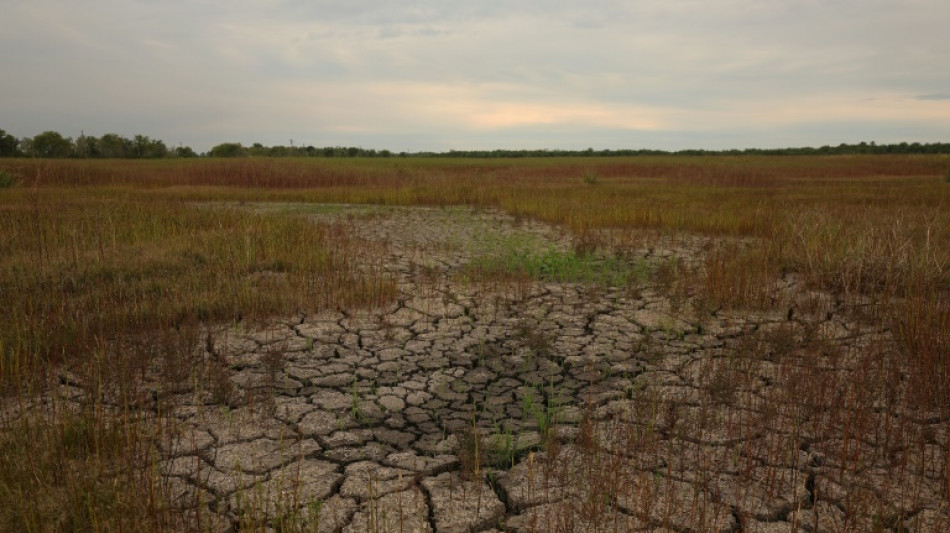
Disasters cause $3.8 tn in crop loses over 30 years: FAO / Photo: © GETTY IMAGES NORTH AMERICA/AFP/File

 South African election results renew debate over identity-based voting

 South African voters report smoother local election but declining IEC trust

 Dolly Parton museum and Nashville hotel open after singer’s death

 George and Amal Clooney attend New York political-comedy reading

 British buyers pay substantial premiums for period-home appearance

 Thomas Markle released to house arrest after child-abuse-image charge

 Dawn of War 4 developers chose Adeptus Mechanicus for tactical variety

 Italy face unbeaten South Africa in Turin Nations Championship match

 ChatGPT interactive interface feature tested across six custom tools

 Freshways milk-price cut deepens pressure on UK dairy farms

 Labour and National remain virtually tied as New Zealand vote count advances

 The Good Daughter adapts Karin Slaughter thriller with Rose Byrne and Meghann Fahy

 Heavy-lift drone evacuates wounded Ukrainian soldier from frontline kill zone

 Morrison says West Brom recovered after pressure from successive derby losses

 Britain considers 2027 state visit for Ukraine’s Zelensky

 Arizona Democrats Secure Historic Trifecta with New Legislative Leadership

 Carney Welcomes U.S. Trade Reversal After Democratic Midterm Victory

 Armenian FM Discusses EU Accountability for Palestinian Rights in Madrid

 Trump and Vance Pursue Secret Diplomacy with Iran Amid Military Pressure

Natural and man-made disasters have caused $3.8 trillion in crop and livestock loses over 30 years, the UN's Food and Agricultural Organization said on Friday.
Floods, droughts, insect infestations, storms, disease and war have caused about $123 billion per year in lost food production between 1991 and 2021, the equivalent of five percent of total production or enough to feed up to half a billion people per year, the FAO said in a report.
This is the first time the UN body has tried to compile such an estimate, with the aim of putting into context the scale of the cost of disasters on both a global and personal scale.
"The international community is taking stock of the fact that disasters are... increasing tremendously... quadrupling since the 1970s" and are having an increasing impact on food production, the deputy head of FAO's statistics department, Piero Conforti, told AFP.
The FAO report, entitled "The Impact of Disasters on Agriculture and Food Security", found that disasters are increasing in severity and frequency, from 100 per year in the 1970s to around 400 events per year in the past 20 years.
- Climate change a systemic risk -
Climate change is increasingly responsible, as well as human and livestock diseases.
"Agriculture around the world is increasingly at risk of being disrupted due to multiple hazards and threats such as flooding, water scarcity, drought, declining agricultural yields and fisheries resources, loss of biological diversities and environmental degradation," said the FAO.
It identified the "systemic drivers of disaster risk" as climate change, pandemics, epidemics and armed conflicts.
The damage adds up quickly.
Average annual grain losses hit 69 million tonnes, the equivalent of France's annual production.
Some 40 million tonnes of fruit and vegetable production was lost, and 16 million tonnes of meat, dairy and eggs.
Around 23 percent of losses due to disasters were sustained in the agricultural sector.
The FAO further found that poorer nations suffered the highest losses due to extreme events in terms of the percentage of their agricultural output, at up to 10 percent.
Asia is the worst-hit region, sustaining 45 percent of total agricultural losses due to disasters, and losing the equivalent of four percent of its agricultural output.
Horn of Africa nations that are regularly impacted by drought lost an average of 15 percent of crop production.
Island developing nations have also been particularly hard hit, sustaining losses of seven percent of their agricultural output.
- Women at greater risk -
Women are also hit harder than men.
"That's because of resource constraints and structural constraints that women face in accessing things like information, financial instruments, the resources that they need to prepare to respond to or recover from disaster events," said the report's author, Zehra Zaidi.
In Pakistan, where women account for 70 percent of farm labourers, it was shown after floods that men found other work much easier than women.
Lack of sufficient data kept the FAO from calculating losses to fishing and forest production.
Despite the increasing frequency and intensity of disasters, it is possible to reduce risks to agriculture.
"There is no one size fits all solution," said the FAO's Conforti, but "there are a range of practices that can enhance the resilience of agricultural systems."
That includes agronomic techniques such as using different plant varieties and different methods to prepare the soil, as well as creating and improving warning systems.
When locusts invaded the Horn of Africa region in 2020 and 2021, early warning provided the time necessary to treat 2.3 million hectares (5.6 million acres) in the region and nearby Yemen.
Some $1.77 billion in losses in grain and dairy production was saved, the FAO estimates.
Moreover, it was extremely cost-effective, with each dollar invested in prevention measures resulted in $15 of avoided crop losses.
B.Wyler--VB