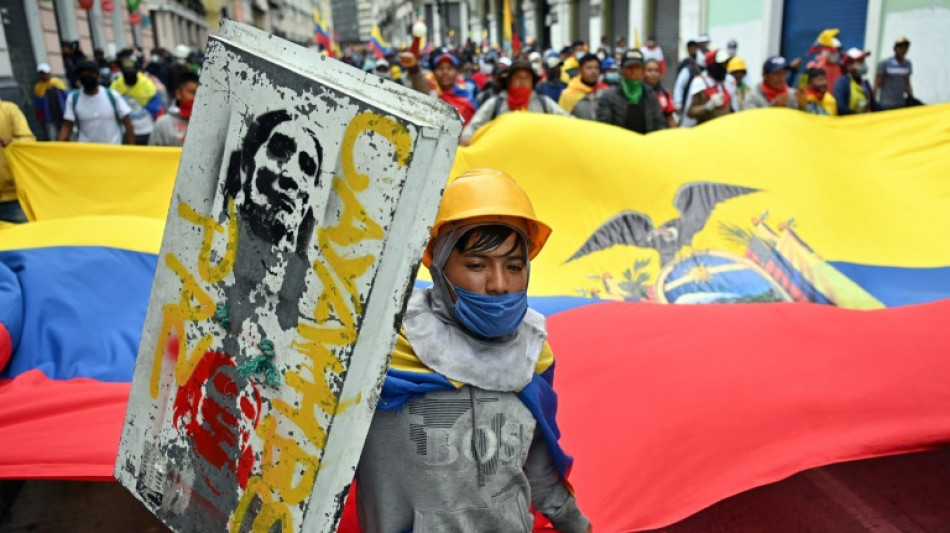
Ecuador: from Darwin to drug trafficking / Photo: © AFP/File

 South African election results renew debate over identity-based voting

 South African voters report smoother local election but declining IEC trust

 Dolly Parton museum and Nashville hotel open after singer’s death

 George and Amal Clooney attend New York political-comedy reading

 British buyers pay substantial premiums for period-home appearance

 Thomas Markle released to house arrest after child-abuse-image charge

 Dawn of War 4 developers chose Adeptus Mechanicus for tactical variety

 Italy face unbeaten South Africa in Turin Nations Championship match

 ChatGPT interactive interface feature tested across six custom tools

 Freshways milk-price cut deepens pressure on UK dairy farms

 Labour and National remain virtually tied as New Zealand vote count advances

 The Good Daughter adapts Karin Slaughter thriller with Rose Byrne and Meghann Fahy

 Heavy-lift drone evacuates wounded Ukrainian soldier from frontline kill zone

 Morrison says West Brom recovered after pressure from successive derby losses

 Britain considers 2027 state visit for Ukraine’s Zelensky

 Arizona Democrats Secure Historic Trifecta with New Legislative Leadership

 Carney Welcomes U.S. Trade Reversal After Democratic Midterm Victory

 Armenian FM Discusses EU Accountability for Palestinian Rights in Madrid

 Trump and Vance Pursue Secret Diplomacy with Iran Amid Military Pressure

Five things to know about Ecuador, which holds a runoff presidential election on Sunday.
- New narco-trafficking hub -
The election campaign has been dominated by pledges to tackle the lawlessness that has engulfed the once peaceful South American nation.
In the last few years, Ecuador has become a key player in the regional cocaine trade as drug trafficking from Colombia and Peru expands into the Andean country, taking advantage of lax security in ports on its Pacific coast.
The drug trade has spurred a wave of horrific violence, making security the top concern of voters.
Ecuador's murder rate since 2018 has quadrupled, kidnappings are rife, and a string of clashes between rival drug gangs has claimed more than 400 lives in Ecuadoran prisons since 2021, leaving behind a trail of dismembered and burned bodies.
- Indigenous power -
Ecuador's more than one million Indigenous people have cultivated powerful political representation, which has played a key role in the downfall of three presidents between 1997 and 2005.
In June 2022, the country was paralyzed by 18 days of Indigenous-led protests over the high cost of living and fuel prices, in which six people died.
Three decades earlier, an Indigenous uprising forced the government to surrender more than two million hectares (7,700 square miles) of land to Amazonian and Andean tribal groups.
But while the constitution recognizes their ownership of the land, the state maintains control of everything under the soil.
- Assange protector -
For seven years, the Ecuadoran embassy in London was at the center of the Julian Assange saga, offering asylum to the WikiLeaks founder pursued by the US for divulging military secrets about the wars in Iraq and Afghanistan.
But in 2019 Ecuador's government -- which shifted right after distancing itself from former socialist president Rafael Correa -- decided it had had enough of Assange and booted him out of the mission, accusing him of meddling in the politics of other states and being unhygienic, among other complaints.
The Australian has since been in a high-security prison east of London, where he is fighting Britain's plans to extradite him to the United States.
- Oil, bananas and shrimp -
One of the many ways drugs traffickers are getting their product out of the country is by smuggling it among one of Ecuador's top exports: bananas.
The fruit is the country's third leading export product after oil and shrimp, with Ecuador in 2020 overtaking India as the world's top exporter of the crustaceans.
The country's violence has also engulfed shrimp farmers, who are forced to shell out millions of dollars for private security industry-wide amid a wave of armed heists at sea and on land for their "pink gold."
- Galapagos Islands -
Ecuador is home to the famous Galapagos Islands, a marine-rich archipelago made up of 234 islands, inlets and rocks, with flora and fauna found nowhere else in the world.
Observing its wonders in the 19th century, British scientist Charles Darwin developed his theory of evolution after studying finches and mockingbirds there.
The impact of human activity through climate change and mass tourism threatens the unique ecosystems on the islands, listed as a world heritage site by UNESCO.
F.Fehr--VB