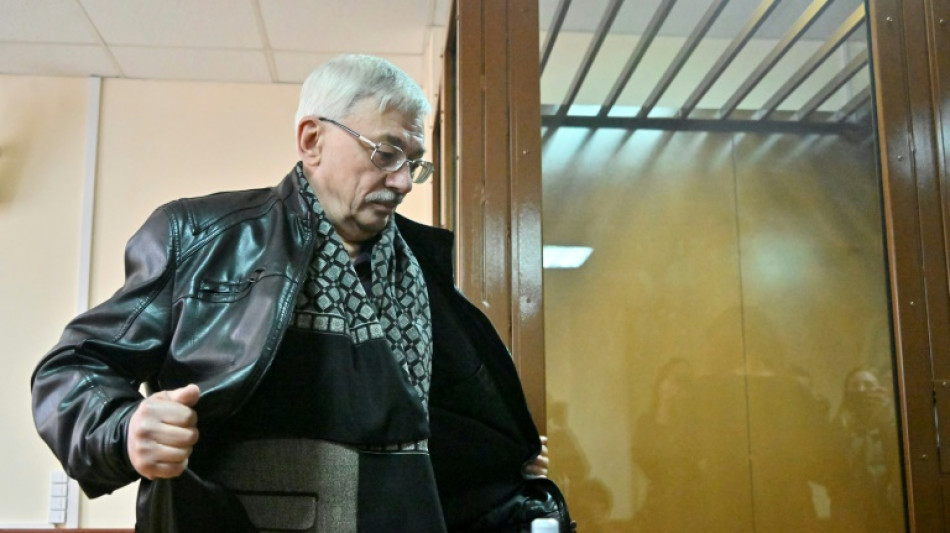
Fined Russian dissident denounces Ukraine offensive, repression / Photo: © AFP

 South African election results renew debate over identity-based voting

 South African voters report smoother local election but declining IEC trust

 Dolly Parton museum and Nashville hotel open after singer’s death

 George and Amal Clooney attend New York political-comedy reading

 British buyers pay substantial premiums for period-home appearance

 Thomas Markle released to house arrest after child-abuse-image charge

 Dawn of War 4 developers chose Adeptus Mechanicus for tactical variety

 Italy face unbeaten South Africa in Turin Nations Championship match

 ChatGPT interactive interface feature tested across six custom tools

 Freshways milk-price cut deepens pressure on UK dairy farms

 Labour and National remain virtually tied as New Zealand vote count advances

 The Good Daughter adapts Karin Slaughter thriller with Rose Byrne and Meghann Fahy

 Heavy-lift drone evacuates wounded Ukrainian soldier from frontline kill zone

 Morrison says West Brom recovered after pressure from successive derby losses

 Britain considers 2027 state visit for Ukraine’s Zelensky

 Arizona Democrats Secure Historic Trifecta with New Legislative Leadership

 Carney Welcomes U.S. Trade Reversal After Democratic Midterm Victory

 Armenian FM Discusses EU Accountability for Palestinian Rights in Madrid

 Trump and Vance Pursue Secret Diplomacy with Iran Amid Military Pressure

Veteran Russian human rights campaigner Oleg Orlov on Wednesday denounced Russia's offensive in Ukraine and the suppression of dissent as he was fined by a Moscow court for an op-ed on the dangers of "fascism" in his country.
The court found Orlov, co-chair of Nobel Prize-winning group Memorial, guilty of "discrediting" the Russian army and ordered the bespectacled 70-year-old to pay a 150,000-ruble (1,400-euro) fine.
After the verdict, Orlov was greeted with applause by a small group of supporters.
He said the verdict was "illegal" and "unjust" and he would be appealing.
"Let us remember the many people who have been sentenced to long, long years in prison for the truth," he said, adding: "Freedom for political prisoners!".
He recognised his own sentence was "infinitely milder than sentences handed to many other people" on similar charges.
In a trembling voice, Orlov had told the court the op-ed he was fined for was about "how the war affects our country and destroys the future of our country".
"As a citizen of Russia, I believe the actions of the armed forces in Ukraine contradict Russia's interests," he said.
Orlov's friend and fellow Nobel laureate Dmitry Muratov, the editor of Russia's Novaya Gazeta newspaper who joined Orlov's defence team, stood by him.
Muratov argued against the case made by prosecutors, who had brought World War II veterans to the trial to state how offended they were by Orlov's words.
"The Second World War was for our land. The Afghan war and the special military operation are for somebody else's," he said, using the official term used in Russia to refer to the Ukraine offensive.
"The right to have a personal opinion is the backbone of democracy," he said.
- 'No other choice' -
The charges against Orlov could have carried up to five years in prison.
Russians who speak out against Moscow's offensive are often sentenced to jail.
Prosecutors said they had decided to ask for a lighter sentence than they could have due to Orlov's age and health.
But Orlov argued: "Many of my like-minded people were punished very cruelly: many years of imprisonment for words, for a peaceful protest, for the truth."
He cited as examples opposition politician Vladimir Kara-Murza, serving 25 years in Siberia on treason charges, and artist Alexandra Skochilenko, in prison for having swapped supermarket tags with anti-war messages.
Orlov said he did not regret staying in Russia after the Kremlin launched the offensive, which sent much of the rights community abroad.
"This is my country and I thought that from Russia my voice would be the loudest," he said.
He said that his decades experience of campaigning for human rights had left him "no other choice" but to also protest the Ukrainian offensive, despite huge risks.
- 'Out of the darkness' -
The dissident said he did not regret staging one-man protests in central Moscow shortly after Putin launched the offensive in February 2022.
At the trial, prosecutors had asked that Orlov go through a psychiatric analysis, reminiscent of the Soviet-era practise of sending dissidents to psychiatric wards.
The judge rejected the request.
"The prosecution is relying on the criminal practice of this (Soviet) time," Orlov said. "Punitive psychiatry."
Orlov is among a generation of Russian rights activists who remember Soviet repression well.
A trained biologist, he joined Memorial in its early days in the late 1980s.
Memorial established itself as a key pillar in civil society by preserving the memory of victims of communist repression and campaigning against rights violations.
The organisation was officially disbanded by Russian authorities in late 2021, just months before Russian President Vladimir Putin sent troops to Ukraine.
The charges against Orlov are among the array of legislation the Kremlin has used to prosecute critics of its campaign in Ukraine after an outburst of protests in the early days of the conflict.
Thousands of Russians have been detained, jailed or fined for opposing the conflict.
Orlov concluded his courtroom speech on Wednesday saying: "Patriotism is not above all pride in one's country but stinging shame for the crimes that are being carried out in my country's name."
"It will not be long before our country comes out of the darkness in which it is currently plunged," he said.
R.Buehler--VB