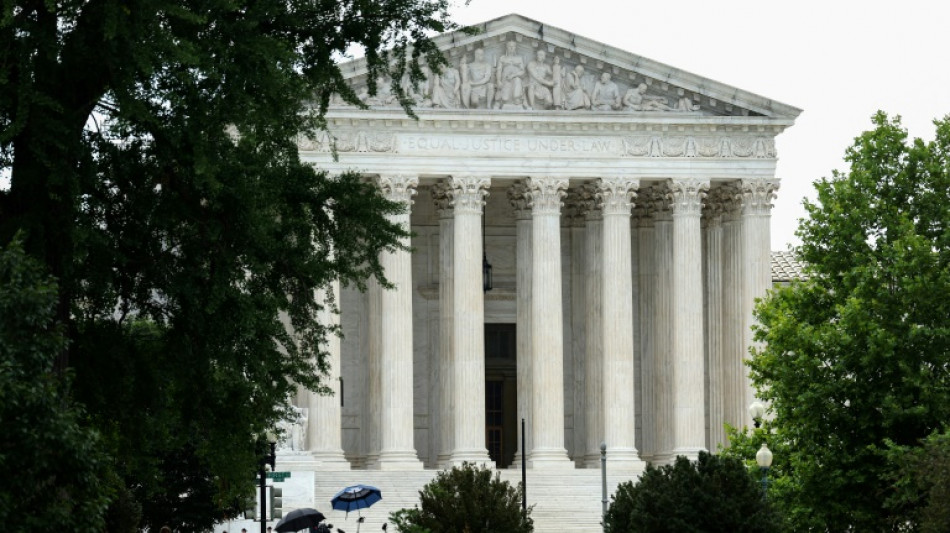
US Supreme Court to hear racial gerrymandering case / Photo: © GETTY IMAGES/AFP

 South African election results renew debate over identity-based voting

 South African voters report smoother local election but declining IEC trust

 Dolly Parton museum and Nashville hotel open after singer’s death

 George and Amal Clooney attend New York political-comedy reading

 British buyers pay substantial premiums for period-home appearance

 Thomas Markle released to house arrest after child-abuse-image charge

 Dawn of War 4 developers chose Adeptus Mechanicus for tactical variety

 Italy face unbeaten South Africa in Turin Nations Championship match

 ChatGPT interactive interface feature tested across six custom tools

 Freshways milk-price cut deepens pressure on UK dairy farms

 Labour and National remain virtually tied as New Zealand vote count advances

 The Good Daughter adapts Karin Slaughter thriller with Rose Byrne and Meghann Fahy

 Heavy-lift drone evacuates wounded Ukrainian soldier from frontline kill zone

 Morrison says West Brom recovered after pressure from successive derby losses

 Britain considers 2027 state visit for Ukraine’s Zelensky

 Arizona Democrats Secure Historic Trifecta with New Legislative Leadership

 Carney Welcomes U.S. Trade Reversal After Democratic Midterm Victory

 Armenian FM Discusses EU Accountability for Palestinian Rights in Madrid

 Trump and Vance Pursue Secret Diplomacy with Iran Amid Military Pressure

The US Supreme Court is to hear a case on Wednesday about discrimination against Black voters that could impact whether Democrats or Republicans control the House of Representatives next year.
The high-stakes voting rights case involves a challenge to a congressional district map drawn up by the Republican-majority legislature in South Carolina.
It is one of several legal battles involving racial gerrymandering -- the manipulation of electoral maps to minimize the voting power of minorities -- winding their way through the US courts.
A panel of federal judges approved a new congressional map for the southern state of Alabama this month that includes a second electoral district with a large population of African Americans, who tend to vote Democratic.
"The law requires the creation of an additional district that affords Black Alabamians, like everyone else, a fair and reasonable opportunity to elect candidates of their choice," they said.
Black voters represent around a quarter of registered voters in Alabama but are in a majority in only one of the state's seven US House districts.
The new map was drawn up after the Supreme Court ruled in June that the redistricting plan adopted by Alabama for the 2022 congressional elections violated the 1965 Voting Rights Act, which was passed by Congress during the civil rights movement to prevent racial discrimination at the polls.
Chief Justice John Roberts and Justice Brett Kavanaugh, both conservatives, joined the three liberal justices to fashion the 5-4 majority in the Alabama case.
A congressional map in Louisiana is also facing a legal challenge on the grounds it results in just one Black majority district although African Americans make up 30 percent of the southern state's population.
Republicans currently hold a slim 221-212 majority in the House and an increase in the number of Black majority districts could tip the balance in next year's congressional elections, when all 435 House seats will be up for grabs.
- 'Bleached' Charleston -
In the South Carolina case, a three-judge panel found the redrawn congressional map moved 60 percent of the Black residents of Charleston -- nearly 30,000 people -- from one district into another which already had a Black majority.
Six of the current members of the House from South Carolina are white and one is Black.
Sophia Lin Lakin of the American Civil Liberties Union (ACLU), which brought the South Carolina case along with the civil rights group the NAACP, said the state's congressional map constitutes "an extreme racial gerrymander."
"It limits the ability of Black voters to access representatives who can advocate for them," Lakin said.
She noted that the panel of lower court judges had ruled unanimously that the map "violates the Constitution by sorting voters predominantly on the basis of their race."
"In service of that racial target, the state legislature, 'bleached' Charleston, in the words of the court, by selectively targeting areas lived in by many Black voters for movement out of the congressional district," she said.
Jeff Rosen, president of the National Constitution Center, said the South Carolina Republican lawmakers who drew up the map openly acknowledged that they were carving Black voters out of Charleston, but claimed it was a permissible partisan gerrymander and not a racial gerrymander.
"They say the effort was a political effort of increasing incumbency protection and electing Republicans and the intent was not to harm Black people," he said.
The Supreme Court will hear oral arguments in the South Carolina case on Wednesday and is expected to issue a ruling by the end of January.
F.Stadler--VB