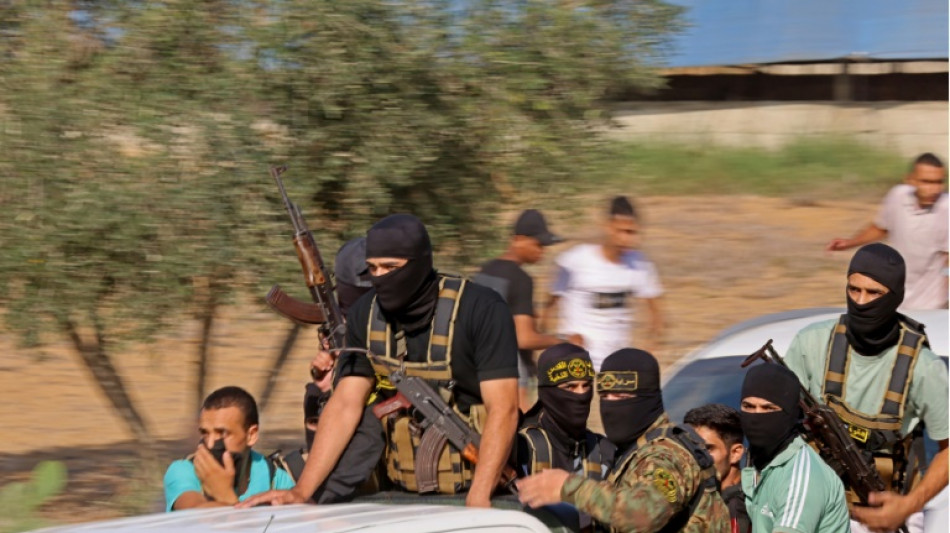
Snipers, drones, bulldozers: Gaza border guards recount Hamas attack / Photo: © AFP/File

 South African election results renew debate over identity-based voting

 South African voters report smoother local election but declining IEC trust

 Dolly Parton museum and Nashville hotel open after singer’s death

 George and Amal Clooney attend New York political-comedy reading

 British buyers pay substantial premiums for period-home appearance

 Thomas Markle released to house arrest after child-abuse-image charge

 Dawn of War 4 developers chose Adeptus Mechanicus for tactical variety

 Italy face unbeaten South Africa in Turin Nations Championship match

 ChatGPT interactive interface feature tested across six custom tools

 Freshways milk-price cut deepens pressure on UK dairy farms

 Labour and National remain virtually tied as New Zealand vote count advances

 The Good Daughter adapts Karin Slaughter thriller with Rose Byrne and Meghann Fahy

 Heavy-lift drone evacuates wounded Ukrainian soldier from frontline kill zone

 Morrison says West Brom recovered after pressure from successive derby losses

 Britain considers 2027 state visit for Ukraine’s Zelensky

 Arizona Democrats Secure Historic Trifecta with New Legislative Leadership

 Carney Welcomes U.S. Trade Reversal After Democratic Midterm Victory

 Armenian FM Discusses EU Accountability for Palestinian Rights in Madrid
Israel long thought its hi-tech security barrier blockading the Gaza Strip was impenetrable, brimming with razor wire, cameras and sensors and fortified with a concrete base against tunnels and remote-controlled machine guns.
But in the aftermath of the surprise Hamas onslaught, soldiers who were on guard duty have recounted the shocking moments when the militants launched their complex operation to breach Israel's "Iron Wall" around the enclave in multiple locations.
The massive attack at dawn Saturday came under cover of a rocket barrage aimed at Israel and involved sniper fire, explosives dropped from drones, and bulldozers that ripped through the six-metre (almost 20-foot) tall double fence barrier.
More than 1,500 militants quickly swarmed through in pick-up trucks and on motorcycles, joined by others using gliders and speedboats at sea, to unleash gun attacks that claimed hundreds of lives in nearby communities.
"At 6:30 am (0330 GMT) the rockets started," a lookout soldier who was stationed in Nahal Oz, across from Gaza City, said in a televised interview from her hospital bed.
"About 30" militants quickly occupied the army base and held it for seven hours, the soldier, identified only as Y., told Israel's Channel 12.
"I sprinted barefoot to the bomb shelter, and after an hour we started hearing voices in Arabic, and they started shooting at the entrance," she recalled.
Until an elite Israeli army unit finally retook the base, "for all those hours, it became their (Hamas's) camp", the soldier said.
- Sniper attacks -
In the opening moments of the massive attack, snipers "fired at the observation posts" dotted along the 65-kilometre (40-mile) long barrier, an Israeli army spokesperson told AFP.
A soldier stationed at an observation post also said the Palestinian gunmen "started shooting at... observation cameras, and it got to the point where we could no longer observe" the border.
In comments published by independent Israeli news website Hamakom, the unnamed soldier said that, as her army base came under attack, "we were told our only option was to... run for our lives into the situation room."
Other soldiers shared similar accounts in social media posts and media interviews, all pointing to a initial mass attack to cripple the barrier's observation and communications systems.
The army spokesperson denied to AFP rumours of a cyber attack targeting military systems as the cause of the blackout.
Video footage released by Hamas also shows militants firing at observation posts, including their remotely operated systems with firing capabilities.
Other footage online was taken by the cameras of drones that hovered above watchtowers and dropped explosives onto them, while militants are also seen using bulldozers or blasting gaping holes through the border fence, allowing fighters to rush through.
- 'My worst nightmare' -
The attack that followed was the worst in Israel's 75-year history, setting off retaliatory strikes on Gaza and sparking a war that had claimed thousands of lives by Tuesday, with no quick end in sight.
"It's a huge failure of the intelligence system and the military apparatus in the south," said retired military general Yaakov Amidror, a former national security adviser.
Israeli soldiers who were posted along the border recounted the terror of the initial attack, in which Hamas fighters killed or captured their comrades and destroyed or commandeered tanks and other military hardware.
In testimony posted on Instagram, a lookout soldier said the early morning attack was "nothing I could have imagined in my worst nightmares".
"I never thought I would ever see such thing in a lookout. I did my best until a sniper hit" the observation system, she said.
"They took us by surprise and we weren't ready for it... and (there was) no intelligence at all."
Survivors of the attacks on nearby communities have been shocked at the failure of the systems that were meant to ensure their security.
Inbal Reich Alon, 58, from the hard-hit Beeri kibbutz, recounted that, years ago, "after they set up the barrier, we'd realised we were safe".
That, she added, "was an illusion".
R.Buehler--VB