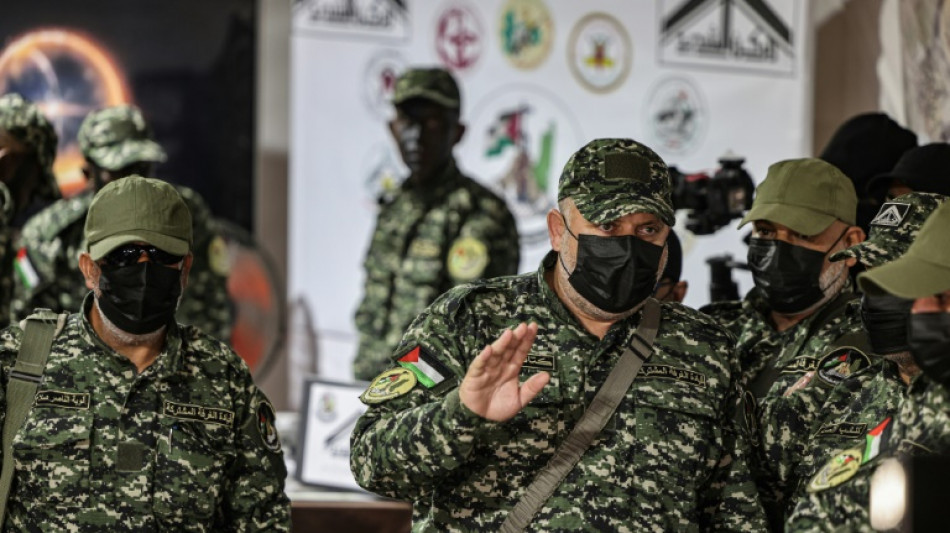
Grim prospects if Israel launches ground assault on Gaza / Photo: © AFP

 South African election results renew debate over identity-based voting

 South African voters report smoother local election but declining IEC trust

 Dolly Parton museum and Nashville hotel open after singer’s death

 George and Amal Clooney attend New York political-comedy reading

 British buyers pay substantial premiums for period-home appearance

 Thomas Markle released to house arrest after child-abuse-image charge

 Dawn of War 4 developers chose Adeptus Mechanicus for tactical variety

 Italy face unbeaten South Africa in Turin Nations Championship match

 ChatGPT interactive interface feature tested across six custom tools

 Freshways milk-price cut deepens pressure on UK dairy farms

 Labour and National remain virtually tied as New Zealand vote count advances

 The Good Daughter adapts Karin Slaughter thriller with Rose Byrne and Meghann Fahy

 Heavy-lift drone evacuates wounded Ukrainian soldier from frontline kill zone

 Morrison says West Brom recovered after pressure from successive derby losses

 Britain considers 2027 state visit for Ukraine’s Zelensky

 Arizona Democrats Secure Historic Trifecta with New Legislative Leadership

 Carney Welcomes U.S. Trade Reversal After Democratic Midterm Victory

 Armenian FM Discusses EU Accountability for Palestinian Rights in Madrid
Israel appears likely to stage a ground assault on Gaza in response to deadly weekend attacks by Hamas, risking close-quarters fighting in densely populated areas, including in underground tunnels and around hostages.
Israel's government on Monday said it would "immediately cut (its) water supply to Gaza" as part of a "complete siege" on the Hamas-controlled territory.
Next, "Israel will launch the largest joint (air/sea/land/space) operation against Gaza in history," John Spencer, an expert at the Modern War Institute at US military academy West Point, predicted on X, formerly Twitter.
Alexander Grinberg, of the Jerusalem Institute for Strategy and Security, said that "strikes will first of all target Hamas command centres and troops, with fire coming from everywhere".
"At the same time, the army will prepare to enter Gaza," he said.
Such urban fighting will force combatants into hand-to-hand combat, reduce visibility, increase the risk of traps, blur boundaries between civilians and soldiers and render armoured vehicles next to useless.
- 'Inherent risks' -
City fighting is "a 360-degree battlefield as the threats can be all around you," said Andrew Galer, a former British army officer, now an analyst at private intelligence firm Janes.
Going house-to-house to secure potentially booby-trapped buildings means bringing in bomb disposal experts with cumbersome gear like ladders, ropes and explosives -- "possibly all while taking fire" and in the dark, he added.
And there are "inherent risks" of friendly fire given "the difficulties of situational awareness", Galer said.
"Using artillery can make the situation worse, as while it may kill some defenders, the rubble then provides them with cover".
- 'Gaza Metro' -
Gaza's roughly 2.3 million Palestinian inhabitants have been living under an Israeli blockade since 2007.
Its overcrowded, narrow web of streets is doubled underground by a dense tunnel network known to Israeli troops as the "Gaza Metro".
Gaza's 14-kilometre (nine-mile) border with Egypt was once burrowed under with hundreds of tunnels used to smuggle fighters, weapons and other contraband -- although many have now been destroyed.
But since 2014, Hamas has been digging underground pathways to get around territory it controls.
Some tunnels are as deep as 30 or 40 metres (100-130 feet) below ground, allowing militants to change position away from the danger of strikes.
Rocket batteries hidden just a few metres beneath the surface can be uncovered with a trapdoor just for the time it takes to fire a salvo.
Israel's army and intelligence are certain to know about a portion of the network, and bombarded it heavily in 2021.
But other parts remain secret and will make any Israel Defense Forces (IDF) ground operation in Gaza more difficult.
- 'Long, difficult, many losses' -
Hamas "knows its tunnels by heart," said Colin Clarke, research director at the New York-based Soufan Center think-tank.
"Some are probably booby-trapped. Preparing to fight in such terrain... would require extensive intelligence... which the Israelis may not have," he added.
Underground fighting would hand a major tactical advantage to the Hamas defenders and their leadership.
"Everyone knows it will be long and difficult, with many losses," Grinberg said, although technology such as robots could work in the assaulting forces' favour.
On the other hand, Hamas' tunnel advantage "could also turn out to be a trap," he added.
"When tunnels are found, they can be closed off to shut in the people inside. In this case, the order is likely to be for no quarter" to be given.
- 'Bring the hostages back' -
The dozens of civilian hostages Hamas seized at the weekend present another complication for the IDF.
"Israeli society wouldn't forgive it if the hostages' lives are not a priority," said Sylvaine Bulle, a sociologist studying Israel at France's National Centre for Scientific Research (CNRS).
Citizens' attitude would be "you have failed to ensure our security, bring us the hostages back," she predicted -- leading to "conflicts... between politicians and the military".
The government is unable to negotiate for now, said Kobi Michael, a researcher at the Tel Aviv-based INSS think-tank.
"With all the sorrow, with all the pain... the hostage issue cannot be the first priority," he said.
"Israel will reach to the hostage issue only with the upper hand and when Hamas will be defeated and weak, not a second before," Michael added.
A Qatar-based Hamas official told AFP Monday there was "currently no chance for negotiation on the issue of prisoners or anything else".
W.Huber--VB