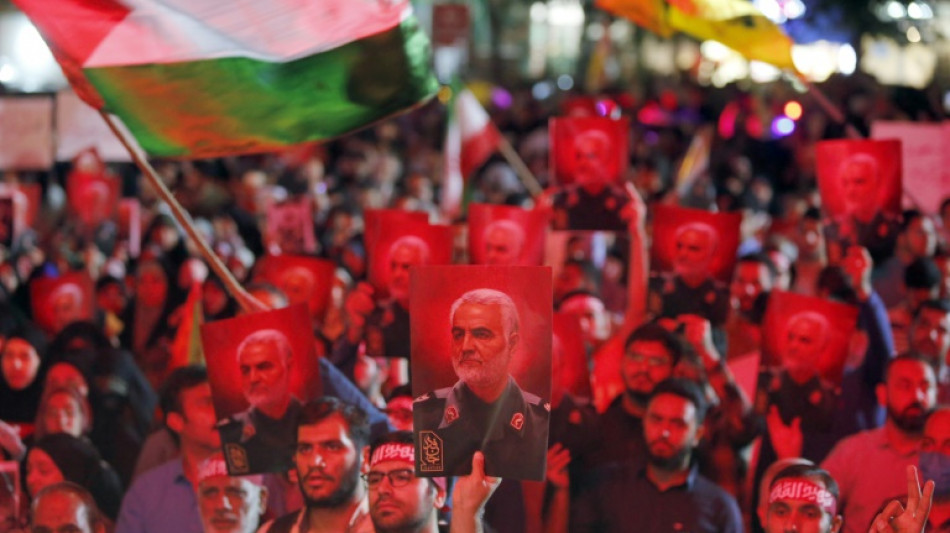
Iran lauds Hamas attack even as it denies involvement / Photo: © AFP

 South African election results renew debate over identity-based voting

 South African voters report smoother local election but declining IEC trust

 Dolly Parton museum and Nashville hotel open after singer’s death

 George and Amal Clooney attend New York political-comedy reading

 British buyers pay substantial premiums for period-home appearance

 Thomas Markle released to house arrest after child-abuse-image charge

 Dawn of War 4 developers chose Adeptus Mechanicus for tactical variety

 Italy face unbeaten South Africa in Turin Nations Championship match

 ChatGPT interactive interface feature tested across six custom tools

 Freshways milk-price cut deepens pressure on UK dairy farms

 Labour and National remain virtually tied as New Zealand vote count advances

 The Good Daughter adapts Karin Slaughter thriller with Rose Byrne and Meghann Fahy

 Heavy-lift drone evacuates wounded Ukrainian soldier from frontline kill zone

 Morrison says West Brom recovered after pressure from successive derby losses

 Britain considers 2027 state visit for Ukraine’s Zelensky

 Arizona Democrats Secure Historic Trifecta with New Legislative Leadership

 Carney Welcomes U.S. Trade Reversal After Democratic Midterm Victory

 Armenian FM Discusses EU Accountability for Palestinian Rights in Madrid
Iran took the lead in celebrations following the surprise attack by Palestinian Islamist group Hamas on Tehran's arch-enemy Israel, even as it rejected accusations of direct involvement.
The Islamic republic's backing was made manifest by billboards installed in Tehran's major plazas, including Palestine Square.
"The great liberation has begun," proclaimed one while a second showed the black and white chequerboard of the Palestinian keffiyeh gradually subsuming the white and blue flag of Israel.
The enormous images went on display just hours after Hamas launched its deadly and unexpected assault, dubbed "Al-Aqsa Flood", on Saturday.
Iran has made support for the Palestinian cause a centrepiece of its foreign policy and much is at stake for Tehran in the war between Israel and Hamas.
- Denials -
Despite its vocal support, Tehran on Monday rejected allegations it had a direct role in organising the assault.
"The accusations of an Iranian role... are based on political motives," foreign ministry spokesman Nasser Kanani said at his first weekly news conference since the attack.
Kanani said the Islamic republic does not intervene "in the decision-making of other countries, including Palestine" and threatened Israel with a "devastating response" if it were to attack Iran.
Iran's permanent mission to the United Nations also denied allegations of the country's involvement, in a statement issued overnight.
During a visit to Lebanon in early September, Iranian Foreign Minister Hossein Amir-Abdollahian met with officials from the Lebanese Hezbollah, Hamas, and the Palestinian Islamic Jihad, reaffirming Iran's strong support for "resistance".
A report at the weekend in the Wall Street Journal said that "Iranian security officials helped plan Hamas's Saturday surprise attack on Israel and gave the green light for the assault at a meeting in Beirut last Monday", citing senior members of Hamas and Hezbollah.
A senior White House official reacted cautiously to the claims, stating on Sunday that it was "too early to say" if Iran was "directly involved" in the attack.
But the official acknowledged there had been "no doubt" that Hamas was "financed, equipped, and armed", among other things, by Tehran.
Ahmad Zeidabadi, a political scientist, said it appeared the Islamic republic was unwilling to get directly involved but that they "expect Hamas to be able to change the situation on its own".
However, he said, Tehran "might be interested at some point" in having its other "aligned groups" such as Hezbollah in Lebanon "reduce the pressure on Gaza by opening a new front" on Israel's northern border.
A strengthened Hamas would be a major boon for Iran, said Zeidabadi, but it would be "a debacle for the Islamic republic" if Hamas were to have "all its political, economic and military infrastructure destroyed".
Iran's President Ebrahim Raisi reacted on Sunday to the attack by saying his country "supports the legitimate defence of the Palestinian nation," after phone talks with Palestinian militant leaders.
"Coordination with the axis of resistance continues," Ismail Sindawi, Islamic Jihad's representative in Syria said on Monday, referring to the alliance of political parties and militant groups that stretches from Lebanon to Afghanistan.
- Stopping normalisation -
The surprise attack came with the backdrop of efforts by the United States to push for a deal normalising diplomatic relations between Israel and Saudi Arabia.
That would follow on from historic treaties with Morocco, the United Arab Emirates, Bahrain and others.
Iran has been highly critical of these efforts and on Sunday, the chief of staff for Iran's armed forces, Mohammad Bagheri, called normalisation "desperate efforts" that will not "slow down" Israel's "collapse".
Iran's supreme leader, Ayatollah Ali Khamenei, last week labelled them a losing gamble.
For Tehran, normalisation adds extra importance to Hamas's survival and success, said Zeidabadi, the political scientist.
"If Hamas is completely defeated, the path to normalisation of relations will open up because there is no other practical alternative to Israel," Zeidabadi said.
"But if Hamas wins, this agreement will be postponed for some time."
P.Vogel--VB