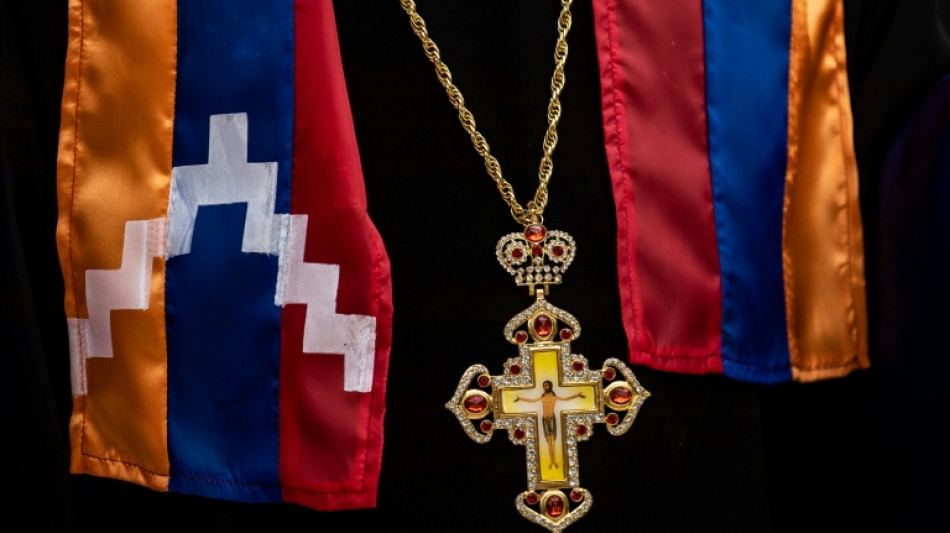
Fears over future of Armenian culture in Nagorno-Karabakh / Photo: © AFP

 Ex-president Hernandez returns to Honduras after Trump pardon

 Norris grabs first race win of season in Hungary

 Sooryavanshi's 81 steers India to Zimbabwe T20 series sweep
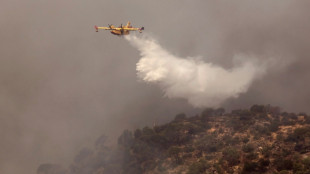 Spanish wildfires intrude on holidaying foreign visitors
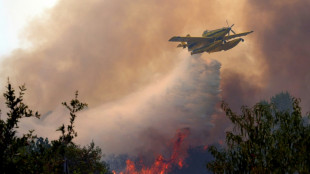 France and Spain battle 'unpredictable' wildfires as 300,000 evacuated
 Taiwan's Chou Tien-chen snatches China Open title at age 36

 Ramsay-Peaty bounces back at Commonwealth Games after tearful outburst
 Iran says halts Middle East attacks as US holds fire
 Wildfires overwhelm exhausted firefighters in France and Spain
 Urgent search for suspect after deadly attack near Berlin Pride

 D-Day beaches inscribed on UNESCO World Heritage List
 As Zimbabwe's raw lithium ban pays off, ambitions grow
 German manhunt after deadly car ramming near Berlin Gay Pride

 Vienna's venerable vineyard taverns forced to move with the times
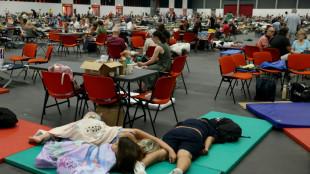 Thousands crowd shelters as wildfires force exodus in France, Spain

 Burnham offers sweeteners, hopeful vibes in first week as UK PM

 'The Odyssey': Christopher Nolan's latest cultural phenomenon

 'Star Trek' celebrates 60th anniversary at Comic-Con

 Merz vows justice after deadly car attack near Berlin Gay Pride event

 Merz vows justice after deadly car attack near Berlin Pride event

 Hiltz extends US 1,500 streak, Lyles advances in 200

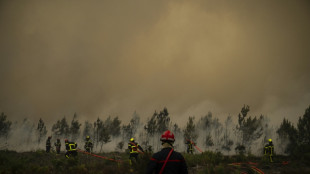 'Difficult night' as France, Spain fires intensify again

 Beaten Ramsay-Peaty casts doubt on future as Australia rule Commonwealth pool

 Ramsay-Peaty beaten into bronze as Australia's Williamson wins Commonwealth gold

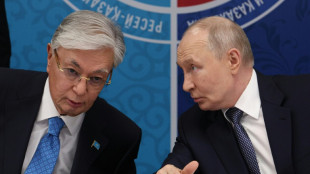 Kazakh leader tells Putin war should end, Ukraine launches fresh strikes

Most ethnic Armenians have fled the breakaway enclave of Nagorno-Karabakh since last month's lightning offensive by Azerbaijan, and some fear that the territory's culture is under threat.
Azerbaijan took control of the mountainous region, considered by Armenia to be its people's ancestral home, in September after a one-day offensive that sparked a mass exodus of the ethnic Armenian population.
It was part of Muslim-majority Azerbaijan since the end of the Russian Empire, but it is dotted with several hundred churches, monasteries and tombstones, some dating back to the 11th century.
Its ethnic Armenian Christian inhabitants attempted to break away after the collapse of the Soviet Union in 1991 -- making a unilateral declaration of independence that failed to achieve international recognition.
Some of the religious sites have unique features and are carved with armed knights dating back to the Mongol Empire of the 13th and 14th century, said Patrick Donabedian of the Laboratory of Medieval and Modern Archeology in the Mediterranean in France.
Key figures who have lived in Karabakh and left during years of dispute include priests from the Armenian Apostolic Church.
They include the clergy of the Dadivank monastery, which is said to have been founded by Saint Dadi at the birth of Christianity.
Some fear their departure has left the region's Armenian cultural sites vulnerable.
"These sites will suffer the same fate as symbolic Armenian sites elsewhere," predicted Hovhannes Gevorgyan, Karabakh's representative in France.
He pointed to the destruction of Armenian historical sites elsewhere in Azerbaijan and in parts of the Karabakh region that were retaken by Baku in the war between Azerbaijan and Armenia over the territory in 2020.
- 'Complete destruction' -
The Armenian church of Saint Gregory in Baku -- listed on the Azerbaijani register of national historic monuments -- is currently closed to the public.
Its gates are locked and one of the entrance doors is blocked shut by the terrace of a nearby restaurant, an AFP journalist observed.
In Karabakh itself, the Saint Saviour cathedral in Shusha -- a city Azerbaijan sees as its cultural capital -- is hidden behind a wall of scaffolding.
Other Armenian monuments languish under tarpaulin.
Since the Azerbaijani offensive in September, "the risks... today take many forms", said Lori Khatchadourian, an archaeologist at Cornell University in the United States.
"There's the risk of damage. There's the risk of outright destruction, the risk of erasing of inscriptions," she told AFP.
Rather than famous monuments, it is historic cemeteries and churches in small villages that are the most under threat, she added.
Khatchadourian is co-founder of Caucasus Heritage Watch, which, she said, used high-resolution satellite imagery to document the fate of the Armenian cultural sites in Karabakh and the Azerbaijani exclave of Nakhchivan.
In Nakhchivan, located near the Iranian border, the group's research shows "the complete destruction of 108 mediaeval and early modern Armenian monasteries, churches and cemeteries between 1997 and 2011".
"This figure represents 98 percent of the Armenian cultural sites we were able to locate," she said.
In the Nakhchivan city of Julfa, formerly Jugha, she said there was a slow-moving methodical process of erosion over a period of 10 years.
This data is impossible to verify from the ground because access to the sites is strictly controlled by Azerbaijani authorities.
Baku has said that mosques and other Islamic sites under Armenian control have been desecrated or damaged.
- Intangible heritage -
Armenian heritage could also be threatened, some say, by the fact that some of the 700,000 Azerbaijanis displaced in the 1980s and 1990s from Armenia, Karabakh and surrounding areas could now choose to move into the enclave.
Azerbaijani President Ilham Aliyev has said repeatedly in recent years that Armenians have no ancestral claim to the region.
Its mosques and churches are Azerbaijanis' historic treasures, he has said.
In December 2021, the International Court of Justice reminded Baku it had a legally binding duty to prevent the vandalism and desecration of Armenian cultural sites -- including monuments, cemeteries and places of worship.
Azerbaijan's culture ministry did not immediately respond when contacted by AFP.
Since its lightning military seizure of Karabakh, Baku has pledged to afford equal rights to everyone in the territory, whatever their ethnic, religious or linguistic origins.
But Armenian intangible heritage is also "inevitably" at risk, Gevorgyan said.
Armenian folk dances and songs, other traditions and even the dialects spoken in Karabakh "risk vanishing over time".
"The natural guardians of places whose culture and traditions they have passed on down the generations might, once they have physically left be able to pass them on to the next generation," he said.
"But what happens after that?"
B.Wyler--VB