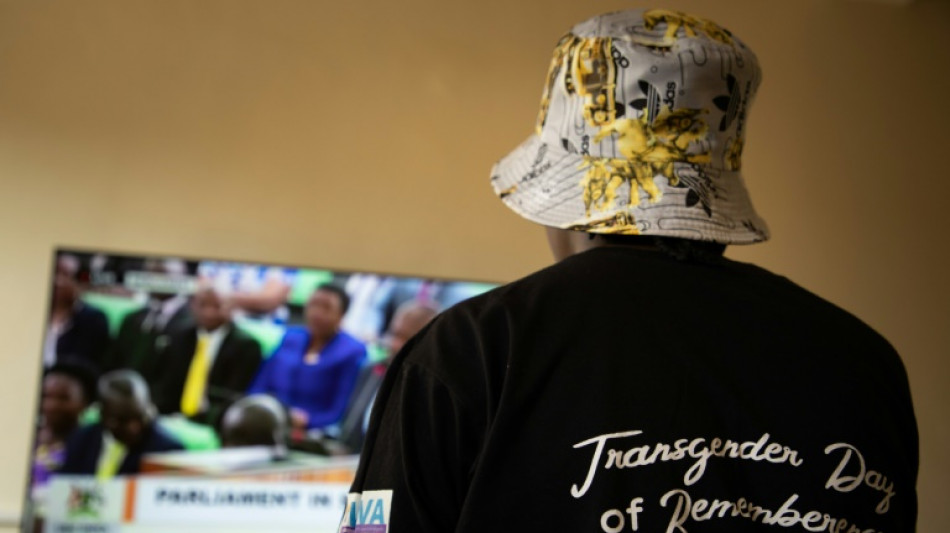
Uganda gov't lawyers advise president not to sign anti-gay bill / Photo: © AFP/File

 South African election results renew debate over identity-based voting

 South African voters report smoother local election but declining IEC trust

 Dolly Parton museum and Nashville hotel open after singer’s death

 George and Amal Clooney attend New York political-comedy reading

 British buyers pay substantial premiums for period-home appearance

 Thomas Markle released to house arrest after child-abuse-image charge

 Dawn of War 4 developers chose Adeptus Mechanicus for tactical variety

 Italy face unbeaten South Africa in Turin Nations Championship match

 ChatGPT interactive interface feature tested across six custom tools

 Freshways milk-price cut deepens pressure on UK dairy farms

 Labour and National remain virtually tied as New Zealand vote count advances

 The Good Daughter adapts Karin Slaughter thriller with Rose Byrne and Meghann Fahy

 Heavy-lift drone evacuates wounded Ukrainian soldier from frontline kill zone

 Morrison says West Brom recovered after pressure from successive derby losses

 Britain considers 2027 state visit for Ukraine’s Zelensky

 Arizona Democrats Secure Historic Trifecta with New Legislative Leadership

 Carney Welcomes U.S. Trade Reversal After Democratic Midterm Victory

 Armenian FM Discusses EU Accountability for Palestinian Rights in Madrid
Lawyers for the Ugandan government have advised President Yoweri Museveni not to sign a draconian anti-gay bill passed by parliament last month as he met with ruling party lawmakers on Thursday to discuss the controversial legislation.
The Anti-Homosexuality Bill 2023, which calls for harsh penalties against anyone who engages in same-sex activity, has been roundly condemned by the international community and rights campaigners.
Museveni has faced widespread calls to reject what has been criticised as among the world's harshest anti-gay legislation.
Under the bill, anyone who engages in same-sex activity could face life imprisonment while repeat offenders could be sentenced to death, according to activists.
Lawyers for the government have advised the president to send the bill back to parliament, according to a letter sent by the deputy attorney general to the speaker of parliament on Thursday and seen by AFP.
The move came as the European Parliament voted to condemn the bill and urged EU states to find a way to pressure Museveni into not implementing it, warning relations with Kampala were at stake.
MEPs urged the European Commission to "use all necessary diplomatic, legal and financial means to convince the president to not sign the law."
In the letter to speaker Anita Among, deputy attorney general Kaafuzi Jackson Kargaba said that the government's legal team has recommended that the bill "be returned to Parliament for reconsideration".
The government wants to "ensure that once the Bill is assented to, it stands the test of time without being struck down by Court as being unconstitutional", Karaba said.
The inclusion of the death penalty in particular would leave the bill open to legal challenge in a country that has effectively ended the use of capital punishment, he said.
The bill was passed in a chaotic late-night parliamentary session and many of its hastily drafted clauses are open to interpretation, with Kargaba warning that some of its provisions are "too broad or vague".
Such provisions "need to be revisited before the Bill is assented to by His Excellency the President to avoid the Bill being challenged in Court on grounds of unconstitutionality upon coming into force."
- 'Deeply troubling' -
Museveni summoned lawmakers from the ruling National Resistance Movement on Thursday to discuss the bill, with the party's chief whip Denis Hamson Obua confirming the meeting to AFP before it got under way.
Sources close to Museveni's office earlier told AFP that they expect the president to reject the current draft of the bill and return it to parliament for reconsideration.
Last month, the White House warned Uganda of possible economic repercussions if the legislation takes effect.
The UN High Commissioner for Human Rights Volker Turk also urged Museveni not to promulgate the bill into law.
"The passing of this discriminatory bill -– probably among the worst of its kind in the world –- is a deeply troubling development," he said after the March parliamentary vote.
But many of Uganda's neighbours are also cracking down on gay rights, with politicians in Kenya and Tanzania for example warning against any efforts to raise awareness of LGBTQ issues.
Homosexuality was criminalised in Uganda under colonial-era laws but since independence from Britain in 1962 there has never been a conviction for consensual same-sex activity.
strs-amu/cw
W.Lapointe--BTB