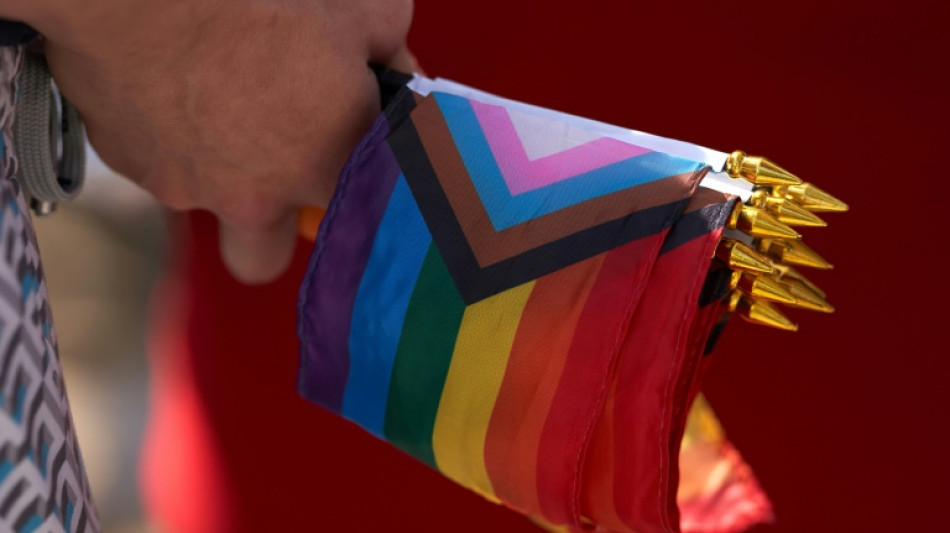
'We have no place': LGBTQ Saudis forced into exile / Photo: © AFP/File

 South African election results renew debate over identity-based voting

 South African voters report smoother local election but declining IEC trust

 Dolly Parton museum and Nashville hotel open after singer’s death

 George and Amal Clooney attend New York political-comedy reading

 British buyers pay substantial premiums for period-home appearance

 Thomas Markle released to house arrest after child-abuse-image charge

 Dawn of War 4 developers chose Adeptus Mechanicus for tactical variety

 Italy face unbeaten South Africa in Turin Nations Championship match

 ChatGPT interactive interface feature tested across six custom tools

 Freshways milk-price cut deepens pressure on UK dairy farms

 Labour and National remain virtually tied as New Zealand vote count advances

 The Good Daughter adapts Karin Slaughter thriller with Rose Byrne and Meghann Fahy

 Heavy-lift drone evacuates wounded Ukrainian soldier from frontline kill zone

 Morrison says West Brom recovered after pressure from successive derby losses

 Britain considers 2027 state visit for Ukraine’s Zelensky

 Arizona Democrats Secure Historic Trifecta with New Legislative Leadership

 Carney Welcomes U.S. Trade Reversal After Democratic Midterm Victory

 Armenian FM Discusses EU Accountability for Palestinian Rights in Madrid
Turki finally summoned the courage last year to come out as gay, but his family's refusal to accept him forced the 20-year-old to seek safety -- and freedom -- outside conservative Saudi Arabia.
Soon after his disclosure, Turki found himself effectively detained by his parents and brothers, confined to a room and barred from attending his university classes.
"When my mother learned of my sexual orientation, she said to me, 'You are not my son,'" he recalled.
"My father and brothers beat me, and I was prevented from going out and meeting my friends for weeks."
LGBTQ rights remain a social taboo in the Gulf kingdom -- the birthplace of Islam governed by an interpretation of sharia law -- even after social changes ushered in by de facto ruler, Crown Prince Mohammed bin Salman.
The reform agenda has included the sidelining of religious police, the introduction of cinemas and all-night desert raves.
But it has failed to translate into expanded liberties for people seeking to proclaim their gender and sexual identities without fear.
Some LGBTQ Saudis felt they were left with no option but to flee their home country, as Turki did within months of coming out, after saving enough money for an international flight.
"I left in the night and travelled to London for good," he told AFP from his new home.
Now Turki, who asked to be identified by first name only for safety reasons, enjoys "a modest life in a shared flat" that he said, most importantly, is "full of freedom".
- 'Very sensitive' -
Under Saudi law, homosexuality is an offence potentially punishable by death, but rights groups say it is hard to determine the extent to which authorities enforce it.
In its most recent report on human rights in Saudi Arabia, the US State Department said there were "no known prosecutions under these laws" in 2021 "except when individuals posted photos of so-called cross-dressing on social media".
And in an opinion piece published in Saudi newspaper Okaz, columnist Fahad Deghaither argued earlier this month that while his country opposes such "lack of modesty", homosexuality "has existed since before the emergence of some prophets, and we have not heard of any homosexual held accountable for his behaviour which he did not choose in the first place".
Still, it seems impossible for sexual minorities to feel welcome, with censorship of LGBTQ references in films and even a state media report last year showing a crackdown on rainbow-coloured toys and clothing in shops in the capital Riyadh.
The reported death by suicide of a transgender woman last month after her return to the kingdom has further exacerbated fears.
"Despite the radical social reforms and the electric shock approach (Prince Mohammed) has to soften the social norms in Saudi society," anything related to LGBTQ rights is "very, very sensitive", said Yasmine Farouk of the Carnegie Endowment for International Peace.
"It is still an Arab Muslim society within a region where this issue remains a... tense one."
- Escaping 'death' -
Turki, like some other LGBTQ Saudis, sees little hope for change.
"No matter what reforms happen, I can't imagine that society will recognise us," he said.
"We have no place."
Several LGBTQ exiles told AFP the story of Eden Knight, a transgender Saudi woman feared to have killed herself after returning from the United States, showed their concerns were justified.
In a note posted on Knight's Twitter account on March 12, she complained of being "subjected to daily searches" and "berated for being a freak" by her family.
"I have tried killing myself in the past, but... I survived," the note said. "This time, I am done."
Knight has not been heard from since.
AFP has not been able to confirm what happened to her. Saudi authorities did not respond to a request for comment.
It is "very difficult" for many Saudis to understand transgender identity, said a transgender woman who requested anonymity.
She told AFP she ultimately gave up on being accepted in her home country and travelled to Britain in September after saving enough money.
"My only hope was to leave and start a new life in a country that understood me."
Hind, a Saudi lesbian now based in Wales who asked to use a pseudonym for safety concerns, said fleeing was a matter of survival.
"Exposing our affairs in Saudi Arabia meant death," she said.
Now Hind feels free to share pictures holding hands with her girlfriend, but her fears have not fully gone away: the couple's faces are covered with smiley faces, ensuring no one can recognise them.
R.Adler--BTB