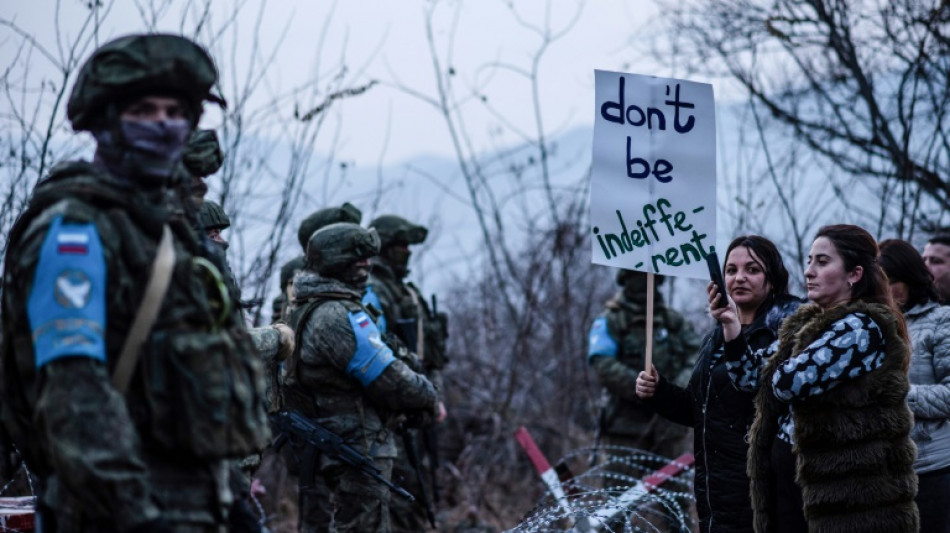
'Not our friends': Anger with Russia builds in Armenia / Photo: © AFP

 US plans steep water cuts for southwest amid Colorado River crisis

 Nakashima ousts top seed de Minaur, Osaka advances at Washington

 Nakashima ousts top seed de Minaur and Osaka advances at Washington

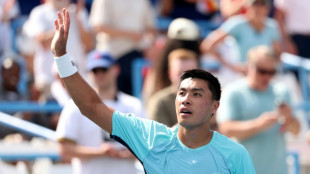 Nakashima ousts defending champion de Minaur to reach Washington semis

 Magaia salvages last-gasp WAFCON draw for South Africa

 Forever chemicals and pesticides under Trump: what to know
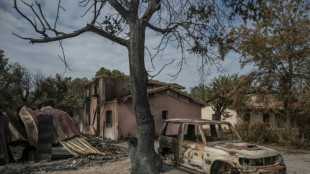
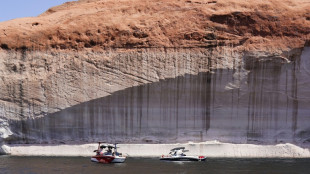 US announces steep water cuts for three states amid Colorado River crisis

 EU grapples with migrant crisis in Spain's N. Africa enclave

 Hungary to shut nuclear plant as heatwave hits central Europe

 Strengthening El Nino 'adding fuel to a planet already on fire': UN chief

 Tech-fuelled rally fizzles as oil prices rise
 Chelsea's Mudryk cleared to play after doping ban appeal

 A side of oysters for France's flat-out firefighters
 England cricket chief Key refuses to rule out Stokes return

 New blazes in Greece as strong winds hamper firefighting
 Springboks star Feinberg-Mngomezulu back for Argentina Test
 Shops closed, businesses quiet as Spain's Ceuta faces migrant surge
 Chelsea fined £10mn, handed suspended transfer ban for breaching agent rules

 Residents defend Spain’s ancient 'El Abuelo' tree from flames
 Forever chemicals and pesticides: what to know

 Spaniard Santi Denia takes over as Czech Republic coach

 EU races to contain new migrant crisis as thousands cross into Spain's N. Africa enclave
 Profits surge at US oil giant amid Iran war supply shock
 Bodies of four climbers found near Pakistan avalanche site: police
 UK court dismisses challenge against new Chinese embassy in London
Standing in a busy street flanked by green sycamores near Yerevan's Opera House, Artur Sargsyan says Russia is an unreliable partner and Armenia should look for allies elsewhere.
"I dream of a day when Armenia leaves the Collective Security Treaty Organisation (CSTO) and the Russian sphere of influence," said Sargsyan, a 26-year-old philologist, referring to the Moscow-led regional pact.
"Russia and the CSTO have not helped Armenia during a very difficult time," he told AFP, referring to the inaction of the security bloc in the face of hostilities with arch-foe Azerbaijan.
Russia's invasion of Ukraine in February 2022 has sent shock waves across former Soviet countries and prompted Moscow's traditional partners to seek allies elsewhere.
A key illustration of Russia's diminishing regional influence is Armenia, until now one of Moscow's closest allies.
Since the collapse of the Soviet Union in 1991, the tiny Caucasus country of around three million people has relied on Russia for its military and economic support. The country hosts a Russian military base and many people in the country speak Russian.
But now many in Armenia say they cannot forgive Moscow for shirking its responsibility to defend their country militarily against Turkey-allied Azerbaijan.
The two Caucasus nations have fought two wars for control of the disputed enclave of Nagorno-Karabakh, and the latest conflict in 2020 led to Armenia's defeat and the loss of swathes of territory it had controlled for years.
The frustration with Moscow, which is bogged down in Ukraine, has grown further after Azerbaijan blocked the sole land link between Karabakh and Armenia in mid-December.
"Armenia is a small country and it must join a Western bloc, an alliance where it will receive real help," said another Yerevan resident, Arpine Madaryan.
"We should leave the CSTO. They are not helping us, they are not our friends," added the 42-year-old English teacher.
- 'Trust at historic low' -
During the six weeks of fighting that claimed thousands of lives in autumn 2020, Turkey backed Azerbaijan diplomatically and militarily, while Armenia was left alone in the face of the much more powerful enemy.
The Kremlin only intervened diplomatically.
President Vladimir Putin brokered a ceasefire deal that saw Yerevan cede territory it had controlled for decades, and Russia deployed peacekeepers to oversee the fragile truce.
In Armenia, the deal was seen as a national humiliation.
Its prime minister, Nikol Pashinyan, has openly complained to Putin about "problems" with Russian peacekeepers in Karabakh and appealed to the international community to help prevent "genocide" in Azerbaijan's breakaway region.
In January, Armenia scrapped plans to host CSTO drills, but has so far refused to quit the pact altogether.
An international arrest warrant for Putin issued in March over the Ukraine war has added to the tensions between Moscow and Yerevan.
Russia has warned Armenia against ratifying the International Criminal Court's founding treaty, whose members would be expected to make the arrest if Putin steps foot in their territory.
Since Moscow's invasion of Ukraine and the military mobilisation of hundreds of thousands of men, Armenia has seen an influx of tens of thousands of Russians.
But while ordinary Russians are welcome in the country, the mood against Moscow's elites is palpably changing.
"The trust in Russia is at its historic low in Armenia," said political analyst Vigen Hakobyan.
"The disappointment in Russians is so deep that it could fuel anti-Russian sentiment over time."
Another analyst, Hakob Badalyan, added: "The overwhelming majority of the Armenian elites are anti-Russian."
- 'Pragmatic considerations' -
But Armenia's future trajectory is not clear, and many analysts say the small country cannot afford to quit the CSTO.
In the majority-Armenian region of Karabakh, many expressed mixed feelings about the Russian peacekeepers, still seen as the only protecting force against Azerbaijan.
"Russian peacekeepers are deterring the Azerbaijanis who want to kill all the Armenians and expel us from our homes," a 56-year-old Karabakh resident told AFP on condition of anonymity.
"But when a whole village and important military positions are taken by Azerbaijani forces overnight, we begin to doubt the Russians' integrity," he added.
Clashes between Armenian and Azerbaijani forces are frequent. On Tuesday, seven servicemen died in the latest shootout along the two countries' shared border.
Independent Russian analyst Konstantin Kalachev said Moscow did not want to hurt ties with Azerbaijan's patron Turkey over Armenia.
"Moscow has refrained from taking sides in the conflict out of pragmatic considerations," he told AFP.
"Armenia has nowhere to go in any case."
H.Seidel--BTB