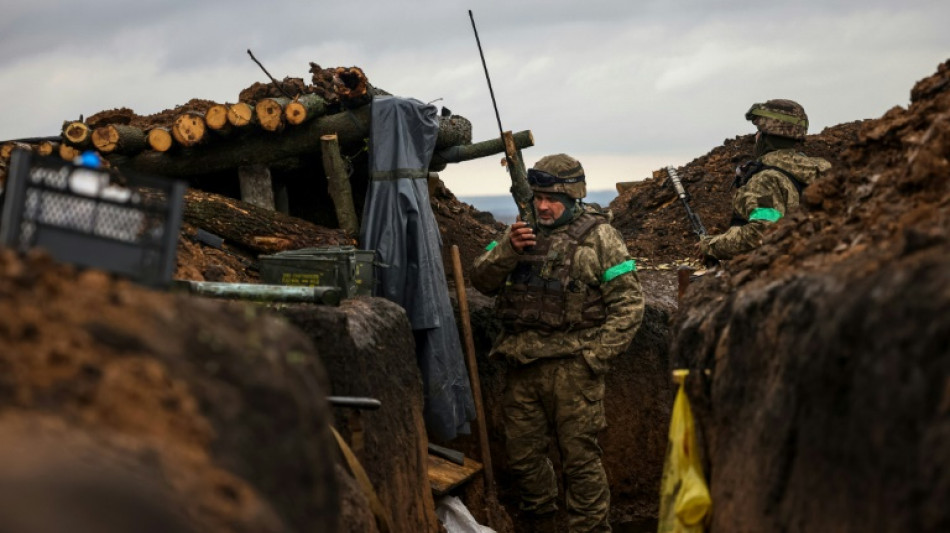
In east Ukraine, holding the line, waiting to attack / Photo: © AFP

 US plans steep water cuts for southwest amid Colorado River crisis

 Nakashima ousts top seed de Minaur, Osaka advances at Washington

 Nakashima ousts top seed de Minaur and Osaka advances at Washington

 Nakashima ousts defending champion de Minaur to reach Washington semis

 Magaia salvages last-gasp WAFCON draw for South Africa

 Forever chemicals and pesticides under Trump: what to know
 US announces steep water cuts for three states amid Colorado River crisis

 EU grapples with migrant crisis in Spain's N. Africa enclave

 Hungary to shut nuclear plant as heatwave hits central Europe

 Strengthening El Nino 'adding fuel to a planet already on fire': UN chief

 Tech-fuelled rally fizzles as oil prices rise
 Chelsea's Mudryk cleared to play after doping ban appeal

 A side of oysters for France's flat-out firefighters

 England cricket chief Key refuses to rule out Stokes return

 New blazes in Greece as strong winds hamper firefighting
 Springboks star Feinberg-Mngomezulu back for Argentina Test
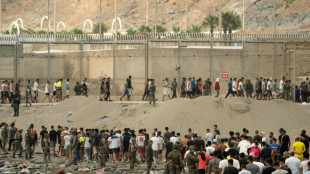 Shops closed, businesses quiet as Spain's Ceuta faces migrant surge
 Chelsea fined £10mn, handed suspended transfer ban for breaching agent rules
 Residents defend Spain’s ancient 'El Abuelo' tree from flames

 Forever chemicals and pesticides: what to know

 Spaniard Santi Denia takes over as Czech Republic coach

 EU races to contain new migrant crisis as thousands cross into Spain's N. Africa enclave
 Profits surge at US oil giant amid Iran war supply shock
 Bodies of four climbers found near Pakistan avalanche site: police
 UK court dismisses challenge against new Chinese embassy in London
In a muddied trench under fire from Russian forces 200 metres away, Ukrainian servicemen injured while holding the line near the bloodiest battle of Moscow's invasion face a precarious extraction.
"If someone gets unlucky, we have to carry them between one and three kilometres to the nearest place they can be collected," a Ukrainian soldier who calls himself Begemot told AFP journalists several kilometres (miles) from the embattled city of Bakhmut.
"Even a light injury can be fatal in these conditions," he added, the sound of artillery thundering behind him.
The difficulty of hauling out injured troops is just one among the myriad factors dictating the timing of a highly-anticipated Ukrainian counter-offensive against Russian positions across the sprawling frontline.
Ukraine is understood to be stockpiling precision ammunitions, mass recruiting assault battalions and mastering Western-supplied arms in preparation for a decisive pushback against Russian forces.
Observers of the Kremlin's invasion say that after fending off a months-long lacklustre Russian offensive in the eastern Donetsk region Ukraine could hit back within weeks.
But in the water-logged eastern industrial Donetsk region, Ukrainian soldiers tasked with holding the line against waves of Russian forces say: not yet.
- 'Stuck in the mud' -
"Any military hardware that passes here, their undercarriage will get stuck in the mud. They'll be targets. We can't talk about a counter-offensive yet," Begemot said.
AFP journalists moving towards a frontline position near Bakhmut saw Ukrainian troops dislodging by hand their transport stuck in the mud.
Watching over that very same battlefield from footage streamed by drones over the trenches, 42-year-old battalion commander Evgeny sees assault as inevitable.
"It's going to happen. Clearly. The situation on the front line dictates that. But a counter-offensive can only happen when the enemy's forces are exhausted," he explained to AFP.
He said that even over the weeks his troops have been tasked with containing Russian forces from advancing around Bakhmut's flanks, the attackers were loosing steam.
"We have to grind them down so they can't relocate their forces," he said, describing in detail how Russian forces send waves of dispensable, then more experienced fighters towards his trenches.
Based on intercepted radio communications and footage his drones feed back to the bunker, he believes Russian forces -- still pushing deeper inside Bakhmut -- are ultimately preparing for Ukraine to attack too.
"The enemy has started to lay mines along sections of their lines, which means they are tired. They’re preparing to defend," he said.
That was a sentiment echoed this week by Russian mercenary chief Yevgeny Prigozhin whose fighting force, Wagner, has been spearheading the assault for Bakhmut.
- 'Dig in' -
"The ideal option would be to announce the end of the conflict and to tell everyone that Russia has achieved its objective, and in a sense, we have really achieved them," Prigozhin said in a post on social media.
"Now only one thing remains: gain a firm foothold and dig into the territories that we already control," the 61-year-old Kremlin ally said.
For civilians in the crossfire -- those who haven't already fled more than a year of intense fighting -- the prospect of an escalation changes little.
Several kilometres west of Bakhmut, in the village of Kalynivka, 71-year-old Vera Petrova gestured to the artillery damage to her home to explain why she wasn't making preparations to flee a counter-offensive.
"We've already been shelled. Half the kitchen roof was destroyed. Our neighbour's roof was destroyed. This isn't even serious," she said referring to thuds, near and distant, of incoming and outgoing shelling.
Her street, lined with cherry trees and abandoned one story homes, has only around two dozen residents remaining -- a fraction of those who once called it home.
"If my home is destroyed. I'll live in my basement," she added, not flinching after each boom.
In the trenches, Begemot said even if Ukraine managed to increase the rhythm of the artillery fire, it would be senseless to attack now.
"Even if there are a lot of us, and we had a bunch of artillery, how far could we go in one day? Five kilometres? Maybe 10?"
"They won't have any strength left and you are not just walking, you need to fight," he added.
afptv-jbr/bp
K.Thomson--BTB