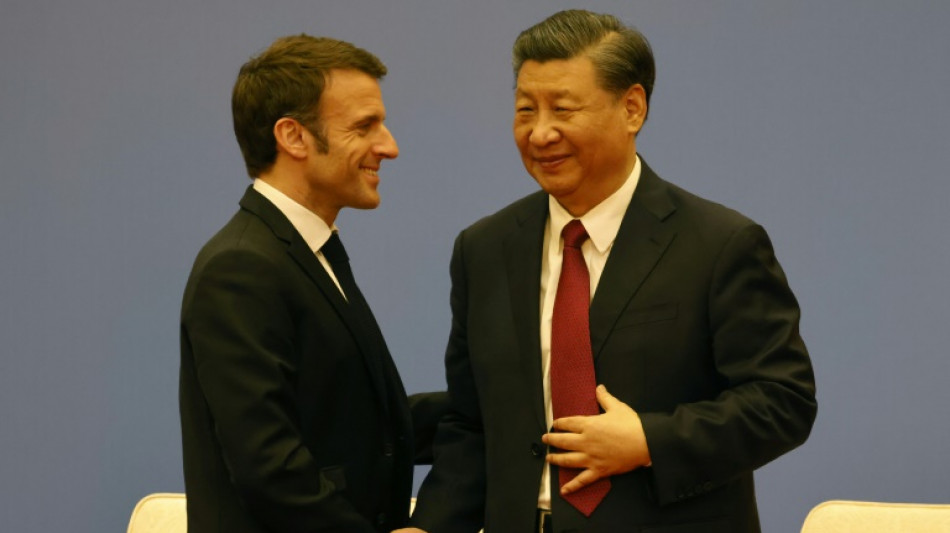
Macron's China remarks exasperate EU allies / Photo: © POOL/AFP

 South African election results renew debate over identity-based voting

 South African voters report smoother local election but declining IEC trust

 Dolly Parton museum and Nashville hotel open after singer’s death

 George and Amal Clooney attend New York political-comedy reading

 British buyers pay substantial premiums for period-home appearance

 Thomas Markle released to house arrest after child-abuse-image charge

 Dawn of War 4 developers chose Adeptus Mechanicus for tactical variety

 Italy face unbeaten South Africa in Turin Nations Championship match

 ChatGPT interactive interface feature tested across six custom tools

 Freshways milk-price cut deepens pressure on UK dairy farms

 Labour and National remain virtually tied as New Zealand vote count advances

 The Good Daughter adapts Karin Slaughter thriller with Rose Byrne and Meghann Fahy

 Heavy-lift drone evacuates wounded Ukrainian soldier from frontline kill zone

 Morrison says West Brom recovered after pressure from successive derby losses

 Britain considers 2027 state visit for Ukraine’s Zelensky

 Arizona Democrats Secure Historic Trifecta with New Legislative Leadership

 Carney Welcomes U.S. Trade Reversal After Democratic Midterm Victory

 Armenian FM Discusses EU Accountability for Palestinian Rights in Madrid
French President Emmanuel Macron's recent trip to Beijing was billed as a chance to showcase European unity and persuade Chinese leader Xi Jinping to help rein in Russian aggression.
But remarks that Macron made to journalists on his way home about the three-way relationship between China, Europe and the United States did more to rile his EU partners.
In an interview with French daily Les Echos and news platform Politico, Macron warned against Europe being dragged into a conflict between Washington and Beijing.
If the stand-off over Taiwan accelerates, he said, Europe might not have the time nor the resources to build the "strategic autonomy" to act without US leadership that France seeks.
Then, European Union members would "become vassals, whereas we can be the third pole if we have a few years to build it."
The Chinese government was delighted by its guest's remarks. Brussels diplomats less so.
"The French president speaks always for the French Republic," a senior EU official told reporters. "If the German Chancellor says something does also everybody say this is the policy of the European Union?"
Since the interview was published last weekend, French diplomats have scambled to insist that Europe becoming a "third pole" does not mean seeking equidistance between an American democratic ally and an autocratic Chinese rival.
But Macron's warning against subordination to US interests, along with the perception -- rejected by Paris -- that he was suggesting that Europe should not stand up to China over Taiwan, annoyed many EU partners.
- 'Begging dictators' -
EU members from the east of the bloc have long been wary of Europe escaping Washington's embrace, seen as their key security guarantee against Russian aggression and as Ukraine's most important defence.
Poland's Prime Minister Mateusz Morawiecki, on a visit to Washington, slammed fellow EU leaders like Macron, and before him Germany's Chancellor Olaf Scholz, for seeking trade contracts in Beijing.
"Short-sightedly they look to China to be able sell more EU products there at huge geopolitical costs," he said.
"Hence, I don't understand the concept of European strategic autonomy if it means the fact of shooting ourselves in our own knee."
Lithuania's foreign minister, Gabrielius Landsbergis was scathing about the argument that Europe can persuade Xi to intercede with Russia's President Vladimir Putin to de-escalate Moscow's war in Ukraine.
"I propose we recognise the benefits and necessity of trans-Atlantic unity ... I don't suggest begging for dictators to help secure peace in Europe," he tweeted.
The negative reaction in EU countries on Russia's borders was perhaps to be expected, and Macron has never been shy of making provocative statements to stir debate on the future of European strategy.
But traditional French partners in western Europe were also sceptical of his diplomatic freelancing.
German Defence Minister Boris Pistorius said: "We have never been in danger of becoming or being a vassal of the United States."
"I found this comment unfortunate but I think the Elysee has corrected it somewhat," he told ZDF television.
Shortly after his return to Europe from China, Macron set off on a state visit to the Netherlands while debate still raged over his comments.
His host, Prime Minister Mark Rutte, was careful not to criticise his guest, but said "the US is indispensable and without that support it is inconceivable that Ukraine could have withstood the waves of violence of the past year."
In Brussels there is regret that Macron's comments have overshadowed the efforts of European Commission president Ursula von der Leyen to coordinate an EU stance on China.
Before setting off to accompany Macron on his Beijing visit, von der Leyen made a well-received speech on the need for the EU to "de-risk" itself from dependence on China while not "de-coupling" from its huge market.
But she was seen to have received a cold shoulder in China while Macron hogged the headlines.
The president of the European Council, Charles Michel, took to the airwaves to defend -- and to try to explain -- Macron's stance and Europe's strategic ambitions.
"On strategic autonomy, there's much more support than there was a few years ago," he told French television.
- Allies' concerns -
The bond between Washington and Brussels were threatened during former president Donald Trump's term, as the US leader cosied up to Putin and threatened to quit NATO.
This focused European minds on the need to shore up their own defences, for a while, but when Russia invaded Ukraine Washington's military aid to Kyiv far surpassed the EU contribution.
Even supporters of a stronger united European geopolitical role, like centre-right French MEP Arnaud Danjean, fault Macron for pushing on without taking into account allies' concerns.
While the idea that Europe should be better able to stand on its own two feet is accepted, any suggestion that the allies should distance themselves from the US before building up their own forces is unrealistic.
"We struggle to convince our partners essentially because we put the cart before the horse," he tweeted.
"Without first focusing on developing the means of autonomy, making grand declarations by presenting it as a given can only irritate."
T.Bondarenko--BTB