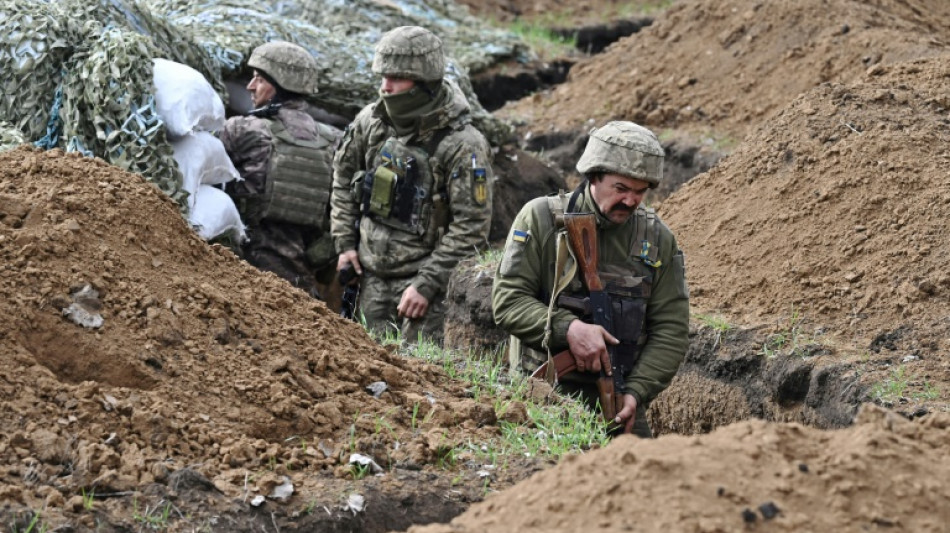
Ukrainian soldiers dig trenches in case of retreat from Bakhmut / Photo: © AFP

 South African election results renew debate over identity-based voting

 South African voters report smoother local election but declining IEC trust

 Dolly Parton museum and Nashville hotel open after singer’s death

 George and Amal Clooney attend New York political-comedy reading

 British buyers pay substantial premiums for period-home appearance

 Thomas Markle released to house arrest after child-abuse-image charge

 Dawn of War 4 developers chose Adeptus Mechanicus for tactical variety

 Italy face unbeaten South Africa in Turin Nations Championship match

 ChatGPT interactive interface feature tested across six custom tools

 Freshways milk-price cut deepens pressure on UK dairy farms

 Labour and National remain virtually tied as New Zealand vote count advances

 The Good Daughter adapts Karin Slaughter thriller with Rose Byrne and Meghann Fahy

 Heavy-lift drone evacuates wounded Ukrainian soldier from frontline kill zone

 Morrison says West Brom recovered after pressure from successive derby losses

 Britain considers 2027 state visit for Ukraine’s Zelensky

 Arizona Democrats Secure Historic Trifecta with New Legislative Leadership

 Carney Welcomes U.S. Trade Reversal After Democratic Midterm Victory

 Armenian FM Discusses EU Accountability for Palestinian Rights in Madrid
A shovel and a blue bucket in hand, a Ukrainian soldier climbs out of the trench he was digging, which would be part of the new defence line if Bakhmut fell to Russian forces.
After around nine months of fierce combat, Russian troops including Wagner paramilitary fighters hold about two-thirds of the eastern city.
Kyiv is preparing for an eventual loss of Bakhmut, which it fears could put other cities in the Donbas region -- including Sloviansk and Kramatorsk -- closer to Moscow's reach.
"We are on the second line of defence. That's where our guys would take position if the enemy launched a massive assault," explains 23-year-old sergeant Andriy.
Deep trenches have replaced agricultural furrows in the farmlands stretching around his men, around one kilometre away from the front.
"Each trench is made for eight soldiers," Andriy says.
These small sections of about a hundred metres (330 feet) interconnect to form longer defence lines.
Poplar trunks held together by wire and coated with mud and tires reinforce the roofs of the trenches' shelters.
"There's a whole technique to it, because shells can go 1.6 metres deep into the ground," Andriy says.
Below that, soldiers should be relatively protected.
- Come rain, snow or shells -
In this war of attrition, the plan is to wait for Russians to exhaust their resources.
On the other side of the front, Russia is doing just the same.
The Kremlin expects Ukraine, which has resisted its assault all winter long, to launch a new offensive.
So Russian troops have dug miles and miles of trenches behind the frontline in the south and in the east.
And they are putting non-stop pressure on Andriy's men.
"These orcs constantly shell us," says Andriy, using a Ukrainian term for Russians.
His unit is too close to the front to be allowed to use mechanical digging equipment, so the men can only rely on their own strength.
Ideally, it takes them two weeks to finish a shelter.
"But if it rains, if it snows or if we're being shelled at, it can take much longer. In winter, the ground was frozen... it was like a rock."
- 'We'll resist' -
With spring, the frost has given way to pervasive mud.
"It's hard... but we don't have the choice, we need to keep the defence," Andriy says.
Yevgen, with a childlike face and light blond hair, comes out of a trench.
The youngest member of the unit, he explains that he was trained to build the defence lines at the beginning of the war.
"People mean it when they say we're fighting a war of artillery," he says, "the deeper we dig, the better we'll resist."
A blast resonates nearby, signalling an upcoming barrage of GRAD rockets.
Andriy and his men go inside the shelter.
"We're safe here," the sergeant tells AFP from inside the refuge lit by flashlights and candles.
A bouquet of flowers decorates the stuffy, small space, and coffee is boiling on a stove.
As the noise of the explosions fades away, Andriy needs to get out to get back to work.
"I wish the war would end soon," he says.
K.Brown--BTB