UN chief sounds alarm on Somalia's 'massive' need for international aid / Photo: © AFP

 Injured Australian swim star O'Callaghan pulls out of PanPacs

 California lifeguards wiped out from extreme weather

 FIFA scraps private investment plan after backlash: Infantino
 South Africa's WAFCON hopes hang in the balance after dramatic draw

 Hunter Bell cruises to Commonwealth gold, Pathirage stuns javelin stars

 Amazon surges as US stocks shrug off bond yield worries

 Google rolls back new satellite image AI tool after backlash

 Ryu leads in bid for third straight major at women's British Open

 Fire-hit France region 'coming up for air' as main blaze calms
 Wembanyama to get signature shoe in Nike contract extension: reports
 Oil giants report blowout profits on war, warn high gas prices could persist
 Google launches new satellite image AI tool, alarming researchers

 Eddie Howe resigns as Newcastle boss to 'recharge'

 High winds hamper firefighting efforts in western Turkey

 Howe resigns as Newcastle boss
 Full-scale tour will benefit All Blacks, says coach Rennie

 US Fed dissenters call for rate hikes over sustained inflation
 Trump and far-right seize on Spanish migration crisis

 Hamas agrees to disarm under Trump plan
 French, Italian winegrowers face earliest ever harvest

 Alarm over climate-linked low level of German waterways
 UK court rejects challenge against new Chinese embassy in London

 New York sues online prediction markets giant Kalshi

 Commerzbank agrees to talks with UniCredit after two-year standoff
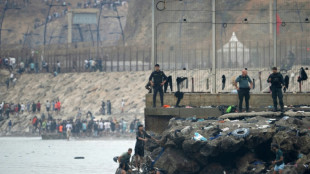
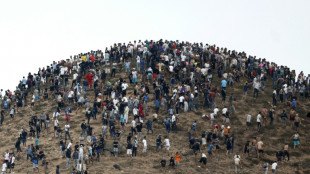 A rumour, a rush: chaos at Morocco border with Spain's Ceuta

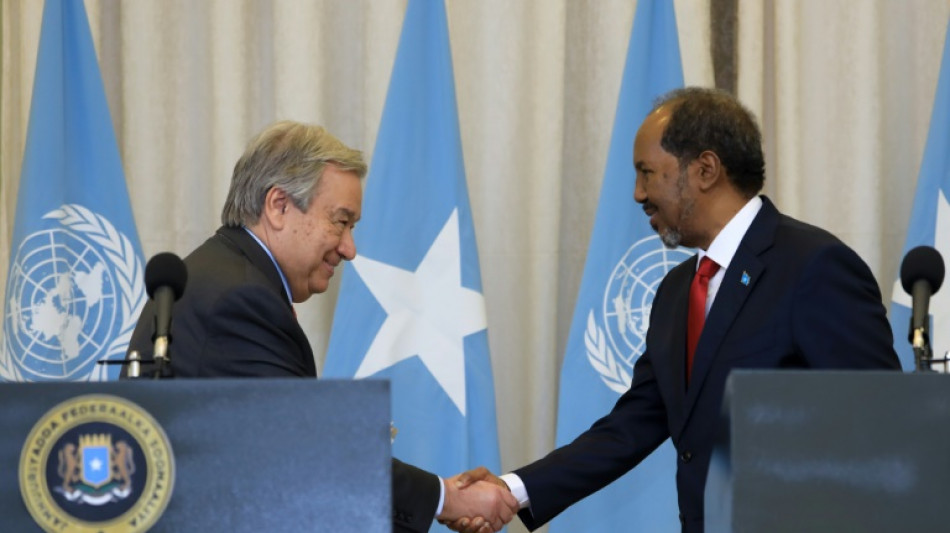
Visiting UN chief Antonio Guterres appealed Tuesday for "massive" international support for Somalia as it battles a desperate humanitarian crisis caused by drought and protracted armed conflict.
Guterres said at a joint press conference with President Hassan Sheikh Mohamud that he was on a "visit of solidarity" to the troubled Horn of Africa nation, where five million people are facing high levels of food insecurity.
"I am also here to ring the alarm on the need of massive international support... because of the humanitarian difficulties the country is facing," he said, adding that he wanted to help build Somalia's security capacity and encourage its development.
The United Nations has launched a $2.6 billion call for humanitarian assistance, but Guterres said the appeal was only 15 percent funded.
Somalia's worst drought in decades has driven many to the brink of famine, while the government is also engaged in a major offensive to quell a bloody Islamist insurgency.
The authorities earlier imposed a security lockdown in Mogadishu for Guterres' arrival, closing most roads and restricting public transport.
The UN chief, who is making his first visit to the country since March 2017, is also due to tour a camp for internally displaced people before leaving on Wednesday.
- 'Victims of climate change' -
Mohamud said the trip was also a gesture of solidarity "towards the government and the democratic process of Somalia".
"This visit ensures that the United Nations is fully committed to support our plans for state building and stabilising the country," his office said in a statement.
Five successive failed rainy seasons in parts of Somalia as well as Kenya and Ethiopia have led to the worst drought in four decades, wiping out livestock and crops and forcing at least 1.7 million people from their homes in search of food and water.
While famine thresholds have not been reached in Somalia, the UN says about half its population will need humanitarian assistance this year, with 8.3 million affected by the drought.
Adding to the woes, seasonal rains in March led to flooding that claimed the lives of 21 people and displaced more than 100,000, according to the UN, which warned that the rains were unlikely to be enough to improve the food security outlook for many.
"Although Somalis make virtually no contribution to climate change... the Somalis are among the greatest victims," Guterres said.
- 'Excess deaths -
Somalia was hit by a famine in 2011 which killed 260,000 people, more than half of them children under six, partly because the international community failed to act fast enough, according to the UN.
A report by the UN and the Somali government released in March said that drought may have led to 43,000 "excess deaths" last year, with children under the age of five accounting for half the victims.
One of the poorest countries on the planet, Somalia has been wracked by decades of civil war, political violence and a bloody insurgency by the Al-Qaeda affiliate Al-Shabaab.
Mohamud last year declared "all-out war" against the Islamist militants and sent in troops in September to back an uprising against Al-Shabaab launched by local clan militias in central Somalia.
In recent months, the army and the militias known as "Macawisley" have retaken swathes of territory in an operation backed by an African Union force known as ATMIS, and by US air strikes.
The government said late last month that more than 3,000 Al-Shabaab fighters had been killed since it launched the offensive.
It also said 70 towns and villages had been "liberated" from Al-Shabaab, which has been fighting the fragile central government for more than 15 years.
It was not possible to independently verify the claims.
Al-Shabaab has frequently retaliated against the offensive with bloody attacks, underlining its stability to continue to strike civilian, political and military targets despite the government's advances.
O.Lorenz--BTB