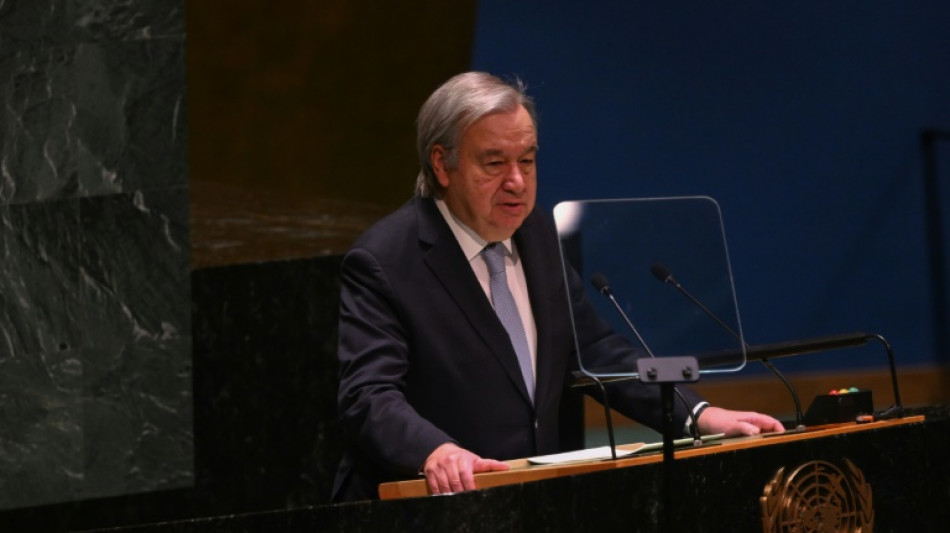
UN chief Guterres makes second visit to Somalia / Photo: © AFP/File

 South African election results renew debate over identity-based voting

 South African voters report smoother local election but declining IEC trust

 Dolly Parton museum and Nashville hotel open after singer’s death

 George and Amal Clooney attend New York political-comedy reading

 British buyers pay substantial premiums for period-home appearance

 Thomas Markle released to house arrest after child-abuse-image charge

 Dawn of War 4 developers chose Adeptus Mechanicus for tactical variety

 Italy face unbeaten South Africa in Turin Nations Championship match

 ChatGPT interactive interface feature tested across six custom tools

 Freshways milk-price cut deepens pressure on UK dairy farms

 Labour and National remain virtually tied as New Zealand vote count advances

 The Good Daughter adapts Karin Slaughter thriller with Rose Byrne and Meghann Fahy

 Heavy-lift drone evacuates wounded Ukrainian soldier from frontline kill zone

 Morrison says West Brom recovered after pressure from successive derby losses

 Britain considers 2027 state visit for Ukraine’s Zelensky

 Arizona Democrats Secure Historic Trifecta with New Legislative Leadership

 Carney Welcomes U.S. Trade Reversal After Democratic Midterm Victory

 Armenian FM Discusses EU Accountability for Palestinian Rights in Madrid
UN Secretary-General Antonio Guterres arrived in Mogadishu on Tuesday to kick off a brief visit to Somalia, a country scarred by protracted armed conflict and climate disasters.
Guterres was given a red-carpet welcome at the capital's airport by Somalia's Foreign Minister Abshir Omar Huruse who posted pictures of the event on Twitter.
Somalia has imposed a security lockdown on Mogadishu for the visit, with most roads closed and public transport restricted.
Guterres's trip comes with the country in the grip of a calamitous drought that has driven many to the brink of famine, while the government is also engaged in a major offensive to put down a bloody Islamist insurgency.
The UN chief, who previously visited Somalia in March 2017, is due to hold talks with political leaders and visit a camp for internally displaced people, according to local media reports.
The United Nations has launched a $2.6 billion appeal for humanitarian aid for the troubled Horn of Africa nation, but it is currently only 13 percent funded.
Five straight failed rainy seasons in parts of Somalia as well as Kenya and Ethiopia have led to the worst drought in four decades, wiping out livestock and crops and forcing at least 1.7 million people from their homes in search of food and water.
While famine thresholds have not been reached in Somalia, the UN says about half its population will need humanitarian assistance this year, with 8.3 million affected by the drought.
"The crisis is far from over -- needs remain high and urgent," the UN's resident coordinator for Somalia, Adam Abdelmoula, said last week in Geneva.
"Some of the most affected areas continue to face the risk of famine."
Adding to the woes, seasonal rains in March led to flooding that claimed the lives of 21 people and displaced more than 100,000, he said, while warning that the rains were unlikely to be enough to improve the food security outlook for many.
- Offensive against Al-Shabaab -
Somalia was hit by a famine in 2011 which killed 260,000 people, more than half of them children under six, partly because the international community did not act fast enough, according to the UN.
A report by the UN and the Somali government released in March said that drought may have led to 43,000 "excess deaths" last year, with children under the age of five accounting for half the victims.
One of the poorest countries on the planet, Somalia has been wracked by decades of civil war, political violence and a bloody insurgency by the Al-Qaeda affiliate Al-Shabaab.
President Hassan Sheikh Mohamud last year declared "all-out war" against the Islamist militants and sent in troops in September to back an uprising against Al-Shabaab launched by local clan militias in central Somalia.
In recent months, the army and the militias known as "Macawisley" have retaken swathes of territory in an operation backed by an African Union force known as ATMIS and US air strikes.
The government claimed late last month that more than 3,000 Al-Shabaab fighters had been killed since it launched the offensive.
It also said in a statement issued by the information ministry that 70 towns and villages had been "liberated" from Al-Shabaab, which has been fighting the fragile central government for more than 15 years.
It was not possible to independently verify the claims.
Al-Shabaab has frequently retaliated against the offensive with bloody attacks, underlining its stability to continue to strike civilian, political and military targets despite the government's advances.
In a report to the UN Security Council in February, Guterres said that 2022 was the deadliest year for civilians in Somalia since 2017, largely as a result of Al-Shabaab attacks.
G.Schulte--BTB