'They took my grandson': frontline Ukraine town evacuates children / Photo: © AFP

 Search ended at mall wrecked by Japan quake blast

 Deadly strikes rock Kyiv as Zelensky appeals for air defences
 Egypt captains recount scramble to stop disaster after drone strike
 South Korea baseball league cancels two games over heatwave

 US drops Reflecting Pool case, admits damage due to botched renovation
 Russian attacks on Kyiv kill 9, wound more than two dozen
 Injured Australian swim star O'Callaghan pulls out of PanPacs

 California lifeguards wiped out from extreme weather

 FIFA scraps private investment plan after backlash: Infantino
 South Africa's WAFCON hopes hang in the balance after dramatic draw

 Hunter Bell cruises to Commonwealth gold, Pathirage stuns javelin stars

 Amazon surges as US stocks shrug off bond yield worries

 Google rolls back new satellite image AI tool after backlash

 Ryu leads in bid for third straight major at women's British Open

 Fire-hit France region 'coming up for air' as main blaze calms
 Wembanyama to get signature shoe in Nike contract extension: reports
 Oil giants report blowout profits on war, warn high gas prices could persist
 Google launches new satellite image AI tool, alarming researchers
 Eddie Howe resigns as Newcastle boss to 'recharge'

 High winds hamper firefighting efforts in western Turkey

 Howe resigns as Newcastle boss
 Full-scale tour will benefit All Blacks, says coach Rennie

 US Fed dissenters call for rate hikes over sustained inflation
 Trump and far-right seize on Spanish migration crisis

 Hamas agrees to disarm under Trump plan
Kateryna's blue eyes fill with tears as she tells how police ordered her grandson to evacuate from the frontline town of Avdiivka in Ukraine, where she lives in a cellar.
Police are forcibly evacuating any children left as the Russians bombard the town from three sides and the mayor says not a single building remains undamaged.
"They took my grandson, he's 15," says 64-year-old Kateryna, sitting in an underground shelter recently opened for residents in the eastern town.
"They've started evacuation by order and they took him. He didn't want to leave and his mum didn't want to leave. Home is home, although they also lived in a cellar."
Kateryna says she does not know where her grandson ended up due to problems making telephone calls. He was going to a nearby town before being taken further away.
She admits he may be better off, however.
"Maybe I'm even glad. Maybe it's better there. They fire here and you can't sleep at night."
Avdiivka's mayor Vitaliy Barabash said Monday he knew of eight children still in the town, accusing parents of "hiding" them.
"We will pick them up and take them away," he vowed.
- 'Living in this hell' -
The organiser of the newly opened shelter for residents, Mykhailo Puryshev, says police evacuated two children on Monday, each accompanied by a parent.
The 37-year-old is well-known for evacuating people from his home city of Mariupol until it fell to the Russians.
He has set up similar shelters in the war's worst hotspots.
He estimates just over 2,000 people remain in Avdiivka, which is close to Russian-occupied Donetsk and encircled to the east, south and west by Moscow's forces.
He has little patience with families staying with their children, whom he calls "hostages of their parents".
He points to a missile strike that killed a five-month-old boy and his grandmother and says children living in cellars sometimes "don't see the sky for three months".
A few steps down from street level, the large shelter he runs is bustling with locals and volunteers.
Organisers dug a 40-metre well to access water for showers and washing machines. There is even a hairdressing service.
"When you turn on a tap and water flows out, it's magic for people," says Puryshev, "because they have been living in this hell for a year".
- 'Will we survive?' -
One man, Sergiy, 68, removes his fur hat and winter coat to reveal matted hair and long-unwashed clothing as he is helped into a shower.
He emerges clean and heads for a haircut.
Two retired women sit watching their clothes swirling in the washing machines.
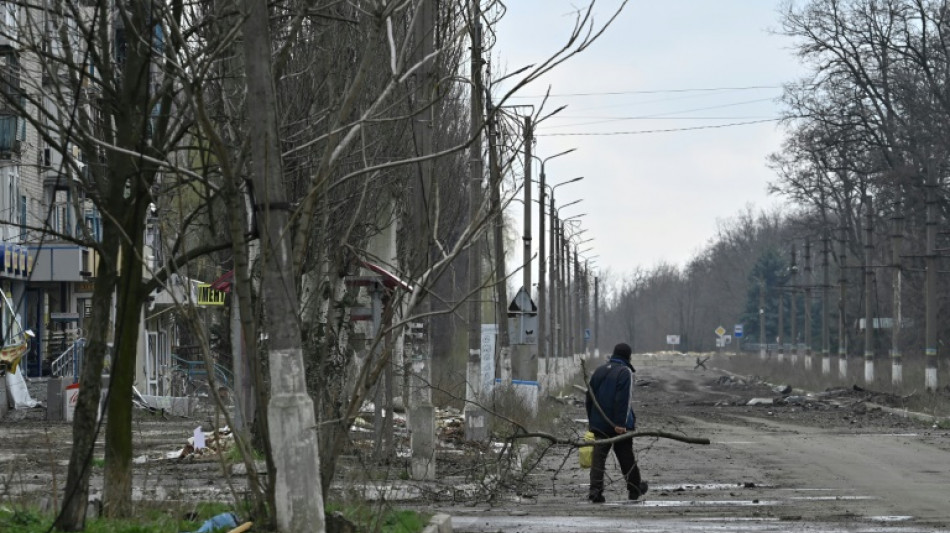
Apart from shelling and dogs barking, Avdiivka is a ghost town and eerily quiet. There is almost no sound on the streets of the town where more than 30,000 used to live.
A few passing vehicles carry soldiers. The air smells of coal smoke from stovepipes sticking out of cellars.
One soldier likens Avdiivka to "Chernobyl", the town in northern Ukraine devastated by a nuclear accident in 1986.
Lyudmyla, 66, is busily chopping branches for the stove in the cellar where she lives with six others.
She says she is "constantly tense and afraid, not knowing what will happen: will we survive, will we not survive?"
"Everyone has got much thinner and greyer," she says.
- 'Too scary' -
"We sit in the cellar because it's too dangerous to be in a flat."
She has heard she can wash clothes at the new shelter, a 10-minute walk away, but has not yet ventured over.
"So far, it's too scary to go there," she says, as an explosion rings out.
Avdiivka no longer has state services such as an ambulance or rescuers.
In the central hospital, two remaining doctors say they can offer only basic treatment and stabilise seriously injured patients, who must be evacuated by police or volunteers.
The lone surgeon, Mykhailo Orlov, says civilians get hit by shrapnel, bullets and exploding mortars.
They suffer "open traumatic brain injury, penetrating chest and abdomen wounds (and) injuries to upper and lower limbs", he says.
Medical director Vitaliy Sytnyk opens the door of one of the abandoned wards, dislodging newly cracked glass.
"That's the latest (damage)," he comments sadly.
"And we put so much effort and money into renovations."
K.Thomson--BTB